Origins and Insertions
Tendons, Ligaments, and Notches, oh my!
Circulation, lymphatics, innervations
Clinical Applications
QoD
100
This is the insertion of the pectoralis major.
What is the lateral lip of the intertubercular sulcus?
100
This is the ligament that connects the humerus to the scapula.
What is the glenohumeral ligament?
100
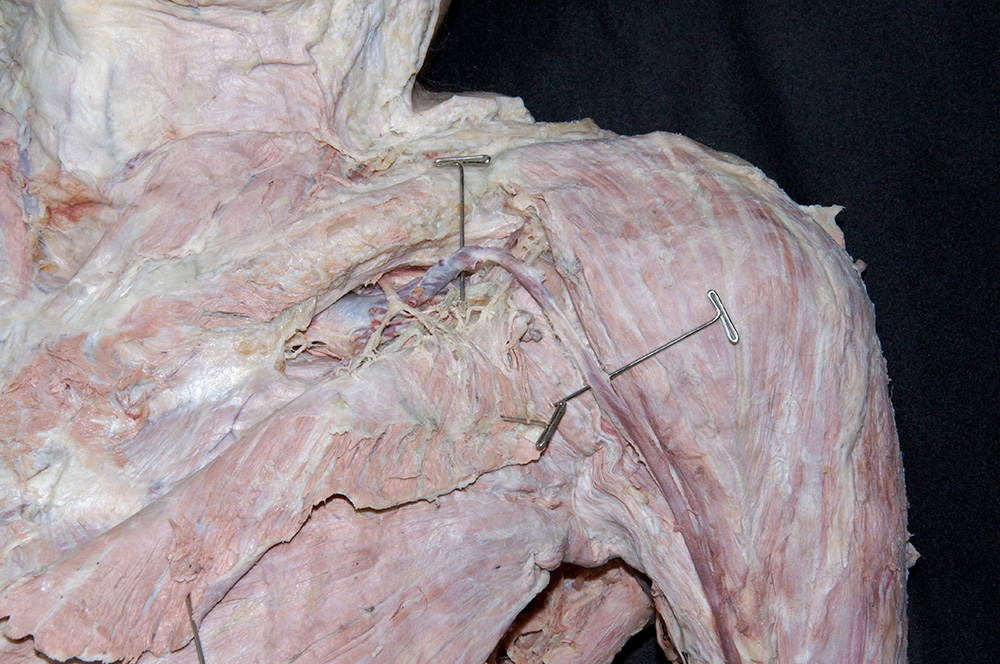 Name this vessel.
What is the cephalic vein?
100
On your internal medicine rotation, your attending asks you to identify this bony landmark.
What is the acromion process?
100
This is the characteristic symptom of radial nerve damage.
What is wrist drop?
200
This is the origin of the subscapularis muscle.
What is the subscapular fossa?
200
The suprascapular nerve and suprascapular artery cross this ligament that traverses the superior notch of the scapula.
What is the transverse scapular ligament?
200
The nerve that innervates the pectoralis major and its spinal levels.
What are the medial and lateral pectoral nerves (C5-T1)?
200
36 y/o female presents to the ED with a right shoulder injury after an altercation with her husband. Xray and CT imaging reveals she was stabbed just superior to the spine of the scapula. No major arteries or nerves were damaged. Based on these image findings, state the impairment in shoulder movement that this pt would present with.
What is weakness in the first 15º of shoulder abduction?
200
A patient fractures their humerus at the deltoid tuberosity. Name the muscle that will be affected.
What are the deltoids (no attachment point)?
300
These are the three origins of the deltoid muslce group.
What are the lateral third of the clavicle, the acromion process of the scapula, and the spine of the scapula?
300
Identify this ligament.
What is the acromioclavicular ligament?
300
Name the four branches of the thoracoacromial artery.
What are the deltoid, pectoral, acromial, and clavicular branches?
300
22 y/o male professional baseball player presents to the clinic for his annual well visit. Pt states that he has pain and weakness in his left shoulder while pitching, specifically during lateral rotation. Upon physical exam, you notice warm, erythemic muscle lateral to the lateral scapular border as well as paresthesis in the axillary region. Name the muscle and nerve that are most likely injured.
What are the teres minor and the axillary nerve?
300
Cancers easily metastasize in the breasts because of this reason.
What is the breasts have a vast supply of lymph vessels with many surrounding lymph nodes?
400
This is the only rotator cuff muscle that inserts on the lesser tubercle of the humerus.
What is the subscapularis?
400
The teres minor, triceps long head, and triceps lateral head compose the borders of the quadranglular space. If one of these muscles becomes inflammed and narrows this space, this nerve would be at risk of being impinged.
What is the axillary nerve?
400
The name of the lymphatic trunk that is supplied by the right upper quadrant of the body and the structure it drains into.
What is the right lymphatic duct and the right venous angle (convergence of the right internal jugular v. and right subclavian v.)?
400
24 y/o female presents to the clinic for a 1-month post-op follow up after her breast augmentation surgery. The surgeon notices erythemic tissue surrounding the incision site that may indicate an infection. Name the cavity that lies deep to the superficial fascia of the breast and superficial to the deep fascia of the pectoralis major muscle that could be infected.
What is the retromammary space?
400
The name of the procedures where injection of a radioactive tracer or dye into the lymph vessels of the breast determines which lymph nodes are the primary draining sites. These lymph nodes can then be removed and sent off for biopsy.
What is sentinel lymph biopsy?
500
Name the insertion point of the anconeus muscle?
What is the lateral surface of the olecranon and the superior part of the posterior surface of the ulna?
500
Give the name of the ligament on the right that is a division of the coracoclavicular ligament.
What is the conoid ligament?
500
On the medial portion of the arm at the cubital fossa, name the lymph nodes present and which vessels they follow up the arm to their drainage point.
What are the cubital/epitrochlear lymph nodes that are connected to lymph vessels which travel up the arm with the basilic v. to combine with the cephalic v. and become the axillary v. The axillary v. drains into the subclavian v. which drains into the right/left venous angle (lymphatic drainage into right lymphatic duct or thoracic duct)?
500
You are an orthopedic surgeon performing a left glenohumeral labrum repair. You decide to take an anterior approach through the deltopectoral triangle. Name the two vessels (artery and vein) that you need to avoid to perform this surgery successfully.
What are the cephalic vein and the thoracoacromial artery?
500
Describe how the dermatome map differs from the cutaneous nerve supply of the upper limb.
What is the dermatomes represent the specific spinal nerve that supplies a region of skin, whereas the cutaneous nerves are representative of the peripheral nerve supply (mixed spinal nerves) of the upper limb after the nerves pass the brachial plexus?
*HINT: a lesion proximal to the brachial plexus will result in dermatomal sensory deficits, whereas a distal lesion will have symptoms that follow the patterns of the cutaneous nerves.