Experiment(al.) Methods
Import/Export
The ~Cytoskeleton~
In and Of a Cell
Relating to Movement
100
This type of image is generated by illuminating molecules tagged to a fluorescent protein reporter with light of a specific wavelength. 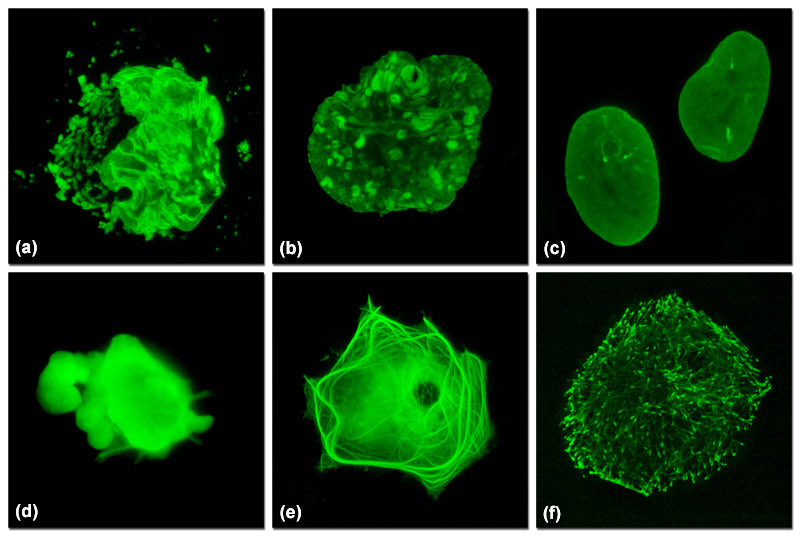
Image Credit: ZEISS Microscopy
What is fluorescence microscopy?
100
Mediates the targeting of cytoplasmic ribosomes translating signal sequence-containing polypeptides to the ER during cotranslational translocation.
What does the signal recognition particle (SRP) do?
100
Myosins, kinesins, and dyneins are examples, which help cytoskeleton structure aid in cell movement.
What are motor proteins?
100
Helps cells maintain homeostasis, offers protection by regulation, with movement, energy generation, and gives it a structure.

What is the function of the cell membrane?
100
The folding state of the N-terminal segment of protein, and the length or hydrophobicity of the transmembrane signal sequence are the criteria.
Ie. Heads or Tails 🙂🙃
What determines the orientation of protein segments in the membrane?
200
This experiment defined a pathway taken by secreted proteins, the secretory pathway: rough ER -> Golgi -> secretory vesicles -> cell vesicles. Done by exposing cells to a labeled protein and then replacing the labeled protein with unlabeled proteins.
What is the Pulse-Chase experiment?
200
Determines the directionality of protein transport across the nuclear envelope and also causes importin to release the protein and recycle it.
What is the Ran/GTP complex?
200
Microtubulins bind GTP to this end of the fiber, due to its high affinity for binding. GTP binding gives microtubulins a conformation favorable for polymerization.
What is the positive end of microtublin?
200
Determined by Hydrogen, ionic, and van der Waals interactions between amino acids.
What determines the 3-D structure of a protein?
200
Temperature (more temp = more kinetic motion), concentration gradient ([high] to [low]), molecule permeability (size + hydrophobicity), distance (less distance = more kinetic motion), surface area (less SA = less kinetic motion), molecule mass (greater mass = more friction created) all affect movement across across.
What affects the rate of simple difussion?
300
To test for _________ of a cellular process, you experimentally inhibit that process and see if it still functions as usual. To test for __________ of a cellular process, conduct in vitro reconstitution and see if functions.
What is necessity and sufficiency?
300
Post-transcriptional proteins, already folded into their tertiary structure, cannot be imported into this structure because this type of import occurs co-translationally.
What is ER import?
300
Actin, ATP, Arp2/3, Filamin, and Formin are biomolecules that are sufficient for forming this network?
What is a branched actin network?
300
This type of membrane transport uses potential energy (generated from an electrochemical gradient) but not directly, and can be classified as a symporter or antiporter depending on which direction (same/opposite) the molecule across the cell membrane.
What is secondary active transport?
300
At higher temperatures, _______ fatty acid tails will increase fluidity as they are more susceptible to changes in membrane viscosity because the phospholipids do have enough kinetic energy to overcome the IMFs holding the membrane together.
What are shorter fatty acid tails?
400
This technique allows for the separation of cell components based on size and density, which allows researchers to address questions concerning the functions of cells.
What is subcellular fractionation via centrifugation?
400
Localization of these factors determines GTPase-activating protein (GAP) activity which triggers GTP hydrolysis and thus converts Ran-GTP to Ran-GDP. This also modulates nuclear import and export of proteins.
What is Ran/GEF?
400
Aids in intracellular transport of organelles and structures and beating of cilia + flagella. Is a negative end-directed motor protein.
What is dynein?
400
Immunofluorescence image scanning helped proved this model of cell membrane as a composite of these types of molecules that are constantly moving, and the movement helps cell membrane maintain itself as a barrier between inside/outside cell environment.
What is the fluid-mosaic model of cell membrane which contains phospholipids, cholesterol, proteins, and carbohydrates?
400
This receptor mutation gives rise to a familial hypercholesterolemia (FH) phenotype which prevents the internalization of LDL resulting in accumulation of high levels of LDL in the bloodstream.
What is clathrin-mediated endosymbiosis?
500
With using model organism Yeast to identify phenotypes/proteins, some genetic screens may be lethal and restrict cell growth, researchers would instead use conditional mutations like isolating __________ sensitive mutations.
What are temperature-sensitive mutations?
500
Inside of this membrane is topologically equivalent to the part that faces the cytosol of the cell. Important when considering where receptors for signals are located.
What is the endoplasm reticulum (ER)?
500
Due to the fact that individual monomers of intermediated filaments are oriented in both directions (can grow in both directions as well) along the axis of the filament, it has this feature which also prevents IFs from aiding in cell movement.
What is apolarity?
500
This enzyme helps maintain asymmetry in the phospholipid bilayer by aiding movement of phospholipid molecules between two leaflets that compose a cell's membrane, important to provide stability for signal transduction and prevent apoptosis.
What is flippase?
500
Prevents a protein from being secreted from the endoplasmic reticulum to the Golgi apparatus and facilitates its return to the cytosol if it is accidentally exported.
What is the KDEL target peptide sequence?