Order of Operations
Patterns
Exponents
Solving Equations
Functions
100
Acronym for Order of Operations
PEMDAS - Please Excuse My Dear Aunt Sally
100
How many tiles would Figure 4 have?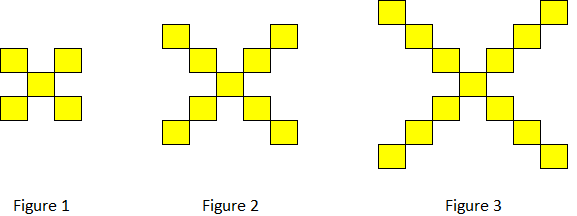
17
100
x0 = ?
1
100
Solve the equation.
2x-3=-9
x=-3
100
Is this a function? Why or why not?
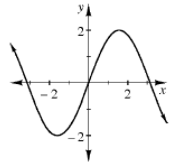
Yes. For every input there is only one output.
200
5+3*6-2
21
200
How many tiles would Figure 0 have?
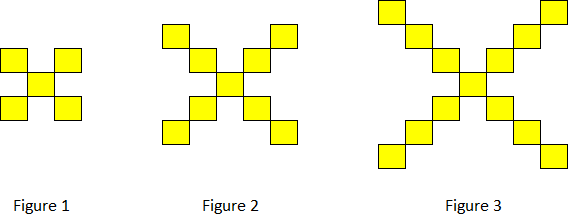
1
200
Rewrite as simple as possible without zero or negative exponents.
n^5/n^9
1/n^4
200
Solve the equation.
-x-3=2x-6
x=1
200
Is this a function? Why or why not?
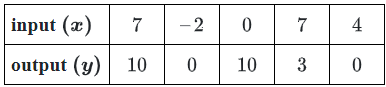
No. For input 7 there are two different outputs.
300
(4*6/3)-2^3
0
300
What is the rate of change (how is it changing)? In other words, what is the slope?
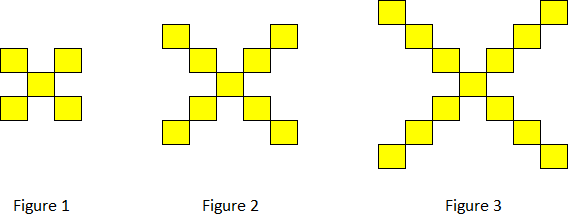
Adding 4 each time (adding 1 to each leg) = +4
300
Rewrite as simple as possible without zero or negative exponents.
(8x^5y^2)/(4xy^3)
(2x^4)/y
300
3y+7-y=5+2y+2
Infinitely many solutions (all real numbers)
300
What is the domain and range of the graph?
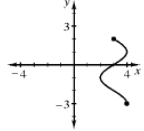
Domain (inputs/x values/independent variable): All real numbers from 2 to 4
2<=x<=4
Range (outputs/y values/dependent variable): All real numbers from -3 to 2
-3<=y<=2
400
(5^2-4)/(1+2)+16/2*7
63
400
How many tiles would Figure 13 have?
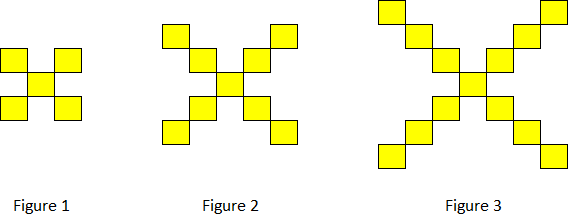
53
400
Rewrite as simple as possible without zero or negative exponents.
(24x^4y^2)/(36x^5y^2)
2/(3x)
400
5x-3+2x=x+7+6x
no solutions
400
What's the corresponding output?
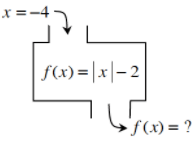
f(x)=2
500

39
500
What would the equation look like?
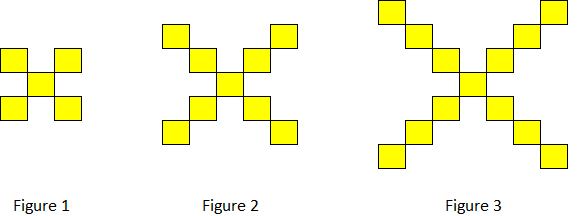
y=4x+1
where y represents number of tiles and x represents figure number
500
((2p^6q^4)^3)/(2p^7q^2r^-1
4p^11q^10r
500
-4+3x-1=2x+1+2x
x=-6
500
What's the corresponding input?
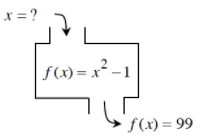
x=10 and x=-10