Properties & Changes
Matter & Mixtures
Energy
Endo v Exo
Heat & Temp
100
Property that does NOT cause a change in the chemical composition of the compounds and molecules involved in the reaction.
physical
100
- definite shape
- definite volume
- particles close together and vibrate in place
- 2 categories; crystalline and amorphous
solids
100
What is energy?
The ability to do work or to cause a change.
100
This type of reaction occurs when a net output of energy is released to the system.
exothermic reaction
100
A measure of the amount of thermal energy
temperature
200
Property that does lead to a change in the chemical composition of the compounds and molecules involved in the reaction.
chemical
200
- indefinite shape
- indefinite volume
- particles are very far apart
- compressible
gases
200
Type of energy used when you eat food to move your muscles?
chemical
200
This type of reaction occurs when a net input of energy is absorbed into the system.
endothermic reaction
200
This is released as a result of thermal energy.
heat
300
smell, texture, color, taste, density, boiling point, melting point, freezing point
physical properties
300
- indefinite shape
- definite volume
- particles are a little more spread out from one another and they are moving slightly faster
- not compressible
liquid
300
Energy and work are most commonly measured in the units of _______
joules (J) = N x m
300
Photosynthesis - endothermic or exothermic reaction?
endothermic
300
The amount of heat that must be added to one unit of mass of a substance in order to cause an increase of one unit in temperature. Or the amount of heat needed to change the temperature of 1g of water by 10C.
high specific heat or specific heat capacity
400
release of heat, production of gas, production of bubbles, combustion, cooking food, digestion, rotting of objects, rusting of objects
chemical change
400
What type of mixture is this an example of? 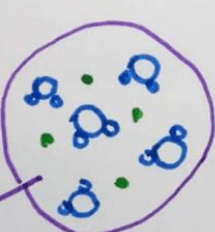
homogenous mixture
400
Convert 36 cal to J
1 cal = 4.184 J
150.624 J = 151 J
400
Burning wood - endothermic or exothermic reaction?
exothermic
400
Convert 120F to 0C
-11.11110C rounded to -11.1 0C
500
1. T or F: Cooking eggs is a physical change.
2. T or F: Fireworks exploding are an example of a chemical change.
3. T or F: Ice melting is an example of a chemical change.
1. false
2. true
3. false
500
What type of mixture is this an example of?
heterogenous mixture
500
Convert 525 Cal to J
1 Cal = 1000 cal
1 cal = 4.184 J
2,196,600 J = 2.20 x 10⁶ J
500
reactants + heat ----> products
endothermic or exothermic reaction
endothermic reaction
500
How many joules of heat are needed to raise the temperature of 10.0 g of aluminum from 22°C to 55°C, if the specific heat of aluminum is 0.90 J/g°C?
q = mC(Tf – Ti) = 10.0g (0.90J/g°C)(55-22) =
q = 297 J