Law of Superposition
Relative Age
Absolute Age
Law of Cross Cutting relationships
100
Layers of rock are made up of _____.
Sediments/Sedimentary Rock
100
The age of rock layers would be _____ on the bottom and _____ on the top.
Older, Younger
100
Define Absolute Age.
The numerical age, in years, or a rock or an object.
100
This material flows between layers.
Magma
200
By age, the top layer is the _____.
Youngest
200
The process that transports material.
Erosion
200
Atoms of the same element that have different number of neutrons.
Isotopes
200
This flow/type of rock never reaches the surface.
Intrusive
300
By age, the bottom layer is the _____.
Oldest
300
Define Correlation.
Matching rocks and fossils from separate locations.
300
Define Half Life.
The time required for half of the parent isotope to decay into the daughter isotopes.
300
This flow/type of rock reaches the surface of the crust.
Extrusive
400
 Arrange in order from YOUNGEST to OLDEST.
E, D, C, B, A
400
This law helps uncover evidence of life in the layers known as _____.
Fossils
400
The process by which an unstable element naturally changes into another element that is stable.
Radioactive Decay
400
The cross cutting rock layers age is usually _____.
Younger
500
Name the three principles of relative-age dating.
Superposition, Original Horizontality, Lateral Continuity
500
Define Index Fossils.
Species that existed on Earth for a short time, were abundant, and inhabited many locations.
500
Draw a pie chart showing the ratio of parent to daughter atoms after two half lives.
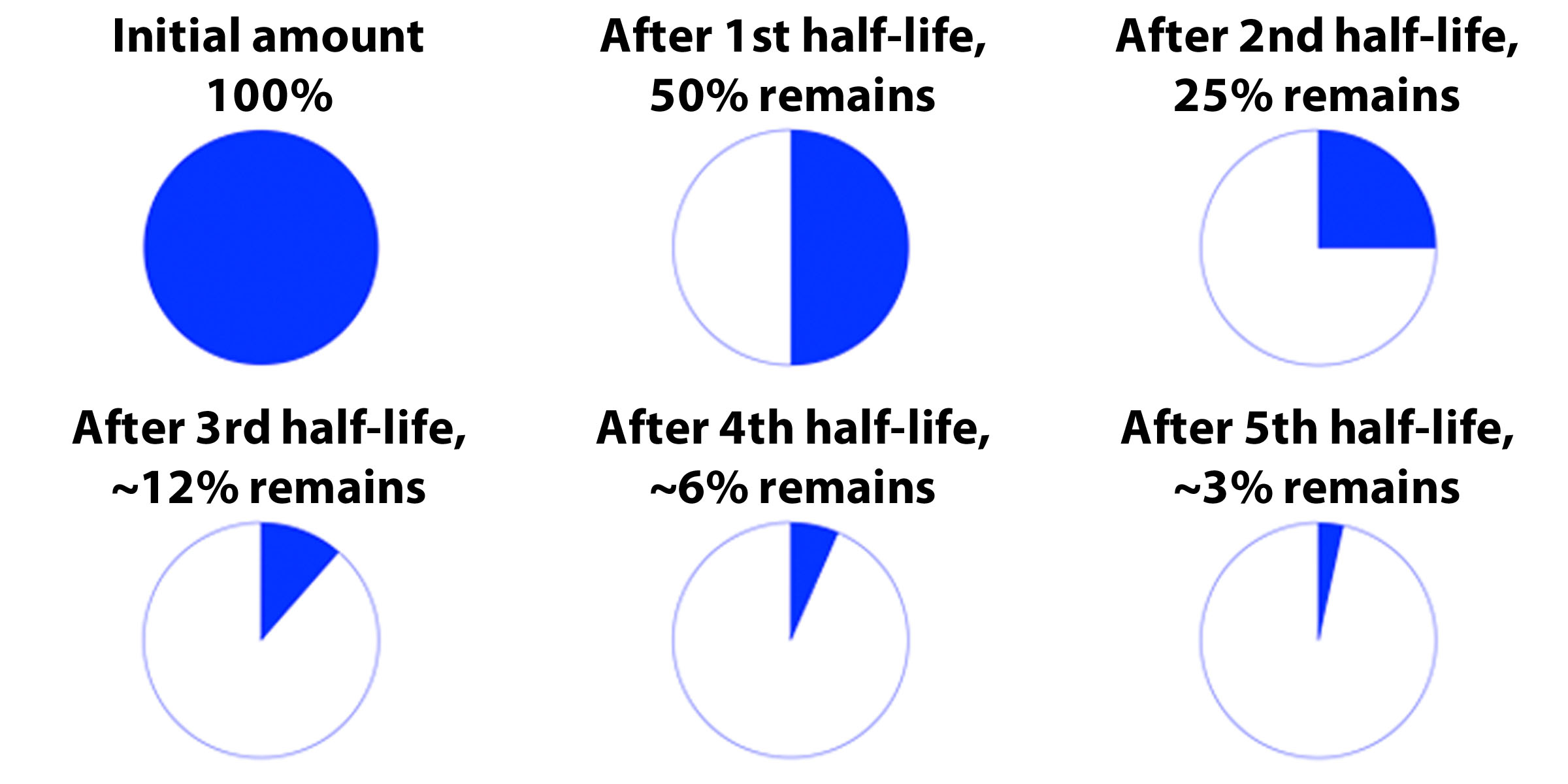

500
Granite would be formed in this layer.
Intrusive Rock Layer