Weathering
Erosion
Volcanoes and Mountains
Constructive and Destructive
Human Technology
100
The process where rocks from Earth's crust are slowly being broken into smaller pieces is called...
Weathering
100
What is the difference between weathering and erosion?
Weathering breaks rocks into smaller pieces; erosion moves those pieces away.
100
Is a volcano a constructive or destructive process?
Both
100
A break or crack in rocks where Earth's crust can move is called...
A fault
100
If you have a hill that you don't want washed away, what should you do?
Plant trees on the hill
200
What are 3 of the 4 physical causes of weathering?
Water, ice, temperature change, and living things
200
The laying down of pieces of Earth's surface is called...
Deposition
200
Volcanic eruptions produce...
Rock , lava, and ash
200
Define weathering, erosion, and deposition. Explain which ones are destructive and which are constructive.
Weathering is the breaking or wearing down of rock into small pieces called sediments. Erosion is the moving or carrying away of sediments. Deposition is the dropping or releasing of sediments in a new location.
Weathering and erosion - destructive
Deposition - constructive
200
When new roads are built, engineers plant bushes along the sloped edges of the road. Why do they do this?
Engineers plant bushes to prevent soil erosion. The roots of the bushes will help hold the soil in place.
300
Explain how plants can weather a rock.
A plant's roots can grow inside a rock, and as they grow, it can break the rock apart.
300
Name 3 of the 4 ways weathered materials are moved.
Water, ice, gravity, and wind
300
What is the difference between lava and magma?
Magma is molten rock below earth's surface; lava is molten rock one it is above the earth's surface.
300
Is a river delta formed by constructive or destructive processes?
Constructive processes. Soil deposition
300
Why are dams, levees, and storm drains important?
These are all ways to control flooding.
400
How can ice cause physical weathering?
If water gets into the crack of a rock and then freezes, it will expand when it turns into ice. The expanding ice can cause the rock to break into smaller pieces.
400
What type of erosion formed the Grand Canyon?
Flowing water from the Colorado River weathered and eroded rocky ground.
400
Based on the image, how do we know that the Appalachian Mountains are older than the Rocky Mountains?
Rocky Mountains
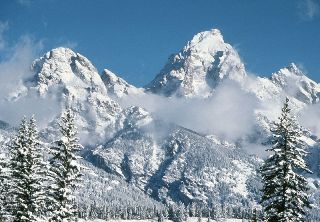
Appalachian Mountains

The Rocky Mountains are tall and jagged while the Appalachian Mountains are short and rounded. This means that the Appalachian Mountains are older because they have eroded more.
400
Mount Rushmore is in South Dakota. Which natural processes are causing the faces on this granite statue to slowly wear away? A. Earthquakes B. Water from floods C. Blowing wind and rain D. Lava flowing from volcanoes
C. Blowing wind and rain (it is the only option containing a slow process!)
400
What problem can a dam cause?
It can burst and cause a flood
500
Name the 2 types of weathering and how they are different.
Physical and chemical weathering.
Physical weathering changes the size and physical appearance of rocks. Chemical weathering causes rocks to change into different materials.
500
Name and describe 3 ways to control erosion and deposition.
Plants - people can grow plants on hills so the roots keep the soil in place Terraces - slow the speed of water running downhill Barriers - block ocean waves from carrying the sand away
500
Where on earth's crust are volcanoes located?
Weak spots on Earth's crust; along or near where Earth's plates come together
500
Are these examples of constructive or destructive landforms?

Constructive Processes
500
Can you predict Earthquakes?
No, but earthquakes can be measured using seismographs and are measured on the richter scale. Also, you can predict an aftershock once you already have had an earthquake.