Spinal cord 1
spinal cord 2
spinal cord 3
spinal cord 4
spinal cord 5
100
What is the structural organization of the CNS and PNS
CNS: Brain and Spinal cord and processing centers
PNS: Cranial nerves and spinal nerves and sensory input and motor response pathways
100
What is an example of a spinal reflex?
Dropping a hot pan. The reflex causes release of the pan BEFORE the information reaches the brain and the pain is perceived.
100
what are the four regions of the spinal cord?
Cervical, thoracic, lumbar, sacral
100
The grooves in the spinal cord are divided into left and right regions. There is a posterior median sulcus and anterior median fissure. Which groove is deeper?
Anterior median fissure
100
What kind of neurons house the axons of the anterior and posterior roots?
Anterior root: motor neurons
Posterior root: sensory neurons
200
What is another name for spinal ganglia? What do they contain?
Dorsal root ganglia because it is on the posterior root side and it houses cell bodies of sensory neurons
200
When spinal nerves divide into rami, what does the posterior and anterior rams supply?
Posterior ramus supplies skin and muscles of the back
Anterior rams supplies most of body wall, skin, and limbs
200
what are the 3 layers surrounding the spinal cord and what are they categorized under?
Dura mater- outermost layer
Arachnoid mater- middle layer
Pia mater- innermost layer
Categorized under Spinal meninges
200
what is the subarachnoid space filled with?
Cerebrospinal fluid (CSF)
200
what is the function of denticulate ligaments with regards to the pain mater?
To anchor the Pia mater to the dire mater and to prevent lateral movement of spinal cord
300
What does the gray and white matter contain?
Gray matter- cell bodies of neurons, neuroglia, unmyelinated axons
White matter- myelinated and unmyelinated axons
Note: Grey matter is your "butterfly" and white matter is the "field" that surrounds the "butterfly"
300
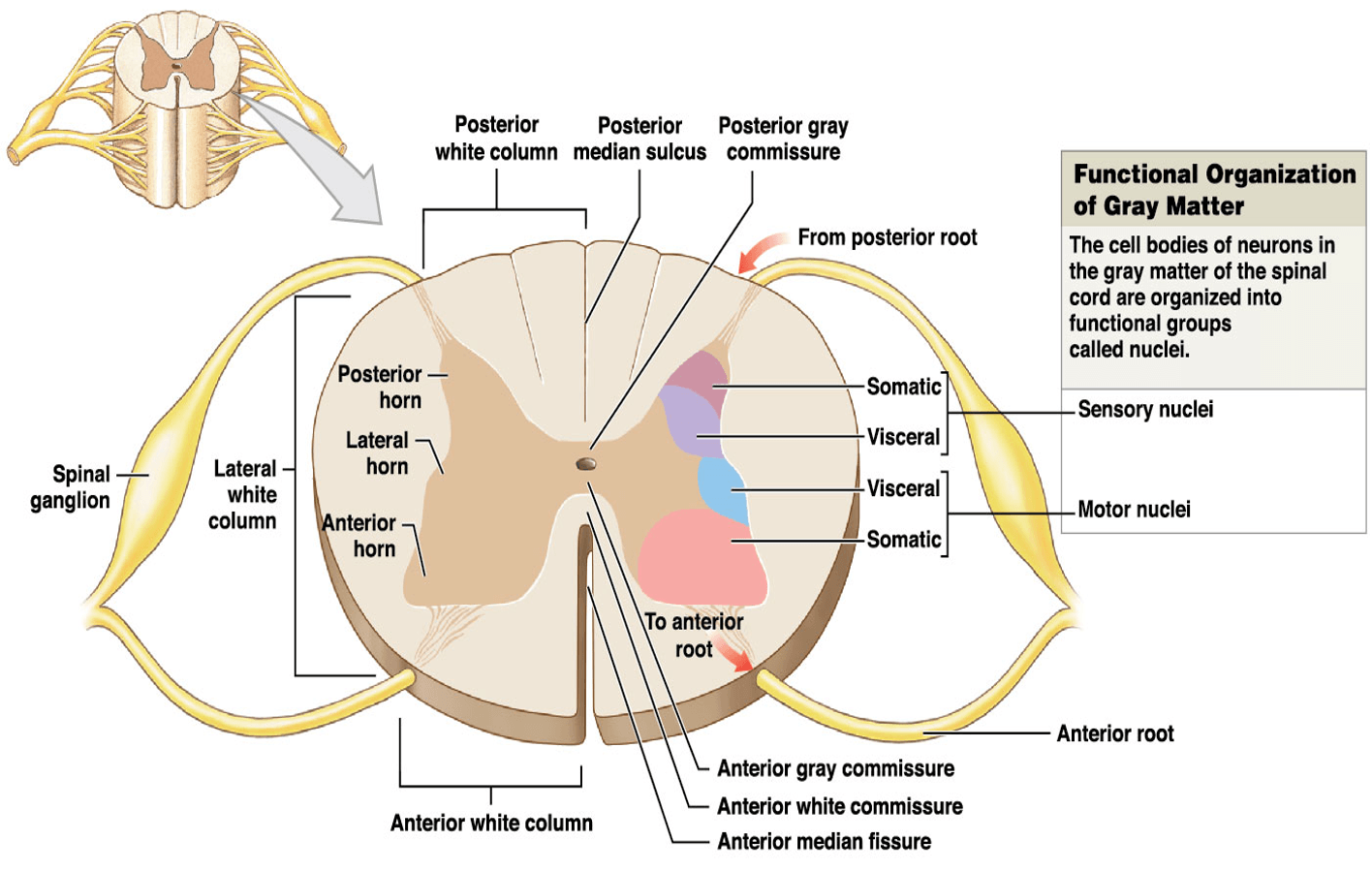
What are gray commissures?
see row 3 column 3
•Narrow bands of gray matter around central canal
•Axons cross here to the other side of spinal cord
•Sensory or motor nucleus location within gray matter determines which body part it controls
300
Not a question, please be sure to thoroughly understand what you are seeing in this picture. Make a mnemonic for the (SVVS) somatic, visceral, visceral, somatic and be able to set it apart from sensory and motor nuclei
300
What is the structural organization of white matter?
Three columns (regions)
-Posterior white columns
•between posterior horns and posterior median sulcus
-Anterior white columns
•between anterior horns and anterior median fissure
-Anterior white commissure
•where axons cross from one side of spinal cord to the other
-Lateral white columns
•on each side of spinal cord, between anterior and posterior columns
300
what are tracts? and what are the two?
Tracts:
-bundle of axons in CNS
-Relay same type of information in same direction
Ascending tracts
-sensory information up toward the brain
Descending tracts
-motor commands down to the spinal cord
400
What are the 3 connective tissue layers surrounding the spinal nerves? NOT the vertebra, remember those are meninges.
1.Epineurium—outermost; network of collagen fibers
2. Perineurium—middle layer; separates nerve into
fascicles (axon bundles)
3. Endoneurium—innermost; surrounds individual
axons
400
TRUE OR FALSE:
All spinal nerves are mixed nerves
True, they contain both sensory and motor fibers
400
What is a dermatome?
What is an example of peripheral neuropathies?
Dermatome: specific bilateral region of skin supplied by a single pair of spinal nerves
Example: Your leg falling asleep
400
What are the 4 major nerve plexuses
1.Cervical plexus
2.Brachial plexus
3.Lumbar plexus
4.Sacral plexus
400
1. What are the 5 patterns of neural circuits in neuronal pools?
2. Which neural circuit would you use if you stepped on a bee, shifted your weight to remove your foot, and scream all at the same time?
1. convergence, divergence, serial processing, parallel processing, and reverberation
2. parallel processing
500
What are the five components to neural reflexes? Can you explain the events in a neural reflex?
Think back to what the main components were to negative and positive feed back loops
see row 2 column 5
1.Receptor, sensory neuron, integration center, motor neuron, effector
2. Step 1: Stimulus activates a receptor (specialized cell or dendrites)
Step 2: With enough stimulation, action potential is generated in sensory neuron. Axon enters spinal cord via posterior root ( Dorsal)
Step 3: Information processing in spinal cord usually occurs at one or more interneurons (EPSP)
Step 4: Interneurons stimulate action potentials in motor neuron; its axon leaves via anterior root ( ventral)
Step 5: Motor neuron stimulates effector (muscle/gland) (neurotransmitter release)
500
see row 1 column 5
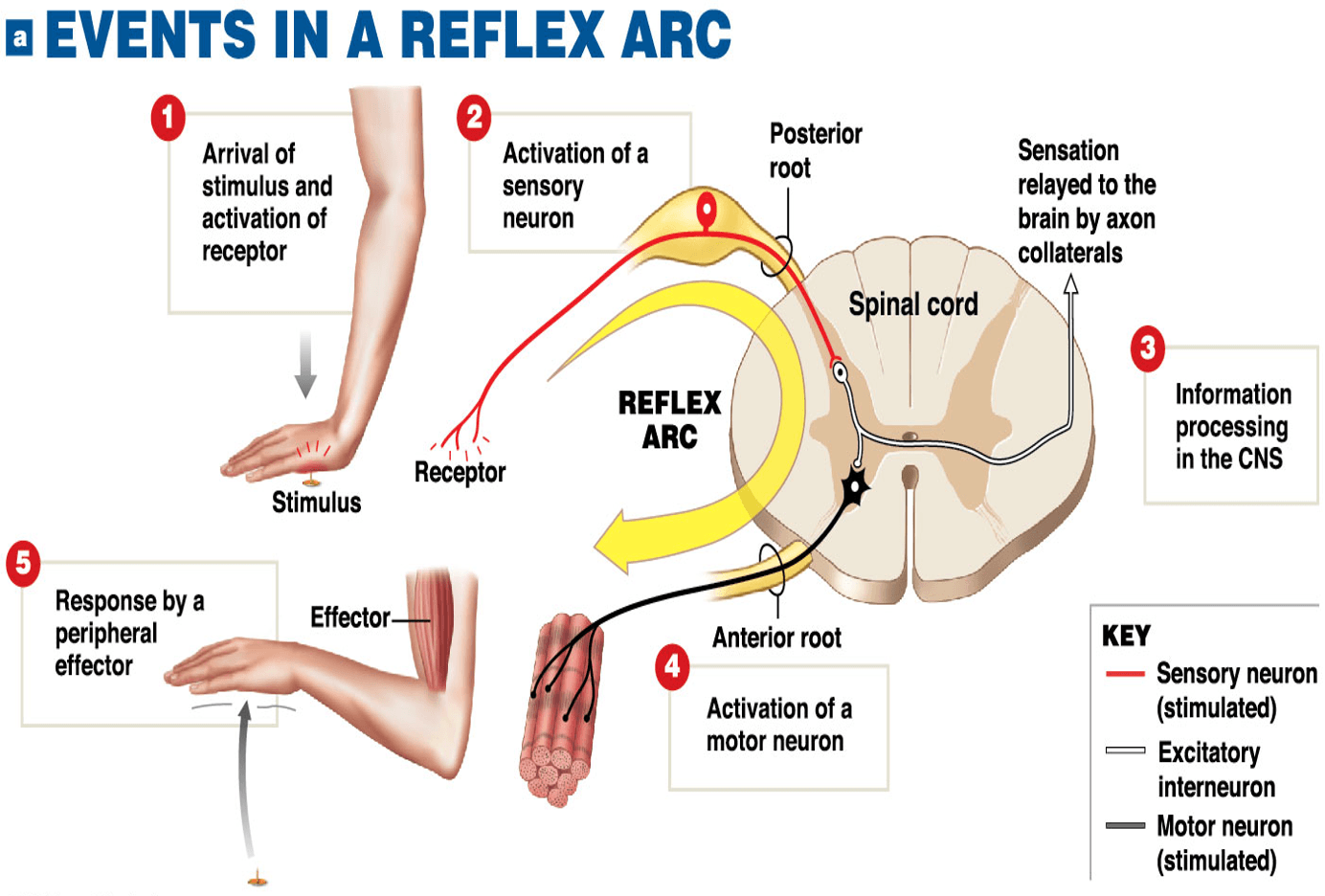
The 5 components being used in a real life scenario
500
What are the developmental reflexes?
-Innate reflexes
•Basic neural reflexes formed before birth
•Genetically programmed (inborn)
•Examples: withdrawal, chewing, visual tracking
-Acquired reflexes
•Rapid, automatic learned motor patterns
•Repetition enhances them
•Examples: braking a car in emergency
500
what types of motor responses are there?
-Somatic reflexes
oControl skeletal muscle contractions (involuntary)
•Superficial reflexes—stimuli in skin/mucous membranes
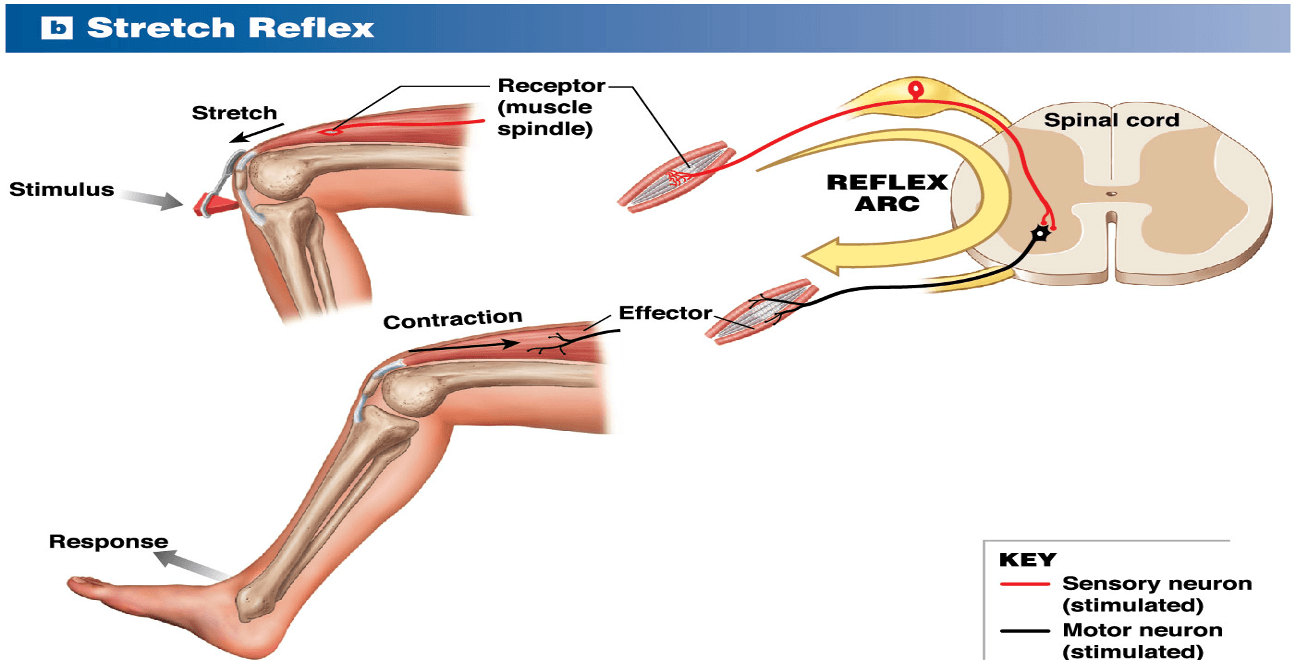
•Stretch or deep tendon reflexes (such as patellar, or “knee-jerk,” reflex)
oImmediate—important in emergencies (slipping, cutting finger)
-Visceral reflexes (autonomic reflexes)
oControl other effectors
•Smooth muscle, cardiac muscle, or glands
500
what is one type of monosynaptic reflex?
-Stretch reflex
•Regulates skeletal muscle length throughout the body
•Very rapid (large myelinated fibers)
•Example: patellar reflex