Inductive & Deductive Reasoning
Conditional Statements
Algebra Properties
Segment & Angle Relationships
Bisectors, Midpoints & Proofs
100
What is a conjecture?
A conclusion reached using inductive reasoning.
100
In the conditional “If p, then q,” what is p called? What is q called?
p is the hypothesis; q is the conclusion.
100
Which property justifies: a + 0 = a?
Identity Property of Addition.
100
What is a linear pair?
Two adjacent angles whose noncommon sides form a straight line (they are supplementary).
100
What is a midpoint?
a point exactly in the middle of two other points on a segment
200
What is a counterexample?
An example that makes a conjecture's hypothesis true but its conclusion false.
200
What do you call a conditional and its converse joined by “if and only if”?
A biconditional.
200
Which property justifies: if a = b, then a + c = b + c?
Addition Property of Equality.
200
What theorem states that vertical angles are congruent?
The Vertical Angle Theorem.
200
M is the midpoint of segment PQ. P is at coordinate −3, and Q is at coordinate 9. Find the coordinate of M.
M = (−3 + 9) / 2 = 3.
300
A student notices the first four multiples of 5 (5, 10, 15, 20) all end in 0 or 5, and concludes every multiple of 5 ends in 0 or 5. Is this inductive or deductive reasoning?
Inductive reasoning.
300
Write the converse of: “If a shape is a rectangle, then it has four right angles.”
If a shape has four right angles, then it is a rectangle.
300
Which property justifies: 5(x + 2) = 5x + 10?
Distributive Property.
300
Two lines intersect as shown. m∠1 = 55°. Find m∠3.
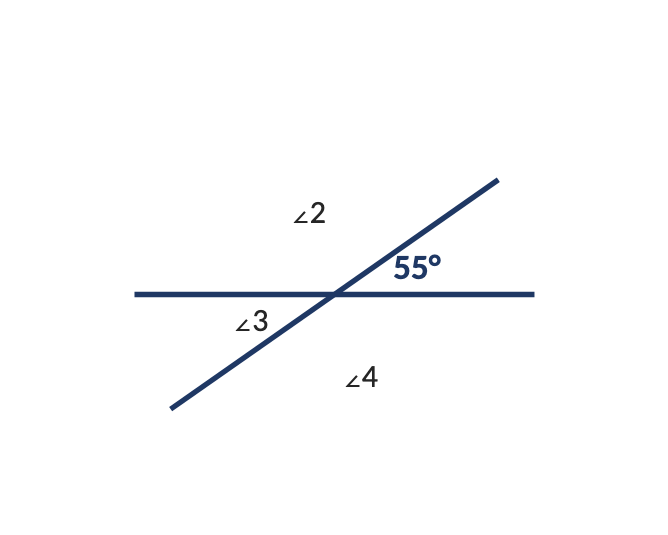
m∠3 = 55° (vertical angles are congruent).
300
What is an angle bisector?
A ray that divides an angle into two congruent angles.
400
Premise 1: If a polygon is a triangle, then it has 3 sides. Premise 2: Figure X is a triangle. State the valid conclusion and name the type of argument.
Figure X has 3 sides. — Modus Ponens
400
Write the contrapositive of: “If two angles are complementary, then their measures sum to 90°.”
If two angles' measures do not sum to 90°, then they are not complementary.
400
3x − 7 = 11, so 3x = 18, so x = 6. Which property justifies the last step (3x = 18 to x = 6)?
Division (or Multiplication) Property of Equality.
400
Two lines intersect as shown. m∠1 = 118°. Find m∠2.
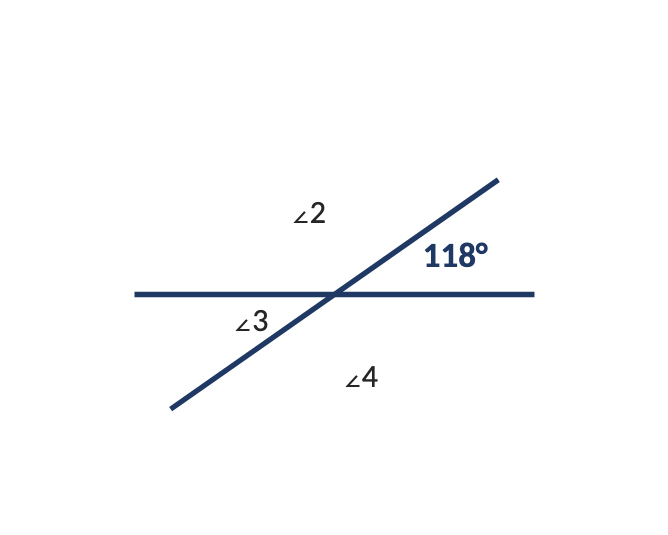
m∠2 = 62° (linear pairs are supplementary: 180 − 118 = 62).
400
Ray XY bisects ∠ABC. m∠ABY = 34°. Find m∠ABC.
m∠ABC = 68° (34° × 2, since the bisector creates two congruent halves).
500
Premise 1: If two angles are vertical angles, then they are congruent. Premise 2: ∠A and ∠B are NOT congruent. State the valid conclusion and name the type of argument.
∠A and ∠B are not vertical angles. — Modus Tollens
500
True or False: the converse of a true conditional is always true. Give an example to support your answer.
False — e.g. “If a figure is a square, then it has four right angles” is true, but its converse, “If a figure has four right angles, then it is a square,” is false (a non-square rectangle is a counterexample).
500
What is the smallest subset of the real number system that contains −3?
Integers
500
Two lines intersect as shown, with ∠1 and ∠2 forming a linear pair. m∠1 = (2x + 10)° and m∠2 = (3x − 5)°. Find x and m∠1.
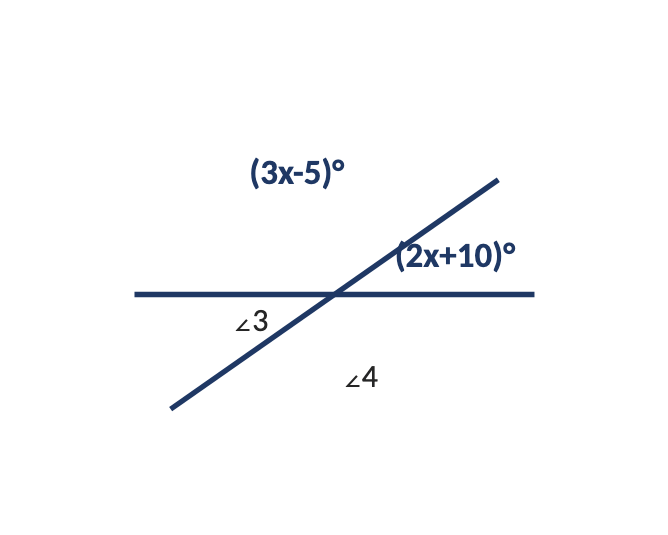
(2x+10)+(3x-5)=180 → 5x+5=180 → x=35. m∠1 = 2(35)+10 = 80°.
500
Given: AB ≅ CD. Prove: CD ≅ AB.
Step 1: AB = CD (Definition of congruent segments).
Step 2: CD = AB (?)
Step 3: CD ≅ AB (Definition of congruent segments).
What is the missing reason for Step 2?
Symmetric Property of Equality.