Viruses
Darwin
Evolution of Populations
Speciation
Mystery
100
Viruses are comprised of two main components: genetic information in the form of either RNA or DNA and a protein coat called the ____.
capsid
100
Darwin coined the term "dissent with modification." What process did he propose contributed most to this modification?
Natural Selection
100
Evolutions occurs among ____, not individuals.
populations
100
According to the biological species concept, members of a species must be able to mate and ___.
produce healthy offspring who can mate as well.
100
True or false: prions are stretches of circular RNA that cause infection
False, prions are misfolded proteins that cause other proteins to misfold when they interact.
200
Which viruses have single-stranded RNA that acts as a template for DNA synthesis?
A) lytic phages
B) proviruses
C) viroids
D) bacteriophages
E) retroviruses
E) retroviruses
200
Which of the following is not an observation or inference on which natural selection is based?
(A) There is heritable variation among individuals.
(B) Poorly adapted individuals never produce offspring.
(C) Species produce more offspring than the environment can support.
(D) Only a fraction of an individual’s offspring may survive.
(B) Poorly adapted individuals never produce offspring.
200
Although each of the following has a better chance of influencing gene frequencies in small populations than in large populations, which one most consistently requires a small population as a precondition for its occurrence?
A) mutation
B) nonrandom mating
C) genetic drift
D) natural selection
E) gene flow
C) genetic drift
200
Horses and donkeys can mate and produce offspring, mules, but mules cannot mate to produce viable offspring. This is an example of ____. Two answers accepted: one general and one more specific. Name both for double points!
1) reduced hybrid fertility
2) a post-zygotic barrier
200
Name one reason why viruses are not considered living.
They cannot carry out metabolic functions, and they cannot reproduce without the use of a host's cellular machinery.
300
The infection of a cell by a virulent phage always results in what fate for the cell?
Cell lysis or death
300
If two modern organisms are distantly related in an evolutionary sense, then one should expect that
A) they live in very different habitats.
B) they should share fewer homologous structures than two more closely related organisms.
C) their chromosomes should be very similar.
D) they shared a common ancestor relatively recently.
E) they should be members of the same genus.
B) they should share fewer homologous structures than two more closely related organisms.
300
Name three of the five conditions for Hardy-Wienberg equilibrium.
1. No mutations
2. Random mating
3. No natural selection
4. Extremely large population size
5. No gene flow
300
Which of the following factors would not contribute to allopatric speciation?
(A) The separated population is small, and genetic drift occurs.
(B) The isolated population is exposed to different selection pressures than the ancestral population. (C) Different mutations begin to distinguish the gene pools of the separated populations.
(D) Gene flow between the two populations is extensive.
(D) Gene flow between the two populations is extensive.
300
You are maintaining a small population of fruit flies in the laboratory by transferring the flies to a new culture bottle after each generation. After several generations, you notice that the viability of the flies has decreased greatly. Recognizing that small population size is likely to be linked to decreased viability, the best way to reverse this trend is to
A) cross your flies with flies from another lab.
B) reduce the number of flies that you transfer at each generation.
C) transfer only the largest flies.
D) change the temperature at which you rear the flies.
E) shock the flies with a brief treatment of heat or cold to make them more hardy.
A) cross your flies with flies from another lab.
400
Which of the three types of viruses shown above would you expect to include glycoproteins?
A) I only
B) II only
C) III only
D) I and II only
E) all three 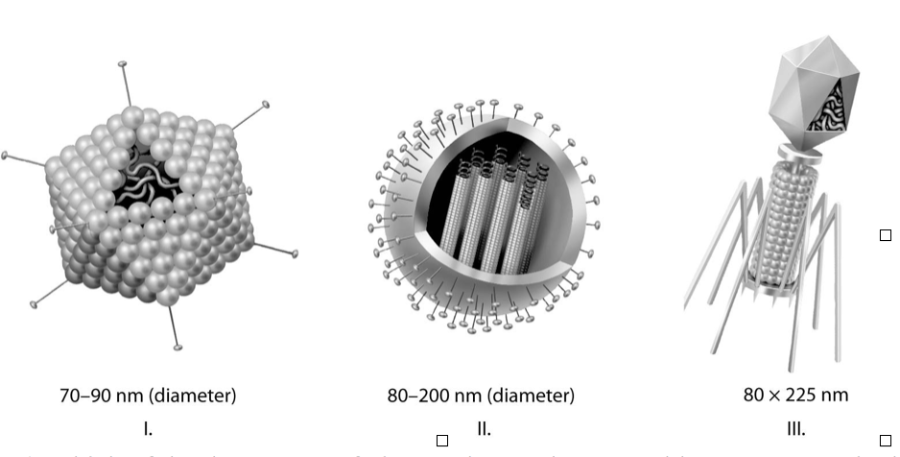
D) I and II only
400
Ichthyosaurs were aquatic dinosaurs. Fossils show us that they had dorsal fins and tails, as do fish, even though their closest relatives were terrestrial reptiles that had neither dorsal fins nor aquatic tails. The dorsal fins and tails of ichthyosaurs and fish are
A) homologous.
B) examples of convergent evolution.
C) adaptations to a common environment.
D) A, B, and C.
E) B and C.
E) B and C.
400
In a Hardy-Weinberg population with two alleles, A and a, that are in equilibrium, the frequency of allele a is 0.2. What is the percentage of the population that is heterozygous for this allele?
A) 0.2
B) 2.0
C) 4.0
D) 16.0
E) 32.0
E) 32.0
400
Plant species A has a diploid number of 12. Plant species B has a diploid number of 16. A new species, C, arises as an allopolyploid from A and B. The diploid number for species C would probably be ___.
A) 12.
B) 14.
C) 16.
D) 28.
E) 56.
D) 28.
500
You isolate an infectious substance that is capable of causing disease in plants, but you do not know whether the infectious agent is a bacterium, virus, viroid, or prion. You have four methods at your disposal that you can use to analyze the substance in order to determine the nature of the infectious agent.
I. treating the substance with nucleases that destroy all nucleic acids and then determining whether it is still infectious
II. filtering the substance to remove all elements smaller than what can be easily seen under a light microscope
III. culturing the substance by itself on nutritive medium, away from any plant cells
IV. treating the sample with proteases that digest all proteins and then determining whether it is still infectious
37) Which treatment could definitively determine whether or not the component is a viroid?
I.
500
 Currently, two extant elephant species (X and Y) are placed in the genus Loxodonta and a third species (Z) is placed in the genus Elephas. Assuming this classification reflects evolutionary relatedness, which of the following is the most accurate phylogenetic tree?
D
500

 Anopheles mosquitoes, which carry the malaria parasite, cannot live above elevations of 5,900 feet. In addition, oxygen availability decreases with higher altitude. Consider a hypothetical human population that is adapted to life on the slopes of Mt. Kilimanjaro in Tanzania, a country in equatorial Africa. Mt. Kilimanjaro's base is about 2,600 feet above sea level and its peak is 19,341 feet above sea level. If the incidence of the sickle-cell allele in the population is plotted against altitude (feet above sea level), which of the following distributions is most likely, assuming little migration of people up or down the mountain?
B
500
On the Bahamian island of Andros, mosquitofish populations live in various, now-isolated, freshwater ponds that were once united. Currently, some predator-rich ponds have mosquitofish that can swim in short, fast bursts; other predator-poor ponds have mosquitofish that can swim continuously for a long time. When placed together in the same body of water, the two kinds of female mosquitofish exhibit exclusive breeding preferences.
If one builds a canal linking a predator-rich pond to a predator-poor pond, then what type(s) of selection should subsequently be most expected among the mosquitofish in the original predator-rich pond, and what type(s) should be most expected among the mosquitofish in the formerly predator-poor pond?
A) stabilizing selection; directional selection
B) stabilizing selection; stabilizing selection
C) less-intense directional selection; more-intense directional selection
D) less-intense disruptive selection; more-intense disruptive selection
C) less-intense directional selection; more-intense directional selection