Is It Living?
Cells/DNA
Homeostasis/ responds to stimuli
Grows and Develops/ adapts to evolve
Displays Organization/ Requires Energy
OST Prep
100
Birds
Yes
100
All living things have to be made of....
One or More Cells
100
To remain safe, all organisms have the natural ability to...
Respond to Internal and External Stimuli
100
Living things grow and develop by...
start as single cells and throughout their lives mature
100
Life requires...
Energy.
100
Carbohydrates are required by many organisms for survival. What is the main function of carbohydrates in these organisms?
A. to provide energy for life processes
B. to produce enzymes that replicate DNA
C. to provide antibodies for fighting viruses
D. to produce hemoglobin in the bloodstream
a. to provide energy for life processes
200
Rocks
No
200
What is the fundamental difference between Eukaryotic and prokaryotic cells?
Eukaryotic have a nucleus, prokaryotic do not
200
What do we call it when living things are arranged in an orderly way?
Organization
200
What is the difference between growth and development?
Growth refers to a quantitative increase in size, mass, or cell count. Development refers to qualitative changes in form, structure, and functional specialization (differentiation) over an organism's lifecycle.
200
Label the order of organization in living things from SMALLEST to LARGEST
Cells, Tissues, Organs, Organ Systems, Organisms
200
Oxygen in Earth's early atmosphere was generated by marine organisms such as cyanobacteria, which are sometimes called blue-green algae. By what process did cyanobacteria oxygenate the atmosphere?
A. fermentation B. photosynthesis
C. protein synthesis D. cellular respiration
b. photosynthesis
300
Soil
No
300
What is the role of DNA in a cell?
DNA contains gene regulatory networks that switch specific genes on or off in a spatial and temporal order, instructing cells to differentiate into distinct types and tissues.
(genetic material)
300
Regulation of an organisms internal conditions to bring them back to their natural state is known as...
Homeostasis
300
How does metamorphosis in insects or amphibians demonstrate developmental change?
Start as a tadpole and change to a frog. Start as a caterpillar and morph into a butterfly in different stages of life.
300
Living things get their energy from...
Eating other organisms or making energy from the Sun.
300
Why are viruses typically considered non-living in terms of cellular organization?
They require a host
400
Mushrooms
Yes
400
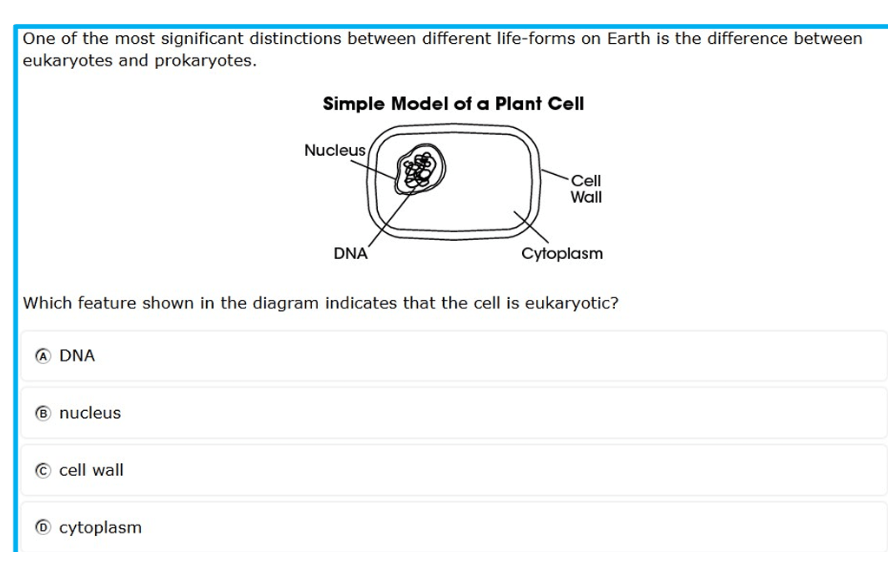
B. nucleus
400
In order to maintain a species (not an individual), species must be able to...
Reproduce
400
Any inherited characteristic that results from changes to a species to help them survive and passed down through their genes to the next generation is known as...
An Adaptation
400
How do humans display organization as living things?
Cells-tissue-organ-organ systems
Specialized cells have specific functions or jobs.
400
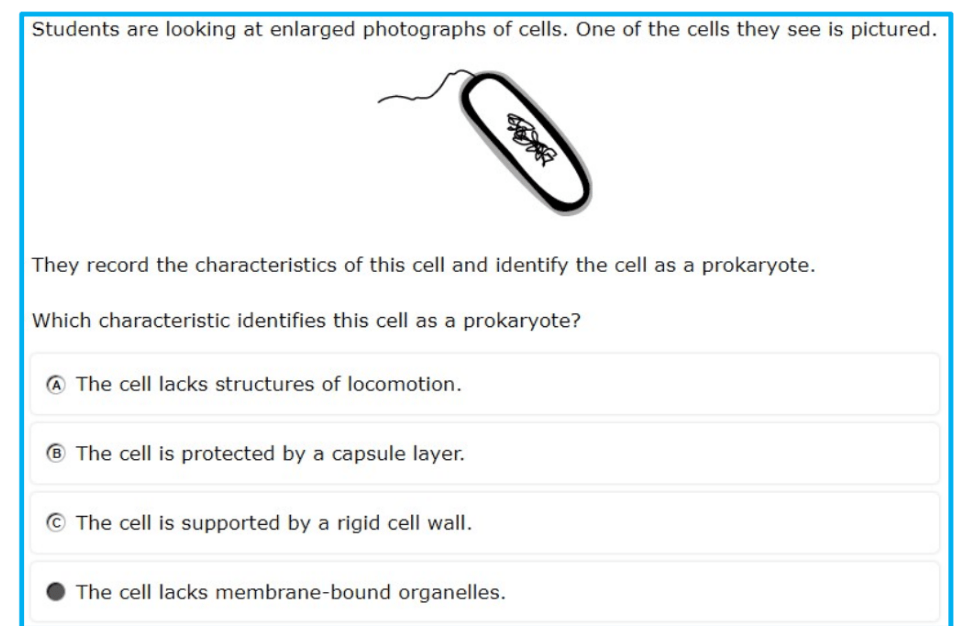
D. The cell lacks membrane-bound organelles