Periodic Trends & Families
Atomic Structure
Electron Arrangment
Matter, Changes, KMT
Sig figs, Conversions, Gas Laws
Nuclear and more!
100
A row on the periodic table
Period
100
The particle responsible for the identify of an element.
Proton
100
The element with an electron configuration of 1s2 2s2 2p6 3s2 3p1.
Al, aluminum
100
Type of matter made of only one type of atom or compound.
pure substance
100
The measurement for this amount with the correct number of sig figs.
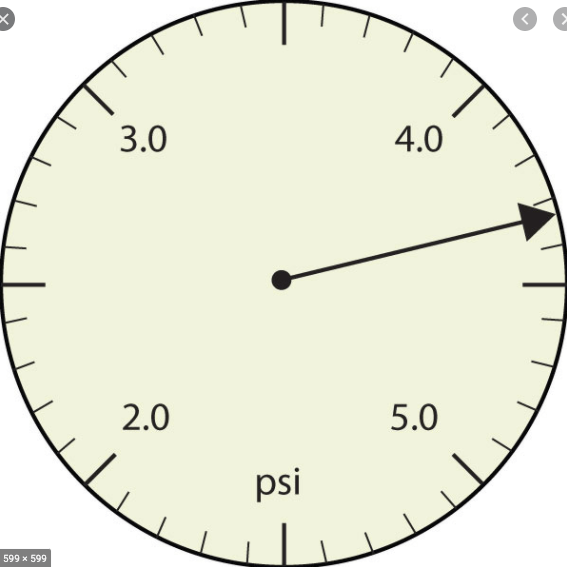
4.33 psi
100
The type of energy released during decay
Gamma ray
200
Highly reactive nonmetals with 7 outer electrons
Halogens
200
Identify the element and give the overall charge for an element with 15 protons, 16 neutrons and 18 electrons.
Phosphorus, -3
200
The element with a noble gas configuration of [Kr] 4d10 5s2.
Cd, cadmium
200
Statement about all matter based on kinetic molecular theory.
All matter is made of particles in constant motion.
200
Use dimensional analysis to convert 130 inches to meters.
(1 yard = 0.9144 meter)
3.3 meters
200
Largest type of particle released during decay
Alpha particle
300
Reactive metals with two outer electrons that may be found in their pure form in nature.
Alkaline earth metals
300
Hyphen notation and nuclear symbol notation for the most common isotope with 74 protons.
Tungsten - 184, 18474W
300
The number of unpaired electrons in iron.
4
300
Relationship between temperature and kinetic energy.
They are directly proportional.
300
Number of atoms in 40.0 grams of calcium.
6.02 x 10²³ atoms
300
An isotope has a half life of 4.5 years. If you have 400 grams, how much of the isotope will remain after 13.5 years?
50 grams
400
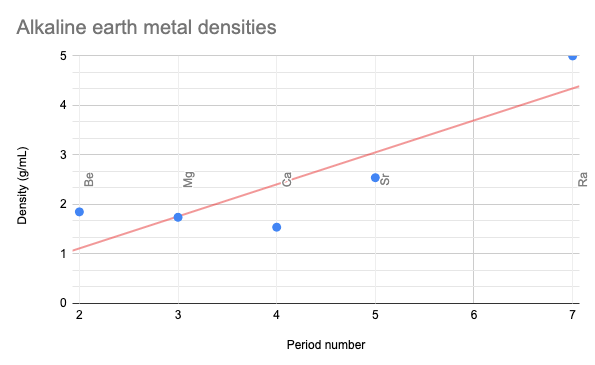 Identify the missing element and give the density based on the graph.
Barium, 3.6g/cm3
400
The reason why an s orbital has a 0 for its magnetic quantum number.
The s orbital is a sphere so it can only be oriented around the nucleus in one way.
400
1)Two things that can't be known based on Heisenberg Uncertainty principle.
2) What can't happen according to Pauli Exclusion principle.
1) momentum and location of an electron
2) two electrons in the same atom can't have the same four quantum numbers.
400
Compare the movement of a hydrogen molecule and a water molecule at the same temperature.
The hydrogen molecule would be moving with a higher velocity than the water molecule.
400
A 30.0 L sample of nitrogen inside a rigid, metal container at 20.0 °C is placed inside an oven whose temperature is 50.0 °C. The pressure inside the container at 20.0 °C was at 3.00 atm. What is the pressure of the nitrogen after its temperature is increased to 50.0 °C?
3.31 atm
400
The process used for creating new elements larger than uranium.
Artificial transmutation
500
1)The trend across a period.
2) The trend down a group.
3) Predicted value for Germanium.
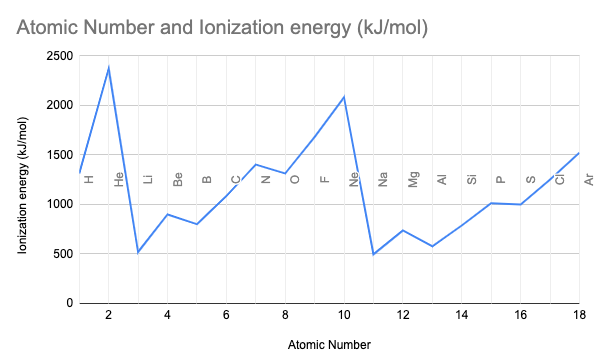
1) Increasing
2) Decreasing
3) 380 kg/mol
500
Identify the element. The quantum numbers for the last electron in this element are P = 4, A = 2, M = -1, S = +1/2
Angular #: s=0, p=1, d=2, f=3
Zr, zirconium
500
The noble gas notation for erbium, Er.
[Xe] 4f11 5d1 6s2
500
Four signs of a chemical change/reaction.
1) Gas production
2) Precipitate production
3) Color change
4) Change in energy
500
At what temperature in Celsius, does a 48.5g sample of argon gas fill a container of 4.56L at 2.50 atm?
-159 degrees Celsius
500
Write the beta decay equation for Thorium-232.
232/90Th ----> 0/-1e + 232/91Pa