Chemistry
Energy in Reactions
Transformation of energy
Solid Liquid Gas
100
Give a property of substances held together by ionic bonds
Conduct electricity when melted or dissolved in water.
100
A reaction where the chemicals involved release heat and get cooler while the surroundings gets hotter is called
Exothermic. An explosion is an example.
100
Give an example of converting kinetic energy into potential energy
A ball that is thrown upwards is moving fast, but goes slower the higher it goes. Eventually, it turns around and starts back down.
100
A sample of a substance feels very light, and expands to fill the container it is in. What state of matter is it?
Gas
200
What types of atoms form each type of bonds?
Metalic bonds are formed by metal atoms releasing their electrons.
Ionic bonds are formed by a metal atom releasing electrons and a nonmetal atom grabbing them.
A covalent bond is formed by two nonmetals sharing electrons. (Both atoms believe they have an "octet", but since they are sharing the last few electrons they need, do they really have an octet?)
200
A reaction where the chemicals involved absorb heat and get hotter, while the surroundings gets colder is called
Endothermic
200
Give an example of gravitational potential energy turning into kinetic energy.
A dropped ball speeds up as it moves down.
Water behind a dam is allowed to flow over the dam and it falls fast and crashes into the river below.
200
A sample of a substance maintains its shape (does not change shape), no matter how hard you wish for it to flow and fill the container (think of a frozen piece of butter in a frying pan). What state of matter is it?
Solid
300
What are characteristics of substances held together by the different kinds of bonds?
Substances held together by covalent bonds have low melting points.
Substances held together by metalic bonds are malleable, ductile (can be made into a wire), conduct heat and electricity.
Substances held together by ionic bonds often dissolve in water, form crystals, are brittle (shatter when hit with a hammer) and have high melting points.
300
Calorimetry is
a process used to measure the heat absorbed or released by a physical or chemical process.
300
How are heat the kinetic energy related?
The hotter molecules are the faster they move. More heat means more kinetic energy in the molecules.
300
The sample flows to the edges of the container, forms a layer at the bottom of the container, and the sample gets very thin. What state of matter is it?
liquid.
400
Which elements have the largest atomic radius?
Alkali metals (column 1) have the largest atomic radius. Their 1 valence electron is held loosely by electrostatic attraction to the nucleus.
Noble gases (8 valence electrons) have the smallest radius. The electrons are held so tightly by the nucleus that the atoms do not react with other elements.
400
Heat =
mCpdeltaT. (the mass of the sample x its specific heat capacity per gram x the change in temperature)
q=mCpdeltaT
400
The law of conservation of energy says what?
Energy can be transferred (moved from one object to another) and transformed (changed from one form into another, like potential to kinetic) but it can never be created or destroyed.
It's the LAW.
400
The sample is super hot, so hot that the atoms have broken down into protons, neutrons and electrons. What phase of matter is this? Where in the universe am I that it is this hot?
Plasma. This only happens on the sun. It's toasty around here!
500
What is the atomic number for sodium (Na)?
Helium (He)?
Carbon (C)
Lead (Pb)
11, 2, 6, 82
500
Heat flows from _______ to ___________.
Hot bodies to cold bodies. Wouldn't it be funny if heat flowed from your ice cream to the warm air around it? Your ice cream would get colder and colder as you stood outside on a hot day.
500
Describe a change of state and its energy requirements.
When gas turns into a liquid, energy is released. Think of this the other way, you have to put energy in to make the liquid turn into gas.
600
If you place an object that is dense on top of an object that is less dense (like a block of lead in water), what happens to the dense object?
Sinks
600
Hotter molecules have more of what?
kinetic energy (more kinetic energy means more speed).
600
For this graph showing the temperature as a substances is heated, which number represe nts solid state, liquid state and gas state?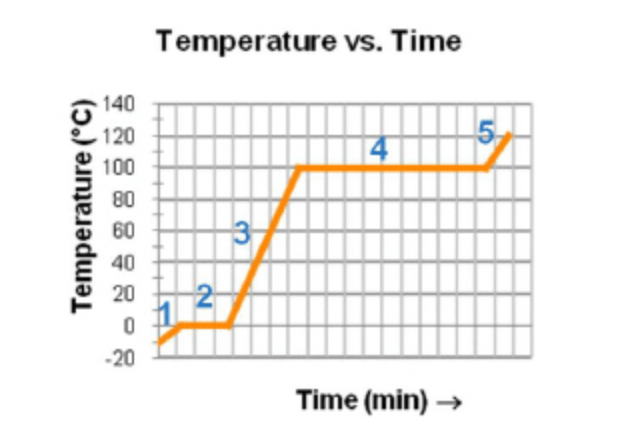
1,3,5. 2 is the time when the solid is melting. The temperature stays the same. 3 is the liquid state: you can have cold liquid (low temp) and hot liquid (high temp).
700
Air contains several gases: oxygen, nitrogen, carbon dioxide, pollutant molecules. What kind of substance is air? Be as specific as possible.
Homogeneous mixture (well mixed: you can tell because air isn't different from one breath to the next)
700
Give an example of chemical energy being converted to heat energy
Propane in the grill is burned to make fire to cook the meat.