Current and Ohm's Law
Series Circuits
Parallel Circuits
Energy and Power
Circuit Diagrams
100
24 C of charge passes in 3.5 s. What is the current?
6.86 A
100
What is different about current in a series circuit compared to a parallel circuit?
The current is the same everywhere in a series circuit
100
A parallel circuit draws 5.0 A total current. One branch draws 2.0 A. How much current flows through the other branch?
3.0 A
100
A device uses 110 V and 2.5 A. Determine the power.
275 W
100
Draw the symbol for:
- a battery
- a resistor
- an ammeter
- an open switch
then the board
200
Determine the resistance of a lightbulb that draws .75 A of current from a 15 V battery.
20 Ω
200
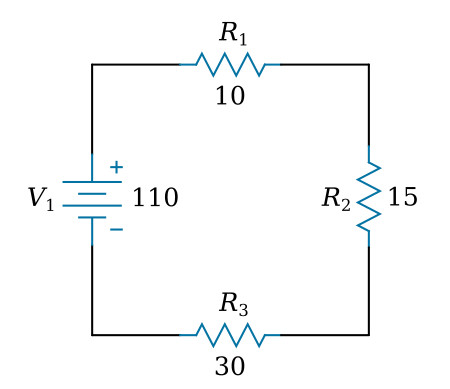
Determine the total resistance of the circuit and the current leaving the battery.
RT = 55 Ω
I = 2A
200
Three resistors of 5 Ω, 6 Ω, and 3 Ω are connected in parallel. Which branch carries the most current and which carries the least?
3 Ohm --> Most
6 Ω --> Least
200
A toaster has a resistance of 40 Ω on a 120 V outlet. Determine the power.
360 W
200
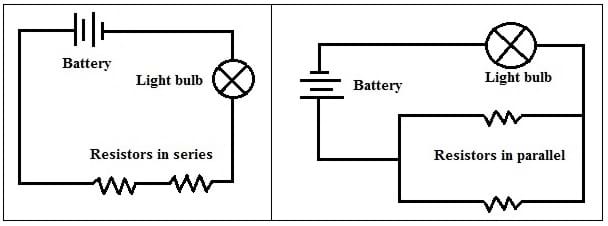 In which direction would the flow of conventional current be for each diagram? What about the flow of electrons?
Conventional: Counterclockwise (+ to -)
Electrons: Clockwise (- to +)
300
Increasing the resistance of a circuit does what to the current?
Decreases
300
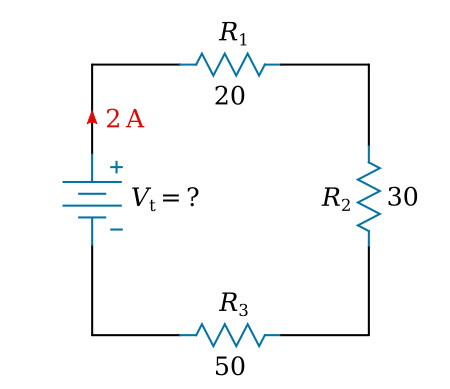
Determine the voltage of the battery.
200 V
300
What is the total resistance of a parallel circuit containing three 10 Ohm resistors?
3.3 Ohms
300
A microwave uses 1200 W for 4.0 minutes. Determine the energy used in joules.
288,000 J
300
Draw a series circuit with a 9V battery, 10 Ω, 12 Ω, and 15 Ω resistors.
on the board
400
A circuit initially has current 6.0 A. The voltage is tripled and the resistance is doubled. Determine the new current.
9.0 A
400
A 30 V battery is connected in series with resistors of 4 Ω, 6 Ω, and 10 Ω. Determine the voltage across each resistor. Confirm that they add to the battery total.
6 V, 9 V, 15 V
6 + 9 + 15 = 30
400
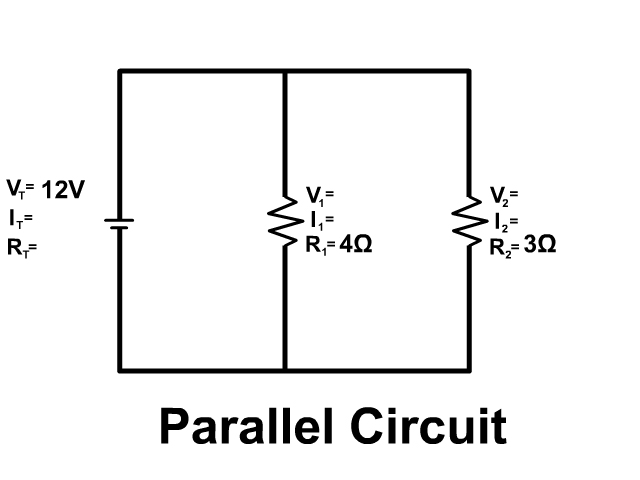 Determine:
- total resistance
- total current
- current through each branch
RT = 12/7 = 1.71 Ω
IT = 7 A
I4 = 3 A, I3 = 4 A
400
A heater draws 12 A from a 120 V outlet for 2.5 hours. Determine:
- power
- energy used
1440 W
12,960,000 J
400
Draw two separate circuits:
- one with three identical bulbs in series
- one with three identical bulbs in parallel
Indicate which bulbs would be brighter.
Parallel bulbs brighter
500
A device with a resistance of 15 Ω is connected to a 24 V source for 5.0 minutes. Determine the total charge transferred.
480 C
500
A series circuit contains 8 Ω, 10 Ω, and 18 Ω resistors connected to an 18 V battery. Determine:
- total resistance
- total current
- voltage across the 10 Ω resistor
RT = 36 Ω
IT = 0.5 A
V10 = 5 V
500
A parallel circuit has total resistance 3 Ω. One branch is 6 Ω. Determine the resistance of the second branch.
6 Ω
500
Two lightbulbs with resistance of 15 Ω are connected in series to a 24 V battery. Determine the power used by one of the bulbs.
9.6 W
500
Draw a diagram for a series circuit with at least two resistors that will have a current of 1.5 A.
on the board