Descriptive Statistics (Ch 9)
Testing for Differences
(Ch 10)
(Ch 10)
Tests of Relationships
(Ch 11)
(Ch 11)
Designing Qualitative Research
(Ch 14 & 15)
(Ch 14 & 15)
Qualitative Data Collection
(Ch 15-16)
(Ch 15-16)
Qualitative Analysis
(Ch 17)
(Ch 17)
100
•What are the three measures of central tendency?
Mean, Median & Mode (p. 73-174). Make sure you can define each.
100
•Jim has conducted a survey of employee satisfaction with healthcare at his work. He wonders if men and women differ in their reported relationship status (married, partnered, dating, single). If Jim wants to test the differences in two nominal variables, he should use the ___________ test.
Chi-Square test (X2) - see definition of the test on p. 189-193, especially a two-way on 191
100
•Mark’s Hypothesis states: As frequency of communication increases, relational closeness increases. What test should Mark use to determine the relationship (and the direction of that relationship) between two continuous level variables?
Correlation (see p. 208)
100
•Anna decides that for her focus groups of teenage consumers, she will ask the teenagers in her first focus group to recommend some people for her second focus group. Which sampling strategy is characterized by the researcher getting potential participant names from people who are already participating in the research?
Snowball Sample p. 286
100
•__________ is a holistic description of interactants in their cultural or subcultural environment.
Ethnography p. 322
100
•In this step of Corbin and Strauss’s grounded theory, you take a first pass through the data and write notes to yourself in the margin. What was each section about? How might it answer your questions?
What is this step of data analysis called?
Open Coding p. 338-339
200
•What are the two measures of dispersion?
Range & Standard Deviation (p. 175-177).
Make sure you can define each.
200
•Mary wants to collect data on how men and women rate their listening abilities. She asks 50 men and 50 women a series of scale questions about their listening. If she wants to test whether men and women report different scores on her listening scales, what test would Mary use?
Independent t-test (see p. 193)
200
•What does (r) tell us about a correlation? (What does r mean?)
It measures the direction and strength of the relationship -- see chart on p. 209 and 210
200
•Ben decides to write an ethnographic account of how American Red Cross volunteers talk to people who are considering donating blood. He receives permission to sit and observe at a county fair where volunteers are talking to people about the benefits of donating blood. Ben is just there as an observer. He does not interact with the volunteers or the people they are chatting with. In this type of ethnographic observation, the researcher does not engage with interactants (or the group) in a scene. As such, data is limited to what the researcher can overhear.
Complete Observer p. 281-282
200
•Before beginning her interviews, Annabeth draws up a list of questions she intends to use as the basis for her interviews. What is this list of questions typically called?
Interview Protocol p. 309-311
200
•In this step of Corbin and Strauss’s grounded theory, you continue to highlight, label, and refine categories for your data until you have a limited number of categories or themes to answer your research questions.
What is this step of data analysis called?
Axial Coding, p. 338-339
300
•Annabeth is doing a clinical trial for a new medication. Because the dangers of being wrong are so great, she has decided to only accept a 1% error rate. As a result, she sets her ___________ at .01.
Significance Level (see p. 180-181)
Remember in social science (communication), the industry standard is to set our significance level at p=.05.
300
•Dan hypothesized that at his company, women were more likely than men to have taken a vacation in the past month. He used a Chi-Square test to test his hypothesis. Given these results, was his hypothesis supported. Why or why not?
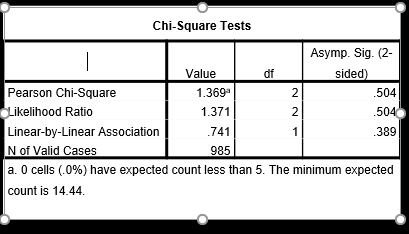
X2 = 1.369
p = .504
No, his hypothesis is rejected because p=.504>.05
300
•This output tests the Hypothesis that: As student opinion of classrooms at WSU improves, their opinion of teaching also improves.
•Given this output, what does r = ?
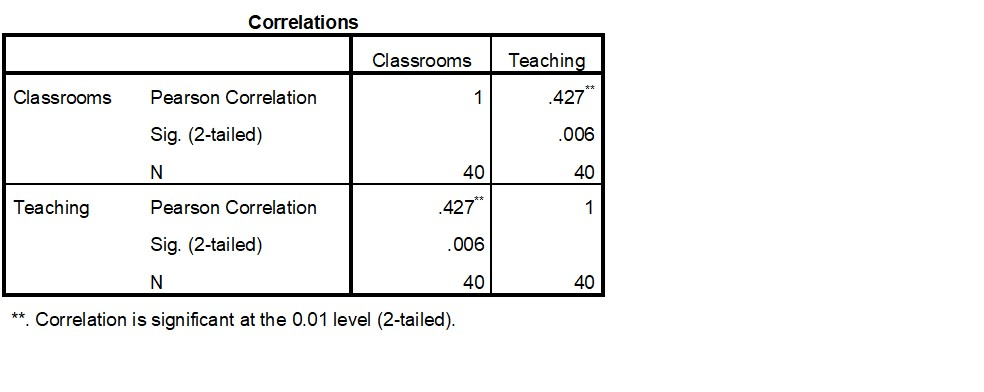
r = .427
300
Lynn is searching for people to participate in her study on second marriages. As such, she intentionally asks people she knows who have remarried to participate in her study. Which sampling strategy is characterized by the researcher selecting a person to be in the study because the person is thought to be a good example of the type of person desired for the research study?
Purposive or Network (either answer is correct, I won't make you choose between them). p. 286-287
300
•Describe the strengths of focus group research.
There are many correct answers. See p. 319-320
300
•In qualitative research, investigators often use several kinds of methods or data to bring credibility to their findings. This process is called:
Triangulation p. 250; 342-343
400
•Amy asked faculty at BYU how they felt like they were treated by the university.
–Scale 1 = Very well; 9 = Very Poorly.
•She then ran descriptive statistics on her data:

•Given this output, what is her 𝑥 ̅? (that should be a letter x with a line over top of it)
the 𝑥 ̅ (that should be a letter x with a line over top of it) is a symbol that stands for mean (average). In that chart, the average/mean score is 2.06.
so the correct answer is 2.06.
400
•Matt decided to test whether male students and female students differed in their overall satisfaction with the current WSU fall break. He used a t-test to test his hypothesis. Given these results, was his hypothesis supported. Why or why not?
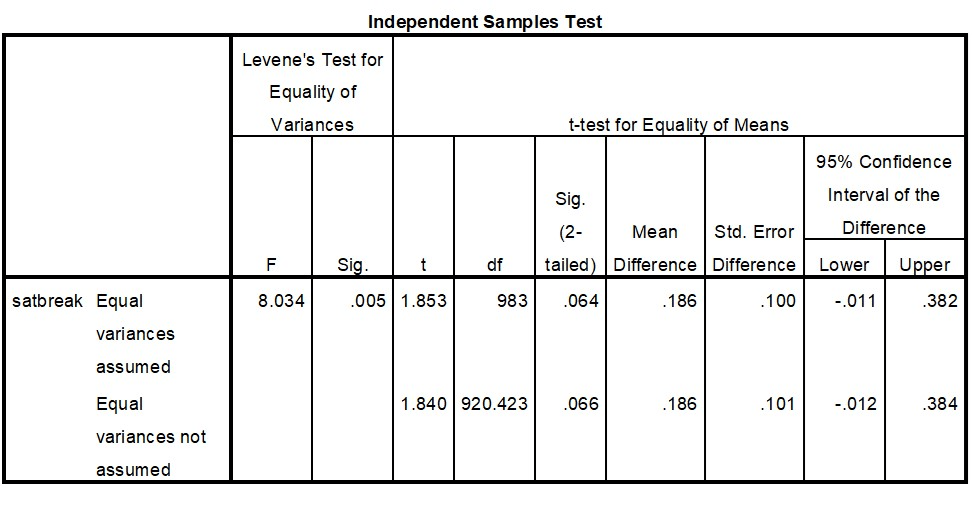
t = 1.853
p = .064
No, his hypothesis is NOT supported because p = .064> .05 (so reject)
400
•This output tests the Hypothesis that: As student opinion of classrooms at WSU improves, their opinion of teaching also improves.
Given this output, should we accept or reject the hypothesis?
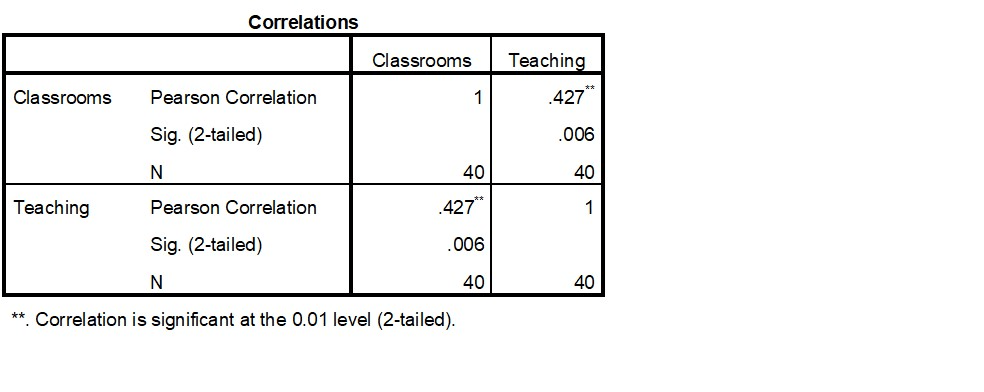
r = .427
p = .006
Accept the hypothesis, because p. = .006 < .05
400
=•In order to get access to participants for a study, you often need to gain the permission of a _____________, or a person who has authority or credibility with the group or organization.
Gatekeeer p. 289-292
400
The focus group moderator
A. should be seen as credible by participants.
B. should share important demographic characteristics with participants.
C. should be skilled in guiding a group in discussion.
D. should avoid the spoke-and-wheel pattern of questions and answers.
E. all of the above.
E (all of the above) -- see p. 317-318
400
•Owen's (1984) method of thematic analysis of qualitative data is done by using the three criteria of:
Repetition, Recurrence, Forcefulness p. 340
500
•Amy asked faculty at BYU how they felt like they were treated by the university. She then ran descriptive statistics on her data:
–Scale 1 = Very Well; 9 = Very Poorly

What was Amy's sd on this question?
sd= standard deviation.
on this question, the sd = 1.934
500
Jordan decided to test the hypothesis that different types of employees (faculty, staff, etc.) at WSU differed in their opinion of WSU’s current fall break. He ran an ANOVA to test his hypothesis. Given these results, was his hypothesis supported? Why or why not?
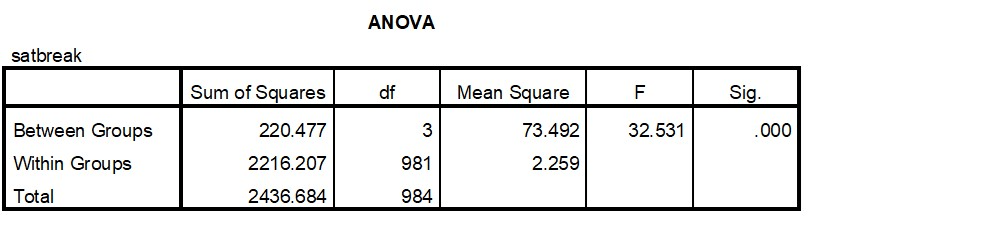
F = 32.531
p = .000
Yes, the hypothesis is accepted because P = .000 < .05
Also, see definition of ANOVA (and a reminder that ANOVA is represented by the letter F) on page 195 in your book.
500
•This output tests the Hypothesis that: Improvements in student’s opinions of the safety on campus will cause improvements in their overall satisfaction at WSU.
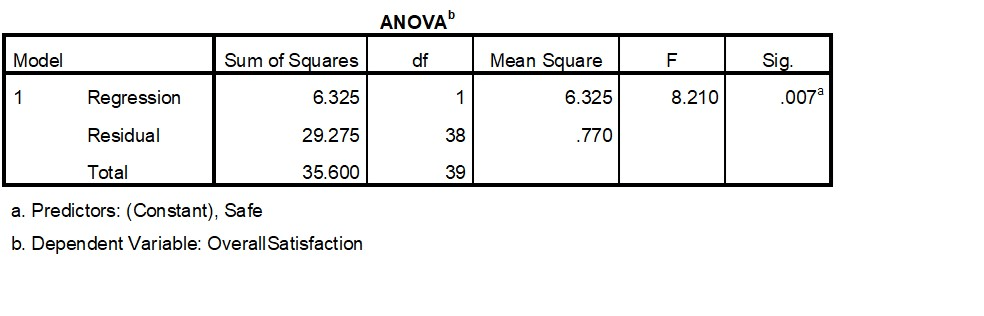
•Given this output, do we accept or reject the hypothesis? Why?
F = 8.210
p = .007
Accept the hypothesis because p = .007 < .05
500
•Which sampling strategy is characterized by the researcher intentionally selecting participants with as much diversity as possible in order to collect a wide variety of data until the participants begin to offer redundant information?
Maximum variation sampling p. 287
500
•Describe three problems a focus group moderator may have to overcome while he/she conducts a focus group meeting.
There are many right answers, see p. 317-318
500
In writing up qualitative results, Participants' quotes should:
A. be paraphrased, not quoted.
B. be used sparingly.
C. illuminate and support the researcher's analysis and interpretation.
D. not be used to substantiate researcher claims.
E. be used only when they can reveal personal information about the participant.
C. illuminate and support the researcher's analysis and interpretation.
p. 355-356