Born This Way
Live Your Life
Hurts So Good
Ice Ice Baby
Drop It Like It's Hot
100
Loss of this enzyme activity in humans (and other primates) is probably the single greatest reason why we have a higher risk of gout
Uricase
100
This form of alcohol confers the greatest risk of development of hyperuricemia/gout.
Beer
100
This is what should be done next in a 55 year old man who presents with a 1 day history of right knee swelling, warmth, and pain.
Aspiration - send fluid for cell count, crystals, and culture/gram stain.
100
These are the first line therapies for acute gout flares.
NSAIDs, colchicine, steroids (can be PO, intra-articular, IM etc)
100
You should avoid using probenecid in these cases.
(Looking for 2 situations)
Nephrolithiasis
CKD Stage III or worse
200
2020 ACR Gout Guidelines recommend this genetic testing before starting allopurinol in these select groups.
(Give me the genetic test as well as the groups)
HLA-B5801
Certain East Asians (Han Chinese, Korean, Vietnamese/Thai) and African Americans
What percentage of these groups have a positive HLA-B5801?
200
This high purine food does not increase risk of hyperuricemia/gout.
High-purine vegetables (ie spinach, asparagus, mushrooms).
Other high purine foods that DO increase risk of hyperuricemia/gout: red meats, seafoods (esp shellfish, sardines, anchovies), organ meats
May (limited evidence) decrease uric acid: low fat dairy, coffee, vitamin C, tart cherry
200
These are the THREE imaging modalities that can be used for diagnosis in gout.
X-ray
Musculoskeletal Ultrasound
Dual Energy CT
200
This is the preferred treatment for a patient with CKD stage IV, type II diabetes (A1c 8.0%), chronic systolic heart failure who presents with an acute gout flare in the right knee.
Home meds: insulin, carvedilol, furosemide, losartan
Intra-articular steroid injection
200
Use of this medication can help prolong viability of pegloticase in patients with severe gout refractory to xanthine oxidase inhibitors and uricosurics.
Methotrexate (will also accept Mycophenolate)
When would you start these?
300
This transporter facilitates reabsorption of uric acid from the proximal tubule. Gain of function mutations can lead to hyperuricemia while loss of function can cause renal wasting of uric acid.
URAT1 - "urate transporter 1" (encoded by SLC22A12)
300
The metabolism of these two dietary molecules requires the use of ATP, which is later broken down into uric acid
Fructose
Ethanol (Alcohol)
300
This finding on physical exam can support a diagnosis of gout in a non-crystal proven patient who presents during the intercritical period.
Tophi
(Pictures)
300
This is an essential adjuvant to start with urate lowering therapy until goal uric acid levels are reached.
Gout flare ppx (can be low dose NSAIDs, colchicine, or prednisone)
300
This pretesting is recommended before starting pegloticase therapy and this testing should be done prior to each infusion.
(Looking for both answers)
Check G-6-PD levels (G6PD deficiency is a contraindication to pegloticase).
Uric Acid. If above 6 mg/dL on two consecutive checks, suggests decreased efficacy and antibody formation, discontinue. Stop other ULT.
400
These two X-linked genes are associated with uric acid overproduction.
(Give me both)
HGPRT and PRPP Synthase
(Bonus: can earn another 300 if you tell me the mechanisms by which each enzyme causes hyperuricemia)
400
Of these medications, which ones lead to increased or decreased uric acid levels?
Thiazides
Losartan
Tacrolimus
Aspirin
Empagliflozin
Thiazides - increase
Losartan - decrease
Tacrolimus - increase
Aspirin - depends on dose (low dose: increase; high dose: decrease)
Empagliflozin - decrease
400
This is the direction of the polarizer light in this patient's synovial fluid found to have monosodium urate crystals.
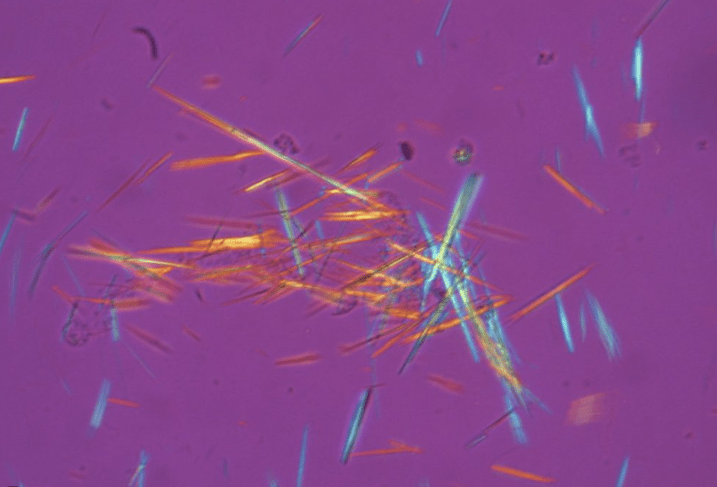
Left -> Right (or Right -> Left)
400
Anakinra is a second-line therapy for gout flares when first-line therapies fail or are contraindicated. It works by blocking IL-1β, a cytokine released upon activation of this intracellular complex by monosodium urate crystals
NLRP3 Inflammasome
400
This immunosuppressant has significant drug-drug interactions with xanthine oxidase inhibitors. Their concomitant use should be avoided.
Azathioprine/6-Mercaptopurine
500
This transporter mediates secretion of uric acid renally and gastrointestinally. Loss of function mutations are thought to be contribute to about 10% of hyperuricemia cases in white populations
ABCG2
500
In a patient with gout, this is the reduction in serum uric acid expected with lifestyle modifications alone
<1 mg/dL
500
A 25 year old woman with no past medical history presents with acute onset 1st MTP pain, redness, and swelling. Her uric acid is 5.3 mg/dL.
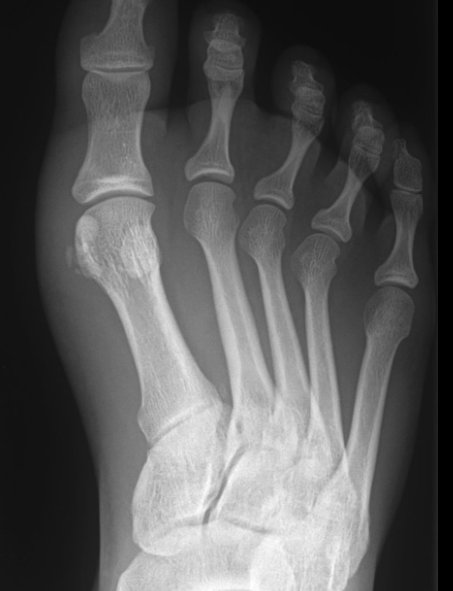
This type of crystal is most likely to be identified with polarized microscopy
Hydroxyapatite/Basic Calcium Phosphate (will also accept none since this needs to be stained with Alizarin Red).
This is acute calcific periarthritis. Pay attention to risk factors!
500
This immunosuppressant can not only lead to hyperuricemia, but it also is both a p-glycoprotein and P450 cytochrome inhibitor, making concomitant colchicine use risky
Cyclosporine
(will also accept tacrolimus)
500
The CARES trial demonstrated non-inferiority for febuxostat for the primary endpoint of MACE.
Cardiovascular Death
All-cause mortality