Basics
Let's classify things
Give me data!
Into the chamber
"Special Cases"
100
What does CROM stand for? What types of OM exist?
CROM = chronic refractory osteomyelitis
Time
Acute OM: days-weeks, rapid onset
Chronic OM: months-years
Mechanism/site
Hematogenous: Long bone is the most common site in children, metaphysis of tibia/femur. Vertebral - most common hematogenous site in adults.
Non-hematogenous (contiguous/diabetic foot): direct inoculation or spread from soft tissue
100
Define "chronic" and "refractory" in regards to CROM
Chronic: >4-6 weeks of clinical duration
Refractory: fails to respond to surgical debridement + 4-6 weeks of appropriate antibiotics
HOWEVER: Can consider refractory before the 4-6 week period if the infection has not responded promptly or the sternum, vertebrae, base of skull or otehr "sites critical to function" are involved
100
What is the cure rate overall? What is the recurrence rate?
With surgery/antibiotics: 35-100% range. 70-80% cure rate.
Recurrence: 20-30%
100
What's your plan? (ATA, min/tx, #tx/week, overall timing)
2.0-3.0 ATA: animal models suggest that a minimum of 2.0 ATA is required to achieve a target O2 tension of >150 mmHg. "Most successful treatment responses were associated with studies using 2.4-2.5 ATA"
90-120 minutes: varies by center
Typically once-daily: 5-7 days per week. Some advocate for BID during first 2-3 post-op days
Ideally: as soon as possible after surgery + with concurrent antibiotics
100
What are "special areas of concern" for OM?
Sternum: after median sternotomy, uncommon (0.4-8.4%) but often fatal (mortality rates of 20-35%)
Vertebral: 25% treated nonsurgically experience medical failure. Morbidity 29%, mortality 12%
Cranial: 2-9% of patients after craniotomy. Direct surgical morbidity 13%, mortality 7% -- secondary mortality from complications as high as 20-40%
Malignant otitis externa: sub-category of skull base infections, "often lethal" mortality 10-20%
Children or proximity to CNS/vital organs: reasonable to try HBOT + abx without surgery, if surgery is high risk
200
What are the symptoms? What testing do you want?
Acute OM: localized pain, edema, erythema, fever, fatigue. Sometimes leukocytosis, but not always.
Chronic OM: subtle with chronic pain, low grade fever/chills. Draining sinus/fistulous tracks. non-healing ulcers/fractures. Inflammatory markers can be normal in subclinical cases.
Labs: CBC, ESR, CRP, BCx, Bone culture (aerobic/anaerobic, gram stain). Targeted testing (fungal, brucella, TB).
Imaging: XR often 1st step, but 50-75% of bone matrix must be destroyed before lytic changes appear). Most accurate: MRI, tagged WBC scans. "Probe to bone" test for DFU
200
Per Cierny-Mader's classification of OM, order these as Stage I-IV OM: Localized, Superficial, Diffuse, Medullary
Bonus: treatment for each
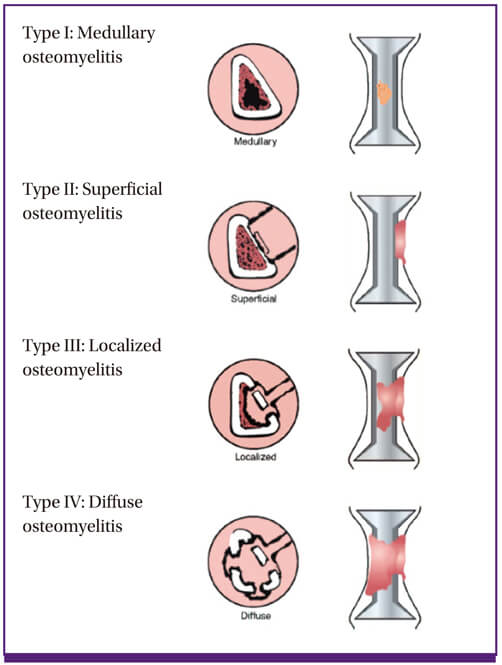
Reference: https://epomedicine.com/medical-students/definitions-criteria-classifications-osteomyelitis/
Stage 1: confined to bone intramedullary surfaces. Typically hematogenous seeding, infected hardware. Treat: antibiotics
Stage 2: Surface infection of periosteum and cortical bone. Often spread from overlying soft tissue wounds. Treat: antibiotics +/- debridement
Stage 3: localized full thickness involvement of cortical bone +/- sequestration. Penetrating trauma, surgical contamination, infected hardware. Treat: Abx, surgical debridement, HBO2
Stage 4: Through and through bone involvement +/- sequestration, mechanical instability. Treat: Abx, surgical debridement, HBO2
BUT can consider HBOT at any stage if refractory
200
Animal studies findings? What are some challenges from a research perspective?
9 prospective animal studies on HBOT & OM
Hamblin: 70% primary healing in HBO2 group vs 26% in controls
Triplet: improved fracture stability in 75% HBO2 treated animals vs 12.5% controls
BUT... No Abx or surgical debridement
HBO2 + ABx: reduced colony counts by a factor of 10^2 to 10^4 after 2 weeks vs 10^3-10^6 after 4 weeks
Conclusion: "Management triad" of culture-directed Abx, surgical debridement, and concurrent HBO2 is most likely to achieve clinical cure. Neither Abx or HBO2 alone reliable impede bacterial growth but synergy produces significant reductions
200
Total number of treatments? How do you decide?
On average: 20-50 total treatments. Studies ranged from 14-100.
If started with debridement, abx, and HBOT is met with "prompt clinical improvement," HBOT "should be continued until debrided bone becomes adequately revascularized"
Regenerative period is typically 4-6 weeks. 20-40 HBOT in that interval. May be extended to 6-8 weeks of culture-directed antibiotics and HBOT, but unlikely to benefit beyond
Utilization review: "generally indicated after 30-40 HBO2." If stalls, reassess whether surg/abx need to be revisited.
200
What area of the spine does OM usually occur in?
Lumbar.
HBO2 + Abx = can help avoid removal of hardware
300
What are the most common pathogens? Bonus: identify specific conditions at risk
All types/overall: MSSA > Pseudomonas > MRSA
Children: <4 years Kingella kingae; otherwise S aureus, Strep pneumo
Vertebral (adults): S aureus, polymicrobial 5-10%
DFU: Polymicrobial (S aureus, strep, enterococci, gram -, anaerobes)
Sickle cell disease: salmonella
Calcaneal (nail through shoe): Pseudomonas
Immunocompromised: aspergillus, M tuberculosis, candida
300
There are 3 "host physiologic classes" utilized for the CM staging paradigm
A Host = normal physiology
B Host = Compromise: systemic (Bs) or local (Bl) or both (Bls)
C Host = OM treatment/outcome is worse for host than ongoing disease
For "B" hosts: how many types of systemic or local compromise can you name? Hint: 9 systemic, 8 local
Systemic: malnutrition, renal failure, DM, chronic hypoxia, malignancy, immune deficiency, immunosuppression, extremes of age, tobacco use
Local: chronic lymphedema, venous stasis, major vessel compromise, arteritis, extensive scarring, radiation fibrosis, small vessel disease, complete loss of local sensation
300
Human studies. What are some challenges regarding defining & researching HBO2 for OM?
What % do you think improved when HBO2 was added to standard of care?
Kawashima: large non-randomized series of 689 OM patients.
256 no HBO2: 88.3% good, 2.7% fair and 9% poor
433 with HBO2: 91.2% good, 2.3% fair, 5.8% poor
Roje et al: combat-related experience (aka high risk wounds - so more prevention), 2008 retrospective analysis. OM developed in 74% of pt without HBO2 vs. 63% if they received HBO2 (p = 0.030)
Yu et al: 2011 retrospective analysis case-matched controls for sternal OM after sternotomy. HBO2 decreased length of ICU stay, less mechanical ventilation time, and reduced mortality. No signif change in total # debridements or total hospital stay
Esterhai et al: non-randomized prospective analysis of 28 patients, "no benefit from HBO2." 4 patients with tibial infections failed to clear infection (3 in HBO2 group, 1 in non-HBO2 group). Small. OM arrest rate of >90% in nontreated control group may indicate not really refractory
Barili et al: prospective trial of 32 patients, post-op sternal infections. All CM Class 4. HBO2 group: less infection relapse rate, shorter IV Abx duration and shorter total hospital stay.
Onen et al: Prospective. 19 iatrogenic spinal infections. Avg 20 HBO2 (range 10-40). All resolved. No surgical revisions or removal of hardware in the 12 patients who had this done.
Coulson et al: Prospective. 8 patients w/ DFU/OM. IV vanc + 40 HBO2 showed healing in 75% previously refractory cases
Savvidou et al (2018): systemic review. 460 patients across 45 studies. All received abx + surgical debridement. HBO2 effective in 80% of cohort studies and 95% of case studies. 73.5% of patients with complete data (419 pt) had "successful outcome and no reported relapse"
300
Does HBO2 for CROM save $$? How much do you think standard treatment for CROM costs?
Strauss (US, 2017): average of $204,000 on hospitalization/treatment prior to HBO2 in US. HBO2 +$35,500. One time 17% increase.
HBO2 can be costly... but appears to be associated with a reduction in total need for surgical procedures, required abx, duration of ICU/inpatient management
300
If I do HBO2 +Abx for my long bone OM, can I avoid surgery? For mandibular OM?
Typically no
Long bone OM (& miscellaneous sites):
HBO2 + Abx (no surgery) = resolution in 60-70% of cases.
Without concurrent surgery, HBO2 does NOT confer a selective advantage over the 70-80% cure rates using standard of care.
HBO2 + Abx + Surg = 80-90% cure rate
Mandibular OM:
HBO2 not recommended as monotherapy.
HBO2 + Abx + Surg = maximal healing
Reasonable to try HBO2 + abx prior to major surgery, particularly in children/adolescents given risk of disfigurement/impaired bone growth
400
Why does craniotomy lead to risk of OM? How helpful is HBO2? How about for sternal OM?
You MAY be able to avoid surgery with HBO2 for these types of OM
Cranial OM:
Bone flap devascularized & devitalized.
HBO2 + Abx +/- limited debridement = "very effective" 70-100% cure rates
Sternal OM:
HBO2 reduces need for sternal debridement & extensive surgical interventions
500
What are 5 mechanisms through which HBOT can treat osteomyelitis?
1. Leukocytes: require oxygen tension levels of 30-40 mmHg to destroy bacteria by oxidative killing mechanisms
2. Transport of antibiotics across bacterial cell walls: oxygen dependent process, diminished when O2 tensions are 20-30 mmHg. Particularly for cephalosporins (100x greater reduction in bacterial counts than either abx or HBOT alone)
3. Anaerobic bacteria suppression: direct effect, 15% of CROM estimated to be 2/2 anaerobic bacteria
4. Osteogenesis enhancement: osteoclast remodeling is O2-dependent. Low O2 inhibit osteoclastic debridement.
5. Ischemia mitigation: HBOT reduces tissue edema, promotes new collagen formation, capillary angiogenesis
500
What are the Tisch stages of malignant otitis externa (MOE, or MEO)?
Bonus: what CN are affected?
Stage I: superficial cortical disease
Stage II: local invasion without CN involvement
Stage III: local invasion with zygomatic bone or CN involvement
Stage IV: diffuse involvement of cranium with meningitis or sepsis
Overall MOE (or referred to as MEO in indications) responds well to primary management with Abx + minimal debridement (stage I/II HBO2 effective in refractory cases, especially more extensive disease (Stage III, IV)
Most commonly affects the facial nerve (CN VII), but can also involve the lower cranial nerves (CN IX, X, and XI) and others as the infection spreads