The Inner Ear - Basic Anatomy
The Inner Ear - Going Deeper
Auditory Nerve
Category of Chaos
100
The "floor" of the Organ of Corti that spans the entire cochlea length.
The Basilar Membrane
100
Define tonotopicity and at least 3 structures in the inner ear that are tonotopic.
The arrangment of the BASILAR MEMBRANE, HAIR CELLS, AND AUDITORY NERVES in a way that allows different frequencies of sound to stimulate different hair cells.
100
What do we call nerves that send information from the brain down to the inner ear?
EFFERENT Nerves
100
During hyperpolorization, what cilia does the hair bundle lean towards?
The SHORTEST one.
200
What are the three "Scala" chambers in the cochlea?
Top: Scala vestibuli
Middle: Scala media
Bottom: Scala tympani
200
Approximately where on this imagine of a (uncoiled) cochlea would you map a 30 Hz tone?
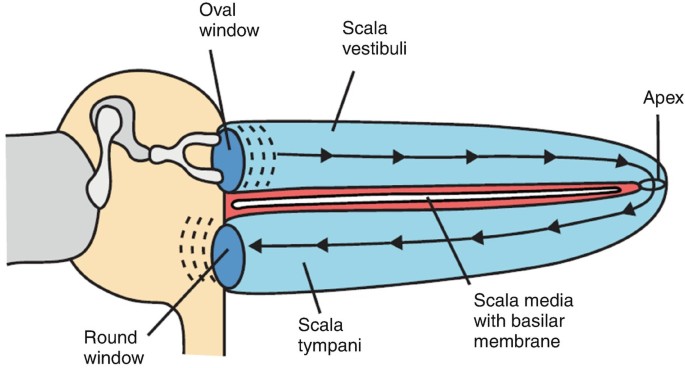
Almost at the VERRRYYYY apex. Remember, the range of human hearing is 20 Hz to 20,000 Hz, so 30 Hz is VERY low.
200
During what stage of polarity are neurotransmitters are pushed out into synaptic cleft of inner hair cells, causing excitation of auditory nerve fibers
Depolorization, Rest, or Hyperpolorization?
Depolorization
200
Define "Threshold" and "Characteristic Frequency"?
Threshold (dB) = quietest detectable sound that gets a AN fiber to spark (and lowest point on the tuning curve)
CF (HZ) = the specific frequency that the given AN fiber responds to BEST
300
What do we call the little structures sitting right on top of the hair cells (we have about 50 on top of each inner hair cell and about 150 on top of each outer hair cell).
What is the name of the structure that connects them to each other?
Stereocillia + Tip Links
300
Am I describing INNER or OUTER hair cells?
- one row
- convert sound into electrical/neural signals teardrop shaped
- adjacent to modiolus (medial)
- ~4000 total/ear
- cillia in "U" shape on top
INNER Hair Cells
300
What is the name of the canal in the temporal bone, where auditory nerves travel on their way to the brainstem?
Internal Auditory Meatus
300
Describe the differences here on the tuning curves for low vs. high frequencies 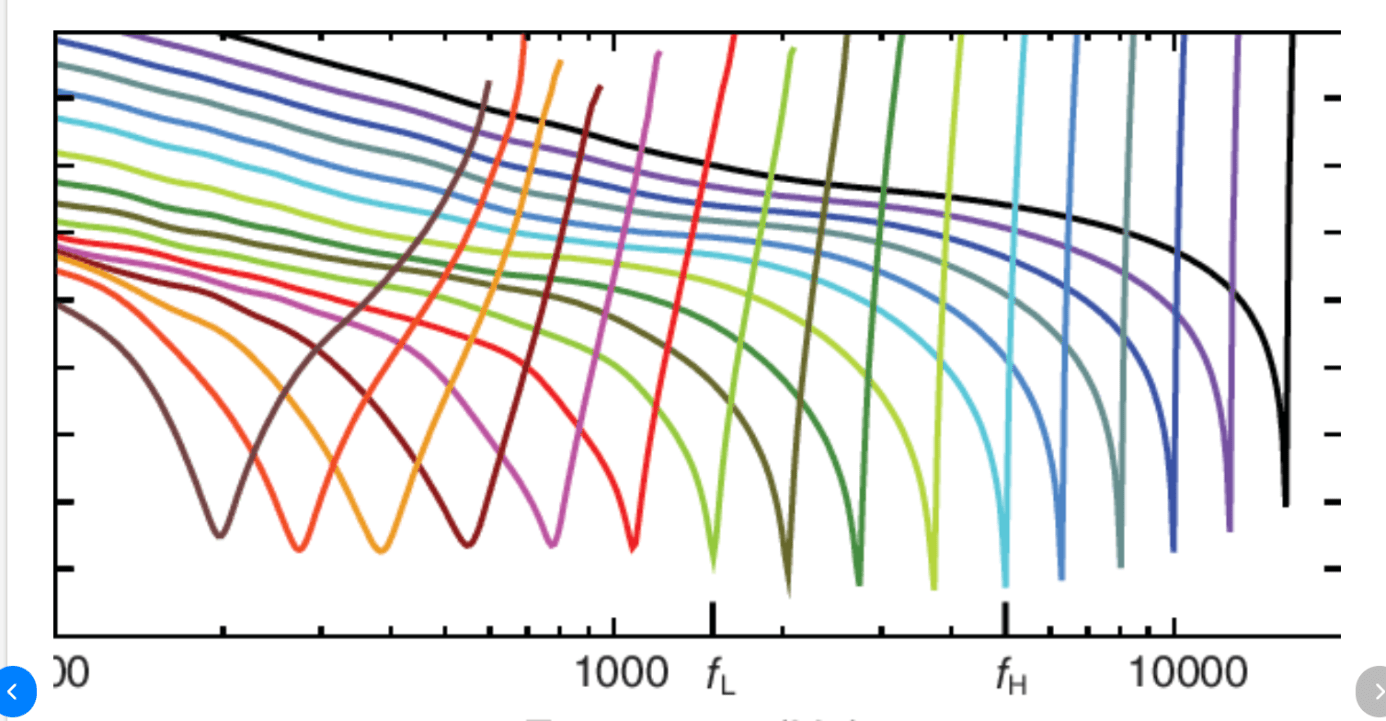
Low Frequencies (left side):
Broader tuning (less sharp).
Gradual slopes on both sides.
Less precise frequency selectivity.
High Frequencies (right side):
Sharper, narrower tuning.
Steep high-frequency slopes.
More precise frequency selectivity.
400
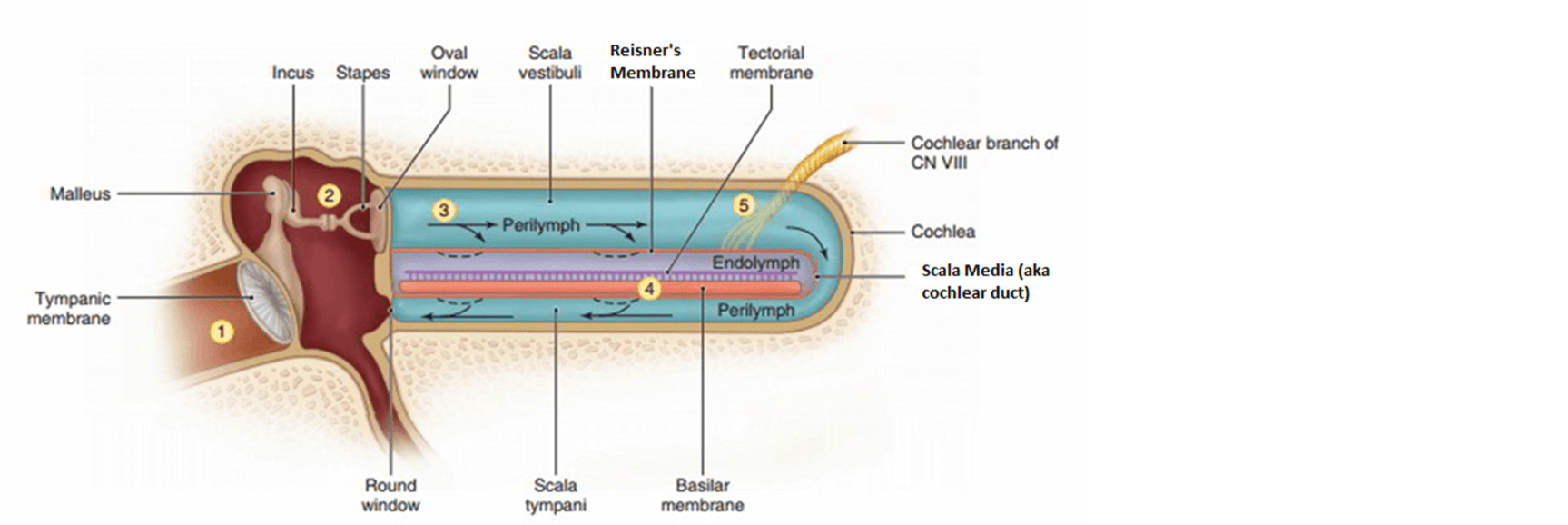
What chamber does the stapes footplate and oval window directly sit in?
Scala Vestibuli
400
Where can you find endolymph and what critical chemical element is it rich in? Why is it important?
In the scala media (and in the vestibular system)--potassium is critical for the activation of the hair cells when it enters the cell body and excited the auditory nerve.
400
Are Type I or Type II thicker in diameter? Why so?
Type I are wider in diameter because they are myelinated.
Myelin is a fatty, white sheath that serves to insulate electrical current from the axon, protect against leakage between neurons, and speeds up transmission time.
400
Frequency selectivity ability of the auditory system to distinguish between different sound frequencies.
Why is sharp frequency selectivity important? (Just think logically!)
Allows us to separate complex sounds, like speech or music.
Helps us understand speech in noise by distinguishing overlapping frequencies.
Enables pitch perception and fine sound discrimination.
500
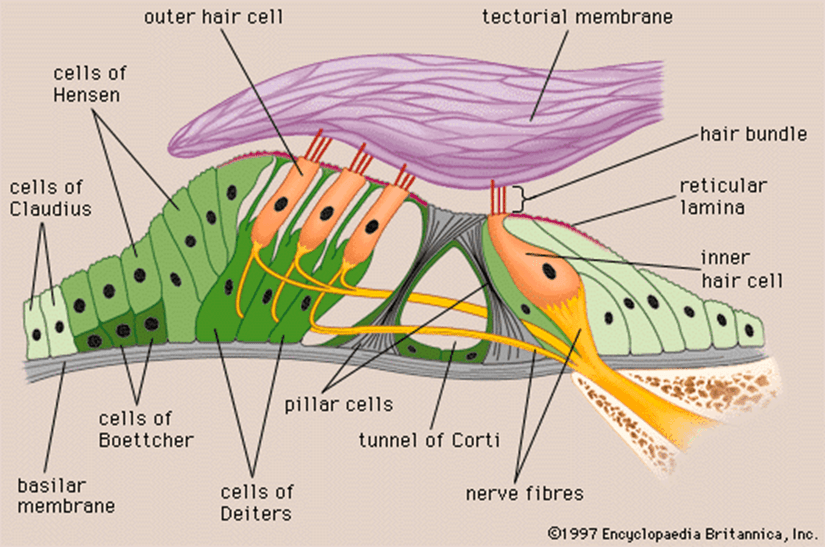
Superior surface of the Organ of Corti that the inner and outer hair cells penetrate
The Reticular Lamina
500
When stereocilia are bent, K+ enters the channel and depolarizes the cell (becomes less negative), resulting in the release of neurotransmitters and the excitation of the afferent nerve fiber at the base of the hair cell.
What is this process called?
Mechanotransduction
500
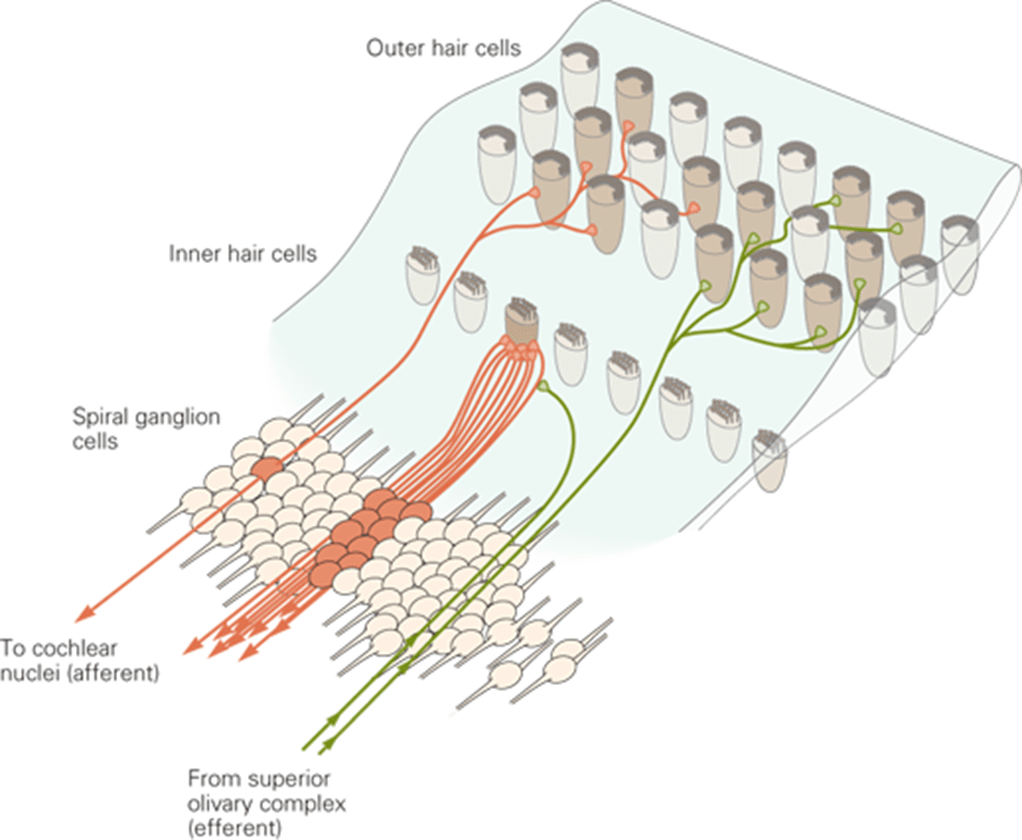
Type II auditory nerve fibers ONLY innervate outer hair cells. True or False?
FALSE
MOST afferent nerves innervate IHCs and MOST efferent nerves innervate OHCs, but there is some mixing!
500
Draw a tuning curve for 5000 Hz and 18,000 Hz. Both have a threshold of 10 dB SPL.
600
The bony "shelving" or support system throughout the cochlea.
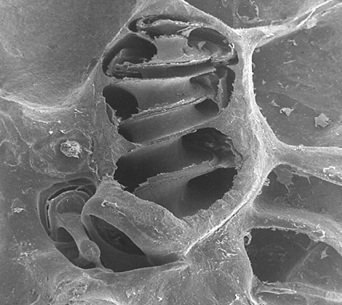
Osseous Spiral Lamina
600
Prestin is a motor protein in the lateral wall of the Outer Hair Cells. Tell me what it does.
Prestin causes electromotility--the elognation and contraction of the OHCs that helps boost the waves of the basilar membrane. We need it to hear LOW LEVEL sounds.
600
Define "Just Noticable Difference"
The smallest frequency difference a person can detect
600
Regarding FREQUENCY (high vs low) AND INTENSITY (loud vs soft), what combo would result in the POOREST/BROADEST frequency selectivity?
LOW FREQUENCY
LOUD INTENSITY