Arguments
Acts
Important Events/More Acts
Declaration of Independence
100
Which of the following is an account of the Boston Massacre from a pro-British point of view? Hint: Which account is blaming the colonists?
A. “He met ten or twelve soldiers and asked them if they intended to murder people. They answered, ‘Yes.’”
B. “The soldiers were pushing at the people. The Captain said, ‘Fire again and let them take the consequence.’”
C. “I asked one soldier if he would fire, and he said yes and pushed his bayonet at me.”
D. “I went down and saw the soldiers planted by the customhouse. The people were calling them lobsters and daring them to fire.”
D. “I went down and saw the soldiers planted by the customhouse. The people were calling them lobsters and daring them to fire.”
100
What was one of the purposes of the Tea Act?
A. To sell colonists surplus tea owned by the East India Company
B. To punish colonists in Massachusetts for the Boston Tea Party
C. To tax colonists on all printed materials
D. To use writs of assistance to punish smugglers
A. To sell colonists surplus tea owned by the East India Company
100
Which of the following is true about Lexington and Concord? They were…
A. The deadliest battles in the history of the United States
B. The first military battles of the Revolutionary War
C. Important British victories during the Revolutionary War
D. Events that led to the Boston Massacre
B. The first military battles of the Revolutionary War
100
Which of the following is NOT one of the unalienable rights listed in the Declaration of Independence?
A. Safety
B. Liberty
C. Life
D. Pursuit of Happiness
A. Safety
200
Which of the following is a Neutralist argument?
A. Colonists are British subjects and should obey British laws.
B. We have certain rights (like property and freedom) that the government shouldn’t take away.
C. Both parties are too extreme and radical.
D. No taxation without representation.
C. Both parties are too extreme and radical.
200
Which of the following laws gave custom officials the authority to use writs of assistance (blank search warrants)?
A.The Tea Act
B. The Intolerable Acts
C. The Stamp Act
D. The Townshend Acts
D. The Townshend Acts
200
Describe the Stamp Act and how colonists reacted to it.
The Stamp Act was a British law which required colonists to buy an official embossed stamp and put it on documents like legal papers and newspapers. The tax was hated by colonists who viewed it as taxation without representation. The colonists held a Stamp Act Congress where they decided to disobey the act and boycott Great Britain. Parliament responded by repealing the Stamp Act.
200
Who wrote the Declaration of Independence?
Thomas Jefferson
300
What are three Loyalist Arguments?
1. Those in Great Britain are our brothers and sisters.
2.Great Britain has the strongest Army in the world. We are not strong enough to beat them in a war.
3. The British fought for us in the French and Indian War. We should pay them back for the war debut in taxes.
4. The Patriots are hypocrites.
5. The king is not a tyrant. He has a difficult job to do.
6. Total separation from Britain would cause horrible problems for the colonies.
300
Which of the following laws required colonists to provide British soldiers with housing and food?
A. The Tea Act
B. The Boston Port Act
C. The Quartering Act
D. The Quebec Act
The Quartering Act
300
Describe the following Act that is considered part of the "Intolerable Act"
The Administration of Justice Act
The Administration of Justice Act allowed British officials charged with serious crimes to be tried in another colony or in Great Britain. Patriots disliked this act because they thought it would allow British officials to get away with murder.
300
Who was meant to read the Declaration?
King George III
400
Translate this Thomas Paine quote into your own words:
“A king hath little more to do than to make war and give away places…Of more worth is one honest man to society and in the sight of God than all the crowned ruffians that ever lived.”
Kings are worthless except for making war and giving away land. Honest men are more valuable to society than kings.
400
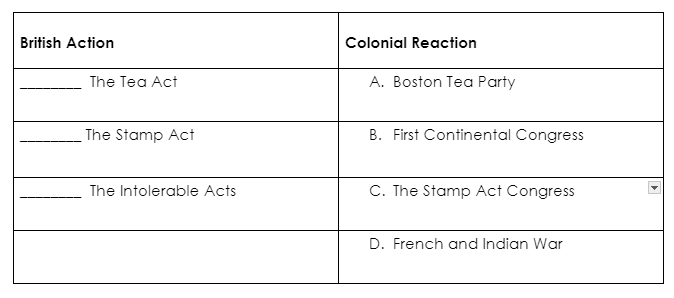
Tea Act -> Boston Tea Party
The Stamp Act -> The Stamp Act Congress
The Intolerable Acts -> First Continental Congress
400
Describe the following Act that is considered part of the "Intolerable Act"
The Quartering Act
The Quartering Act required colonists to provide British soldiers with housing and food. Patriots thought quartering soldiers should not be their responsibility and refused to comply.
400
Why was the Declaration of Independence written?
It announced that the thirteen colonies were free and independent states and no longer under British rule.
500
What is “taxation without representation?”
Taxation without representation was Great Britain’s practice of taxing the colonies even though they did not have any representatives in Parliament.
500
Describe the following Acts that are considered part of the "Intolerable Act"
The Boston Port Act
The Massachusetts Government Act
The Boston Port Act closed down Boston Harbor until the Bostonians paid for the destroyed tea. Patriots disliked this act because it punished all of Boston for the actions of the Sons of Liberty.
The Massachusetts Government Act dissolved the colony’s charter and replaced the elected local leaders with a British governor. This angered Patriots who felt that their rights as British citizens were taken away. They responded by setting up their own government outside of Boston.
500
Describe the following Act that is considered part of the "Intolerable Act"
The Quebec Act
The Quebec Act expanded the territory of Quebec, gave Catholics freedom of religion, and reorganized Quebec’s government. Patriots viewed the reorganization of the government as yet another example of the king abusing his power over the colonies.
500
Describe the parts of the Declaration of Independence.
The Declaration of Independence has five main parts.
It begins with an introduction which explains the purpose for the declaration.
Then, there is a declaration of rights which says that Great Britain has not protected the colonists’ natural rights of life, liberty, and the pursuit of happiness.
The third section is the list of grievances, a long list of everything the king and Parliament have done wrong.
The fourth section is a statement of attempts to redress grievances. This section explains that the colonists gave the king many chances to make things right and he ignored them.
Finally, the document ends with the declaration of independence which says that the colonies are free and independent states.