Definitions
Tectonic plates
Rock Types
WEATHERING & EROSION
Random
100
What is the outermost layer of the earth called?
The crust
100
Where are earthquakes and volcanoes most likely to occur?
Tectonic plate boundaries
100
Which rock forms from magma or lava?
Igneous
100
Give one example of weathering.
Ice wedging, root growth, temperature changes, animal burrowing, acid rain etc
100
How many layers of the earth are there?
5
200
What is weathering?
Breaking down rock into smaller pieces.
200
What causes tectonic plates to move?
Convection currents
200
Which rock forms due to intense of heat and pressure?
Metamorphic
200
Name two agents of erosion.
Wind, water, waves, glaciers.
200
Which layer of the earth is responsible for the movement of tectonic plates?
The Mantle
300
What is erosion?
Movement of weathered material.
300
Which type of plate boundary is most likely to produce earthquakes?
Transform boundary.
300
What type of Igneous rocks contain large crystals and where do they form?
Intrusive rocks form large crystals. They cool slowly underground giving crystals time to grow.
300
Identify which part of the following example is weathering and/or erosion.
Water enters cracks in rock, freezes, expands, and splits the rock apart. Rain washes the broken fragments downhill into a river.
Both
Weathering= Water enters cracks in rock, freezes, expands, and splits the rock apart
Erosion=Rain washes the broken fragments downhill into a river
300
What is the difference between Magma and Lava?
Magma is molten rock beneath the Earth's surface, while lava is molten rock that has erupted onto the surface.
400
What is the lithosphere?
The rigid outer layer of Earth made of the crust and upper mantle.
400
What are convection currents?
Circular movement caused by hot mantle rising and cool mantle sinking.
400
Which type of rock is most likely to contain fossils? Why?
Sedimentary rocks from the accumulation of sediment, such as dead plants and animals, which can preserve the remains of organisms. Metamorphic and igneous rocks typically do not preserve fossils due to the high heat and pressure involved in their formation
400
What are the 3 types of weathering?
Physical, Chemical and biological
400
You pick up a rock that appears to have layers or bands called foliation. It is hard and dense, and some of its minerals appear shiny or sparkly.
What type of rock is it most likely to be?
Metamorphic rock
500
What is deposition?
The dropping or settling of sediments.
500
Describe what happens at a convergent boundary (and what land formations could occur)
Plates move towards each other forming mountains, volcanoes or trenches.
500
Why must metamorphic rocks not melt during formation?
If they melt they become magma and can no longer become metamorphic rock.
500
How can removing vegetation increase erosion?
Roots no longer hold soil together, so wind and water carry it away more easily.
500
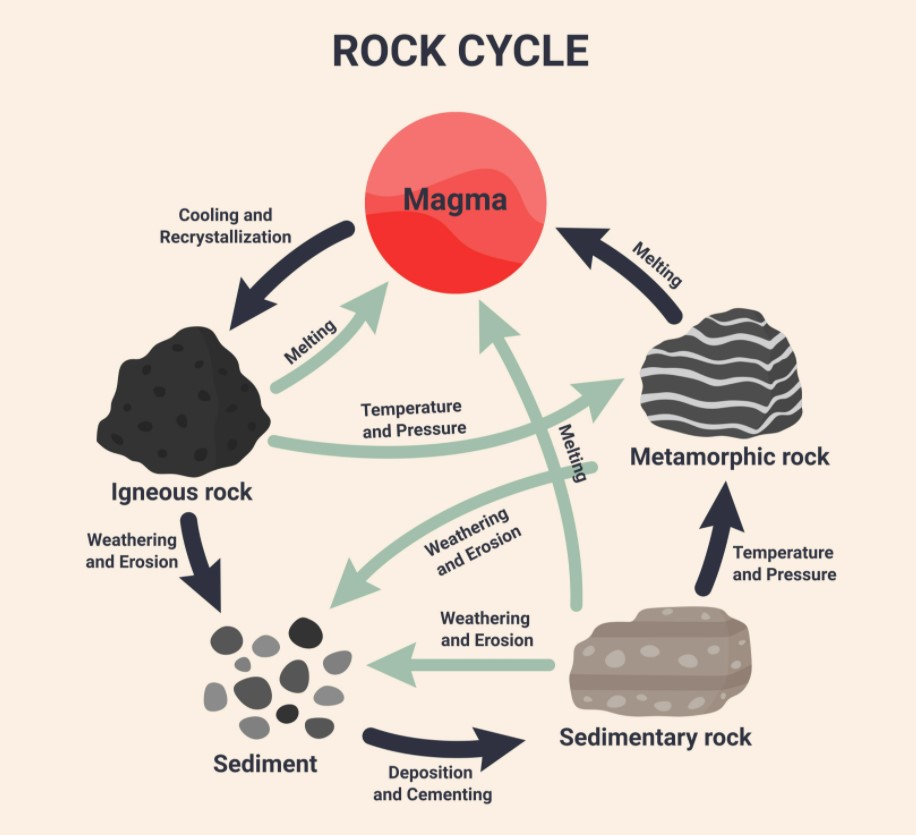
Explain the rock cycle in as much detail as possible.