Terms
Levels of Ecology
Limiting Factors
Biotic VS Abiotic
RANDOM
100
The science that studies the interactions between organisms and their environment.
What is Ecology?
100
This level of ecology studies how changes in one area of the globe affect other regions of the world.
What is global ecology?
100
Two examples of abiotic factors.
1) Soil Type
2) Temperature
3) Climate
4)Water
5)Wind
100
Rainfall affects dispersal of a population by changing a bend in a river between the population.
Abiotic
100
The definition of biodiversity.
What are all the different kinds of life in a given area?
200
This consists of all the organisms in a particular region, along with nonliving components.
What is an ecosystem?
200
The goal of this level of ecology is to understand factors affecting population growth, density, and size. It also involves studies of species interactions such as predation and mutualism.
What is population ecology?
200
Definition of a biotic factor
What is a living factor affecting species abundance and dispersal (disease, predation, prey, etc.)?
200
An ascaris nematode feeds on nutrients in the intestines of a pig.
Biotic (Predation)
200
The process of making new products from materials that were used in another product.
What is recycling?
300
A major grouping of plant and animal communities defined by a dominant vegetation type
What is a biome?
300
What are the two subdivisions of organismal ecology?
*Physiological ecology-how organisms are physiologically adapted to their environment
*Behavioral ecology-how the behavior of an individual organism contributes to survival and reproductive success.
300
Definition of limiting factor.
What is anything that constrains a population's size and slows or stops it from growing?
300
A tiger affects the dispersal of gazelle by consuming newborn young.
Biotic (Predation)
300
The loss of living space due to human activity or catastrophic events.
What is habitat loss?
400
Definition of an abiotic factor.
What is a non-living factor affecting species abundance and dispersal (Temperature, Sunlight, Wind, Soil Type, etc)?
400
The goal of this level of ecology is to study how nutrients and energy moves between organisms and the surrounding atmosphere, soil, or water.
What is ecosystem ecology?
400
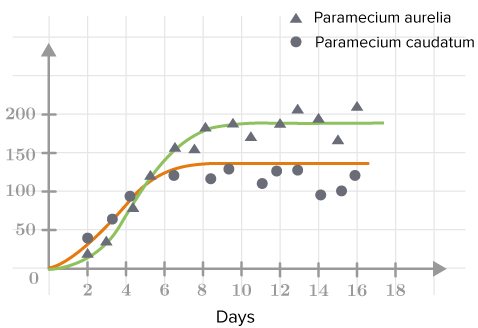 The type of growth curve the populations are showing.
What is logistic?
400
An ox-bird eats the parasites of the skin of a cow.
Biotic (Mutualism)
400
Release of harmful materials into the environment.
What is pollution?
500
The difference between climate and weather
What is...
Climate: The prevailing long-term weather conditions found in an area.
Weather: Specific short-term atmospheric conditions of temperature, precipitation, sunlight, and wind.
?
500
Levels of ecological organization from smallest to largest
What are: organism, population, community, ecosystem, biome, and biosphere?
500
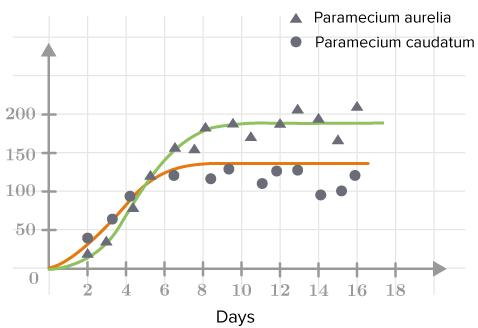
The carrying capacity of Paramecium caudatum.
What is ~140?
500
Worms are unable to living in a certain environment because of the soil type.
Abiotic
500
Plants and animals that have migrated to places where they are not native and that are causing problems for native species.
What is an invasive species?