Patient Care
Safety & Scope
Acquisition
Rhythm Basics
Rhythm Challenge
100
Before placing electrodes, which TWO patient identifiers should be checked?
Full Name, DOB
100
What type of precautions should be used for every patient?
Standard Precautions
100
A regular rhythm has 20 small boxes between consecutive R waves at 25mm/sec. Calculate the rate.
(1500 method)
1500 divided by 20= 75 beats/min
100
An irregular strip has 11 QRS complexes in 6 seconds. Estimate the ventricular rate and name the method.
Approx. 110 beats/min by the 6 second method
100
Conducted PR intervals stay constant, but occasional P waves are not followed by QRS complexes. Identify the block
Second degree AV block type II- Mobitz
200
A patient asks why an EKG is being done. What is the technician's appropriate response?
Explain the procedure within the scope and refer diagnostic or treatment questions to the provider.
200
When should hand hygiene be performed during patient care?
Before and After patient contact
200
A tracing at 25mm/sec has a PR interval of 7 small boxes. What is the interval and how is it classified?
7 x 0.04=0.28 sec: prolonged PR interval
200
A rhythm has no consistent P waves and R-R intervals are irregularly irregular. Identify the pattern
Atrial Fibrillation

200
P waves and QRS complexes march independently, with a slow ventricular rate. Identify the rhythm and urgency.
Third degree /complete AV block: promptly report/ escalate especially with symptoms.
300
A patient refuses an EKG, What should the technician do?
Do not force the procedure; notify the appropriate clinician and document per policy.
300
A tracing appears to show ventricular fibrillation, but the patient is alert and talking. What is your immediate priority?
Assess the patient, check for artifact issues promptly: alert appropriate staff. Do not treat the monitor alone as proof of V.Fib.
300
What does Dextrocardia mean?
condition from birth in which the apex of the heart is swapped from right to left
300
Name 4 heart blocks
-1st degree
-2nd degree- mobitz type 1
-2nd degree- mobitz type 2
-3rd degree
300
Identify Rhythm:
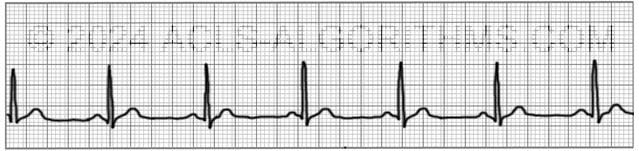
Normal Sinus Rhythm
400
What does EKG stand for?
Electrocardiogram
400
A patient who speaks very little English nods when the EKG technician explains the procedure but appears confused. The patient's teenage child offers to translate. What is the most appropriate next step?
Obtain a qualified medical interpreter, follow facility policy, and verify that the patient understands the procedure.
400
A tracing has uniform 60-HZ fuzz across the baseline. Give two likely checks/corrections.
Check electrode contact, skin prep, cable placement, and any nearby electrical interferences. Correct as identified.
400
Identify the rhythm

3rd Degree Heart Block
400
Identify Rhythm:
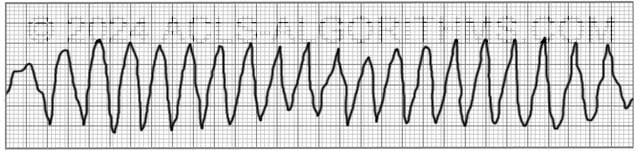
V-Tach
500
What is the normal heart rate range for an infant?
120-160
500
After completing an EKG, a technician realizes the electrodes were incorrectly positioned and the tracing has already been transmitted to the provider. What should the technician do?
Immediately notify the appropriate healthcare professional, accurately document the error according to facility policy, and repeat the EKG with correct electrode placement as directed. Never conceal the mistake.
500
You observe an inverted lead 1 and an unusually positive AVR after acquisition. What technical error should you consider as an EKG tech?
Possible right arm/ left arm electrode reversal, verify placement and repeat if indicated.
500
Identify the Rhythm:

Torsades de pointes
500
A narrow Pacing spike occurs before each wide QRS. What pacing is suggested? What does the technician do if the patient is dizzy?
Ventricular pacing: promptly assess/ report symptoms and tracing to licensed clinician, follow emergency protocol