Parts of an Atom
Elements
Valence Electrons
Periodic Table
Misc.
100
True or False. Protons have a negative charge
False
100
Determine the amount of protons in Neon (Ne)
10
100
As you move left to right on the periodic table, what do you notice about the number of valence electrons?
They increase by 1
100
Which two elements are in the same period?
A. Sn and Rb
B. F and Cl
C. K and Ba
D. Se and Te
A. Sn and Rb
100
Atoms of elements in the same group share what?
A. number of energy levels
B. Number of valence electrons
C. atomic numbers
D. atomic masses
B. Valence Electrons
200
True or False? Neutrons have a negative charge.
False
200
Which element has 16 neutrons, 15 protons, and 15 electrons?
Phosphorus (P)
200
How many valence electrons does Oxygen have?
6
200
What is represented in each block of the periodic table?
One Element.
200
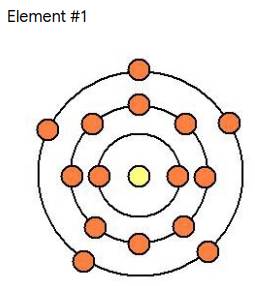
True or False? This element is in group 15 on the periodic table.
True
300
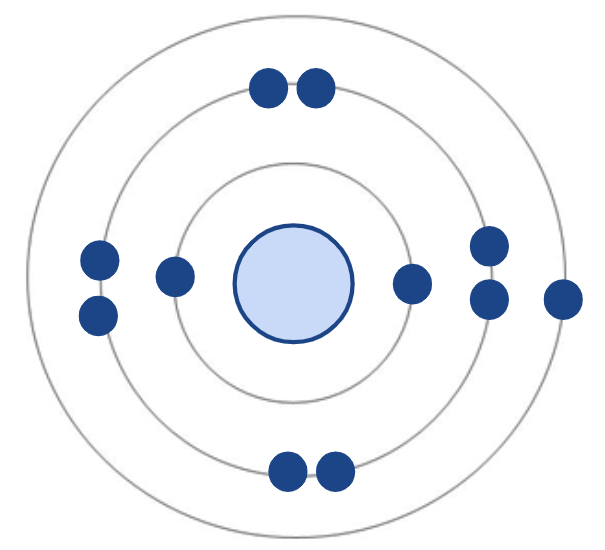
How many electrons are in the element shown?
11
300
The atomic number gives you the amount of which two subatomic particles?
Protons and Electrons.
300
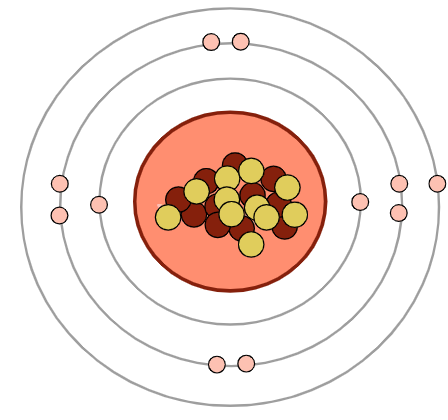
How many valence electrons does this element have?
1
300
Determine the number of protons in Potassium (K)
19
300
How many neutrons are in Sodium (Na)?
12
400
What element does this Bohr model represent? (Hint: protons and electrons match)
Sodium
400
How can you find the atomic mass number of an element?
Add the neutrons and protons.
400
There are ____ valence electrons in the elements of group 16.
6
400
Determine the amount of neutrons in Flourine (F)
10
400
What percentage of the periodic table is metals?
75%
500
What particles are found inside the nucleus?
Protons and Neutrons
500
Which element fits the description: shiny and good conductor.... Zirconium (Zr 40), Carbon (C 6), Arsenic (As 33), Hydrogen (H 1)
Zirconium and other metals.
500
What group of elements have 7 valence electrons?
Halogens (Group 17)
500
Based on their position on the periodic table, which element has chemical properties that are most similar to Argon (Ar #18).... Chlorine (Cl), Helium (He), Nitrogen (N), or Zinc (Zn)?
Helium (He)
500
Double Jeopardy.
Halogens (group 17) are known to be very reactive. Why? (Hint: It has to do with valence electrons)
Halogens have 7 valence electrons and tend to gain one more to achieve stable electron configuration.