Types of Energy
Energy Transformations
Potential and Kinetic Energy
Heat Transfer
Specific Heat
100
What does MR CHENS stand for?
Mechanical, Radiant, Chemical, Heat (Thermal), Electrical, Nuclear, Sound
100
You chew on your on gum and accidently swallow and start digesting it? What energy transformation occured?
Mechanical to Chemical
100
What is potential energy? What is kinetic energy?
Potential energy: energy related to stored energy or position
Kinetic energy: energy related to movement
100
What is convection, conduction, and radiation?
Convention: circular motion of thermal energy in liquids and gases
Conduction: transfer of thermal energy through direct contact
Radiation: transfer of thermal energy through electromagnetic waves
100
What is a conductor? An insulator?
Conductor: transmits heat well
Insulator: does not transmit heat well
200
What is electrical energy?
A. energy from charged particles
B. energy from stored particles
C. energy from electromagnetic waves
A. energy from charged particles
200
A toy car drives down the sidewalk when its circuit is connected to a battery. Which sequence below correctly identifies the energy changes taking place in the helicopter?
A. heat to mechanical to sound
B. chemical to electrical to mechanical
C. chemical to electrical to potential
D. electrical to heat to mechanical
B. chemical to electrical to mechanical
200
The two balls in the diagram below have an equal mass of 1 kg and are released from rest at the heights indicated. How does the potential energy of ball A compare to ball B?
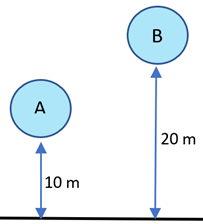
A. Ball A will have more potential energy than ball B because it has a shorter distance to fall.
B. Ball A will have less potential energy than ball B because it has a shorter distance to fall.
C. They will have the same potential energy because they have the same mass
B. Ball A will have less potential energy than ball B because it has a shorter distance to fall.
200
Which type of heat transfer can go through outer space (a vacuum)
Radiation
200
Will a large specific heat (a big number) or a small specific heat (a small number) retain more heat?
A large specific heat
300
What is thermal energy?
A. energy from movement and position
B. energy from the movement of particles. Faster they move, the more of this energy is created
C. energy stored in the nucleus of an atom
B. energy from the movement of particles. Faster they move, the more of this energy is created
300
Which of the following examples correctly explains the transformation from electrical to mechanical energy?
A. A lightbulb - Electricity is being used to create light and heat.
B. A fan - Electricity is being used to spin the blades of the fan.
C. A toaster oven - Electricity is being used to create radiation.
B. A fan - Electricity is being used to spin the blades of the fan.
300
What happens to the potential energy as the pendulum swings from point A to point E?
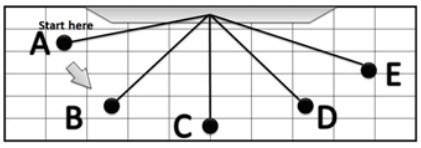
A. Potential energy increases
B. Potential energy decreases then increases
C. Potential energy increases then decreases
B. Potential energy decreases then increases
300
Which direction does thermal energy travel?
A. hot to cold
B. cold to hot
C. hot to hot
A. hot to cold
300
Will a large specific heat (a big number) or a small specific heat (a small number) lose heat faster
A small specific heat
400
What is the Law of Conservation of Energy?
A. energy cannot be created or destroyed, just transformed
B. energy can be created, but not destroyed
C. energy cannot be created, but can be destroyed
A. energy cannot be created or destroyed, just transformed
400
John and Erica went on an evening walk. Erica noticed that John's flashlight was much dimmer than her flashlight. Which statement about energy transformations best explains why a flashlight becomes dimmer over time?
A. The only energy transformation in a flashlight is chemical to electrical. The electric current was weaker in one flashlight because it was turned on longer.
B. Chemical energy in the batteries transforms into electrical energy. The electrical energy is then transformed into heat and light. Over time, the chemicals in the battery are used up, causing the light to dim slowly.
C. The battery in one flashlight had leaked acid. Therefore, the electricity was not able to completely power the bulb.
B. Chemical energy in the batteries transforms into electrical energy. The electrical energy is then transformed into heat and light. Over time, the chemicals in the battery are used up, causing the light to dim slowly.
400
Objects can have kinetic energy, potential energy, or both. Energy can be in the form of motion. Energy can also be stored by objects in various ways, including position, chemical bonds, or physical state (solid, liquid, gas). Which of the statements below is true about energy?
A. An object's mass has no effect on its potential energy.
B. Potential energy is converted to kinetic energy as a stationary object begins to move.
C. Kinetic energy is converted to potential energy as a stationary object begins to move.
B. Potential energy is converted to kinetic energy as a stationary object begins to move.
400
During an investigation, two students placed three ice cubes in a glass of room temperature water. Which of the following scenarios would best describe the results of the investigation?
A. Cold from the ice cubes will transfer to the water, causing the water to cool.
B. Energy will transfer equally between the ice cubes and the water causing no change in temperature.
C. Energy from the water will transfer to the ice cubes, causing the ice to melt.
C. Energy from the water will transfer to the ice cubes, causing the ice to melt.
400
According to the data table, if 200 J of energy were added to 1 g of each of these samples, which would experience the SMALLEST temperature increase and why?
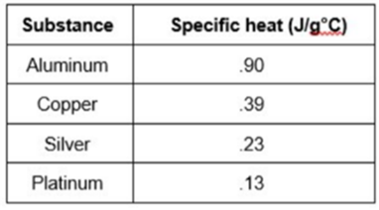
A. Platinum, because the lower the number, the more energy is needed to raise the temperature
B. Aluminum, because the higher the number, the more energy is needed to raise the temperature
C. Aluminum, because the higher the number, the less energy is needed to raise the temperature
B. Aluminum, because the higher the number, the more energy is needed to raise the temperature
500
What is mechanical energy?
A. total kinetic energy and thermal energy
B. total potential energy and kinetic energy
C. total potential and electrical energy
B. total potential energy and kinetic energy
500
The energy stored in a wood log is transformed when the log is burned. Which of the following explanations best describes how the chemical energy stored in the log compares to the heat and light energy produced by burning?
A. The amount of chemical energy is equal to the amount of heat and light
B. The amount of chemical energy is less to the amount of heat and light
C. The amount of chemical energy is more to the amount of heat and light
A. The amount of chemical energy is equal to the amount of heat and light
500
The Law of Conservation of Energy states: energy cannot be created nor destroyed but merely transferred. Using this law, which explanation best describes why bounce heights change with each bounce once a ball is released from a given height above the floor?
A. When the ball hits the floor, ALL of the energy is transferred to the floor. Since the ball loses its energy, it bounces lower and lower until it stops.
B. When the ball hits the floor, the ball gains energy. Thus, it is able to continuously bounce up off the floor.
C. When the ball hits the floor, energy is transferred into sound energy that you hear and thermal energy due to friction with the floor and the air. However, the ball keeps most of the energy, allowing it to continue to bounce for a while.
C. When the ball hits the floor, energy is transferred into sound energy that you hear and thermal energy due to friction with the floor and the air. However, the ball keeps most of the energy, allowing it to continue to bounce for a while.
500
A student needed to explain how the sun's heat traveled to Earth. Which statement below should she choose to describe the transfer of energy from the Sun to the Earth?
A. The Sun uses nuclear fusion to create heat. The thermal energy it creates radiates through the vacuum of space and heats the Earth.
B. Heat from the Sun requires matter to transmit the thermal energy to Earth. It is impossible for heat to flow from the Sun because an enormous vacuum exists between the Sun and Earth.
C. The Sun is an extremely large source of thermal energy. Because of its size, the Sun can conduct its heat through space, heating the Earth.
A. The Sun uses nuclear fusion to create heat. The thermal energy it creates radiates through the vacuum of space and heats the Earth.
500
Students conducted an experiment where they removed 10,000 J of heat from 50 g samples of three different materials and measured the temperature change in each material. Which conclusion about the specific heat of the materials is best supported by the data in the table below?
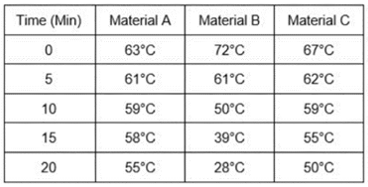
A. Material B has a lower specific heat value than materials A and C because it exhibited the greatest change in temperature.
B. Material B has a higher specific heat value than materials A and C because it exhibited the greatest change in temperature.
C. Material A has a lower specific heat value than materials B and C because it exhibited the greatest change in temperature.
A. Material B has a lower specific heat value than materials A and C because it exhibited the greatest change in temperature.