Evidence of Evolution
Natural Selection
Taxonomy & Cladograms
Adaptations
Misc.
100
Which are examples of homologous structures?
A. The wings of bats and butterflies
B. The fins of fish and whales
C. The hindlimbs of frogs and grasshoppers
D. The forelimbs of primates and penguins
What is choice D? (The forelimbs of primates and penguins)
100
Lichens are returning to the forests of the industrial areas of the United Kingdom due to strict pollution control.
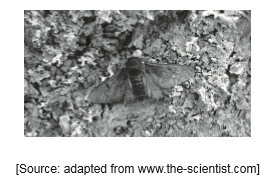
What is the expected outcome in the population of peppered moths (Biston betularia)?
A. Increased numbers of light-colored peppered moths
B. Increased industrial melanism in peppered moths
C. Increased predation of peppered moths
D. Increased speciation of peppered moths
What is choice A? (Increased numbers of light-colored peppered moths)
100
Which is the hierarchy of taxa in order of increasing numbers of species? (most inclusive to most exclusive)
Domain, Kingdom, Phylum, Class, Order, Family, Genus, Species
100
During winter, Arctic foxes grow thicker, white fur for warmth and camouflage. What type of adaptation is this?
What is a structural adaptation?
100
Which of the following scenarios best illustrates the bottleneck effect?
A. A small group of finches is blown off course during a storm and settles on a previously uninhabited island, starting a new colony.
B. A farmer chooses only the largest cows from his herd to breed, ensuring the next generation will also be large.
C. A massive wildfire sweeps through a forest, killing 95% of a squirrel population regardless of their individual traits.
D. Male peacocks with the brightest feathers are more likely to attract mates and pass on their genes to their offspring.
What is C?
200
What is the best evidence for evolution that we currently have?
What is DNA?
200
Natural selection can operate in different ways. What is the effect of disruptive selection?
What is it eliminates individuals with intermediate forms of a characteristic?
200
Which name would Panthera leo have in common with another organism of close relation?
What is the genus or Panthera?
Ex: Panthera tigris
200
A desert plant opens its stomata (pores) only at night to reduce water loss. What type of adaptation is this?
What is a physiological adaptation?
200
What event could cause geographic isolation?
What is a volcano, a mountain formation, a flood, etc.?
300
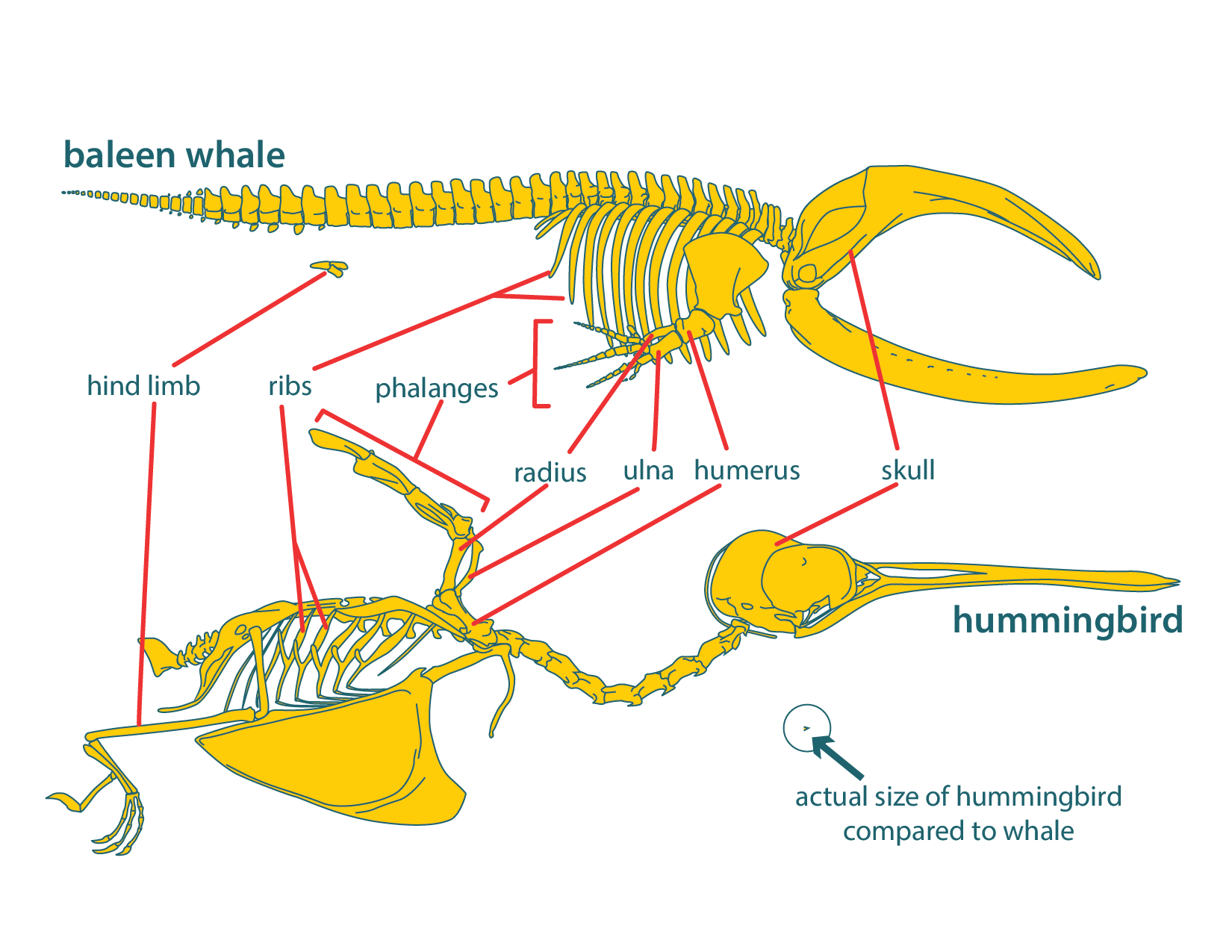 What kind of structures are these?
What are homologous structures?
300
The larval stage of the fly Eurosta solidaginis develops in the plant Solidago altissima. The larva secretes a chemical which causes plant tissue to grow around it forming a swelling called a gall. The gall provides the developing insect with protection from predators.
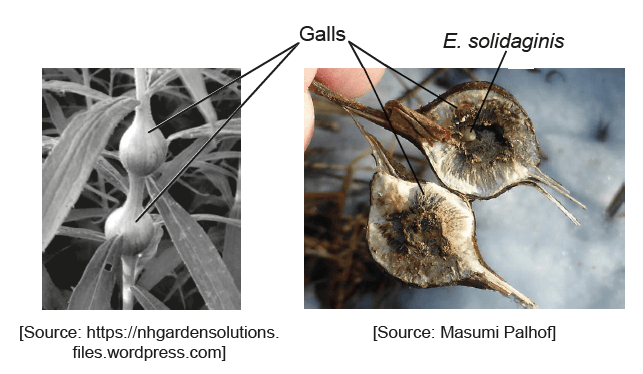
The E. solidaginis fly is preyed upon by the parasitic wasp Eurytoma gigantea.
What kind of selection is taking place in this scenario?
What is directional selection?
300
The cladogram includes four marsupial (non-placental mammal) families.
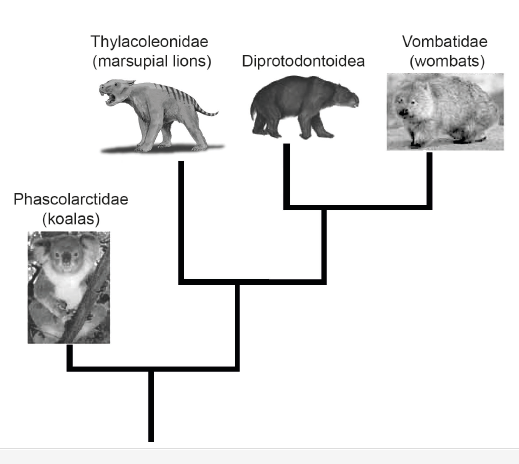
Deduce the family that is most closely related to the Diprotodontoidea.
Vombatidae (wombats)
300
Describe the difference between an innate and learned behavior. Provide ONE example of each in your explanation.
What is innate is something that is instinctive and is not taught? What is learned is something that is observed and then replicated afterwards?
Examples: A duck following its mother vs a bird replicating the call of its mother.
300
Suppose a species of grasshopper normally breeds in June and lays its eggs on the young shoots of an annual grass that comes up in June. A mutant female grasshopper in the population produces a batch of eggs that carry a new allele that delays sexual development until August. Her offspring feed on the young shoots of another grass, in the very same habitat, that comes up in August. Her offspring mate successfully with one another producing a new generation of August-mating grasshoppers. What kind of isolation is this?
What is temporal isolation?
400
The leg labeled 'C' is considered what kind of structure? What does this structure suggest about the relation of this species to the others?
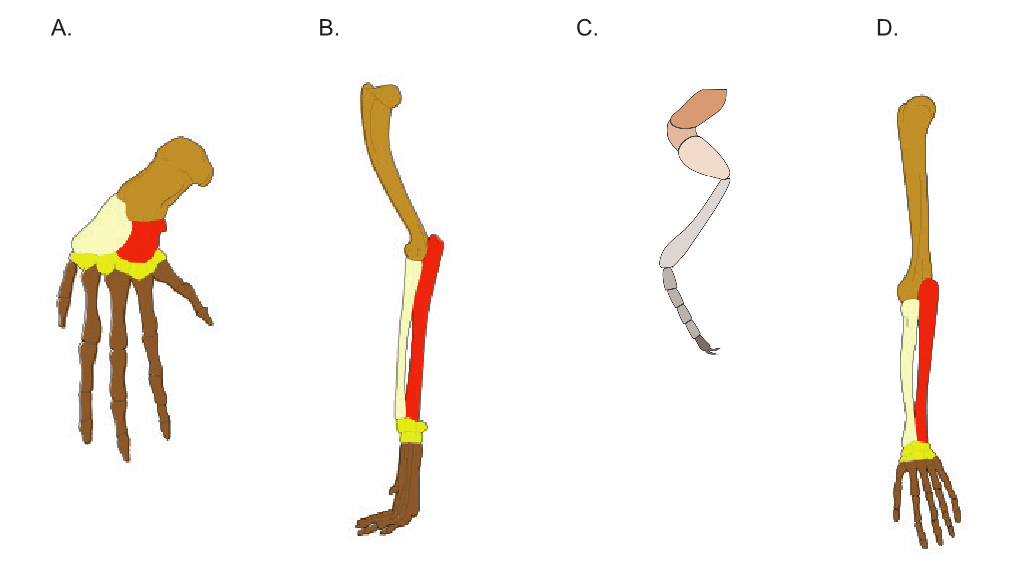
What is an analogous structure? What is a distant relation without a common ancestor?
400
The graph shows a population of beetles where intermediate size is favored, while small and large beetles are frequently preyed upon. What type of selection is illustrated?

What is stabilizing selection?
400
The cladogram was constructed using DNA base sequences from six species. Which node indicates the greatest difference in base sequences?
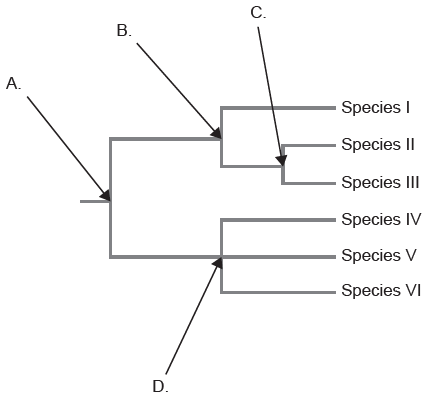
What is Label A?
400
A snake avoids a brightly colored toad after eating one and becoming ill. What kind of behavior is this and why?
What is a learned behavior?
Explanation: It took an experience for the snake to make a future decision on what it eats.
400
In the 1700s, a small group of Europeans settled in Pennsylvania. A specific, rare allele for Ellis-van Creveld syndrome was present in one of the settlers. This allele is now significantly more common in the Pennsylvania Amish community than in the original European population. What kind of genetic drift is this?
What is founder effect?
500
Describe, using one example, how homologous structures provide evidence for evolution.
a. similar structure but different function «in homologous structures»
b. pentadactyl limbs/limb with five digits/toes / other example
c. similar bone structure/example of similarity of bones «in pentadactyl limbs» but different uses/functions
d. two examples of use of pentadactyl limb by a vertebrate group
e. suggests a common ancestor «and evolutionary divergence»
f. process called adaptive radiation
500

Give a real life example of a Graph A selection.
What is...
(Directional selection--one extreme favored over another)
500
The image shows part of a cladogram.
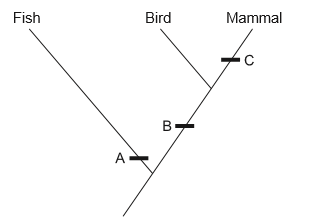
Using the cladogram, identify diagnostic features that characterizes the given groups of vertebrates at A, B and C.
A: gills or fins or scales or no limbs or external fertilization
B: homeothermic or warm blooded or endothermic or lungs or tetrapod or four limbs or pentadactyl limbs or internal fertilization
C: hair or fur or mammary glands or milk
500

Choose one organism from above, list one adaptation they have and explain how it increases that species fitness.
What is...?
500
What is the consequence of genetic drift (bottleneck/founder)?
What is reduced genetic diversity?