Lecture 2
Lecture 3
Lecture 4
Homework
Vocabulary
100
The nucleus of a carbon atom contains 6 neutrons and 6 protons. What is the atomic number and atomic mass of carbon? (include unit for mass)
Atomic number - 6
Mass number - 12 grams
100
Why does the partial negative charge in a molecule of water occur?
The electrons shared between the oxygen and hydrogen atoms spend more time around the oxygen atom nucleus than around the hydrogen atom nucleus.
100
 What type of isomer is this and how do you know?
Structural isomer. You know this because it has the same geometrical arrangement, the atoms are just rearranged.
100
Which of the following explains what is happening when sodium chloride (NaCl) dissolves in water?
Hydration shells are forming around the sodium and chloride ions.
100
In the term trace element, the adjective trace means what?
The element is required in very small amounts.
200
If two or more elements are in the same row of the periodic table, then what do they have in common?
The same number of electron shells.
200
One mol of fructose (molecular mass = 180 daltons) is what? (in grams and molecules)
180 grams or 6.02 x 10^23 molecules of fructose.
200
An atom has 5 electrons in its outer valence shell. How many unpaired electrons does it have? What about if it has 8 electrons in its outer valence shell?
For 5 electrons, there would be 3 unpaired. For 8 electrons, there would be 0 unpaired.
200
What are the four emergent properties of water that are important for life?
Cohesion, moderation of temperature, expansion upon freezing, and solvent properties
200
What is the difference between a compound and a molecule?
A compound is a substance consisting of two or more different elements in a fixed ratio while a molecule is two or more atoms held together by covalent bonds specifically.
300
What is the maximum number of covalent bonds an element with atomic number 13 can make with hydrogen? What element has the atomic number 13?
It can make 3 covalent bonds with hydrogen and it is aluminum.
300
How do the four emergent properties of water facilitate life on earth?
Cohesion and adhesion allow plants to hold and carry water across their bodies, even against gravity.
Water’s ability to absorb and release large amounts of thermal energy means that larger bodies of water can cool their surrounding areas and moderate the air temperature.
Since water expands when freezing, its density is decreased, allowing ice to float. With this lighter density, ice floats on liquid and assures that whole bodies of water don’t freeze solid, making water something that can still be obtained even with ice present.
Waters polarity to dissolve ionic and polar compounds provides it its versatility, which allows many reactions on earth to occur.
300
 What type of isomer is this, what category does it fall under, and how do you know?
This is a cis-trans isomer, a type of stereoisomer. You know because there is variation in the spatial arrangements around a carbon-carbon double bond.
300
In the laboratory, how would you make a 0.5 molar solution of ribose in a volume of 1 liter?
Weight out 75 grams of ribose and add it to a beaker, then gradually add water until the ribose was dissolved and the volume of the solution was 1 liter.
300
What is a calorie defined as? What about a kilocalorie?
A calorie is the amount of energy required to raise the temperature of 1 gram of water by 1 degree C. A kilocalorie is the amount of heat required to raise the temperature of 1 kg of water by 1°C.
400
What is the atomic phenomenon that explains why sulfur is more electronegative than phosphorous?
Sulfur has more protons in its nucleus while still having the same number of electron shells as phosphorous and thus the nucleus of sulfur has a stronger “pull” on the electrons shared in a covalent bond than the nucleus of phosphorous.
400
What happens when carbon dioxide comes in contact with our ocean?
It reacts with water to form carbonic acid.
400
What determines whether a carbon atom's covalent bonds to other atoms are in a tetrahedral configuration or a planar configuration?
The presence or absence of double bonds between the carbon atom and other atoms.
400
If the pH of the blood increases, in order to maintain blood pH stability, what would happen to the concentrations of H2CO3 and HCO3-?
There would be a decrease in the concentration of H2CO3 and an increase in the concentration of HCO3-
400
What is the difference between structural and stereoisomers?
Structural isomers have different covalent bonding arrangements of their atoms across two molecules while stereoisomers have the same order of atoms, but have a different spatial arrangement of their atoms or functional grups.
500
If life arose on a planet where the element carbon was absent, which element might fill the role of carbon? What about the same situation but with nitrogen?
For carbon, it would be silicon. For nitrogen, it would be phosphorous.
500
If you have a solution with a pH of 9, what are your [H+] and [OH-] values?
[H+] would be 10^-9 and [OH-] would be 10^-5
500
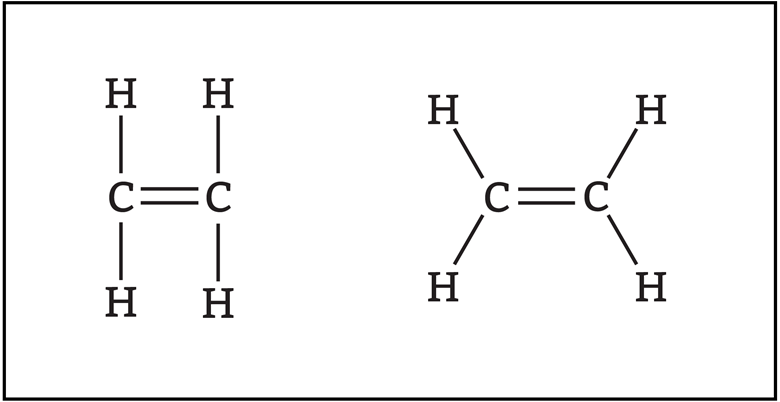
Are these alkanes or alkenes? How do you know
This is an alkene, which you know due to the presence of a double bond between the two carbon atoms.
500
Why are hydrocarbons insoluble in water?
The majority of their bonds are nonpolar covalent carbon-to-hydrogen linkages.
500
What is the purpose of a buffer?
It is meant to minimize changes in concentrations of H+ and OH– in a solution, which helps resist change in pH.