Exciting Equations!
Word Problems <3
Great Graphs
Lovely Logs
100
Solve for x:
10^x-3=997
What is x=3?
100
Given the equation, what is the percent of annual interest in the problem?
400(1+.035/2)^10
What is 3.5%?
100
Is this graph exponential or logarithmic?
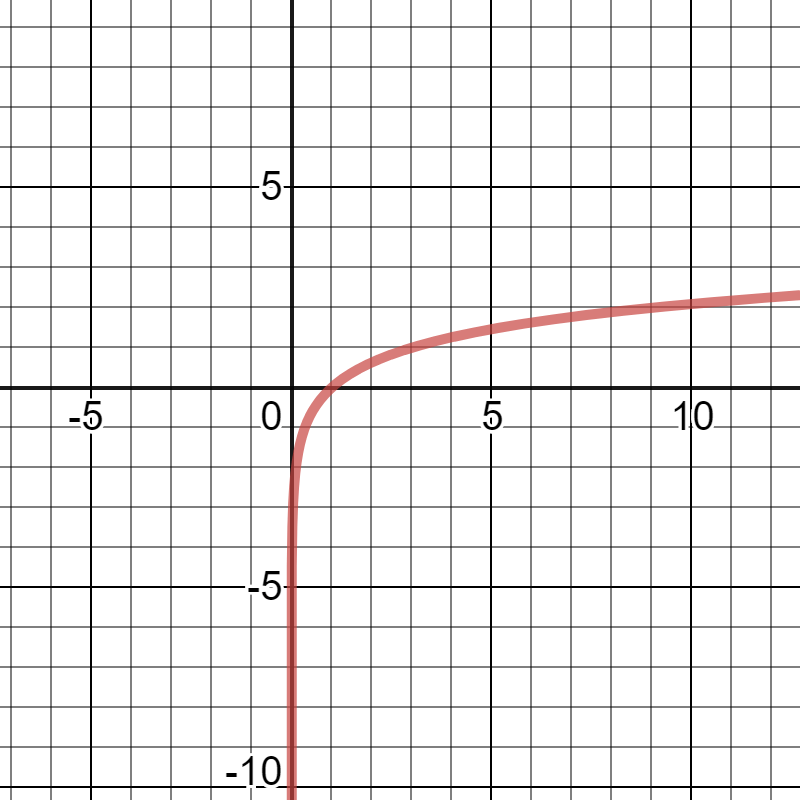
What is LOGARITHMIC?
100
Solve:
log_(2)4096=?
What is 12?
200
Solve for x:
e^(2x-3)=7
What is x=2.47?
200
By investing $650 that pays 1% interest compounded continuously, how much money would you have after 11 years?
What is $725.58?
200
What is the y-intercept and horizontal asymptote of this exponential graph?
f(x)=-3(2)^x-5
Y-intercept: (0.-8), HA: y=-5
200
Condense to a single log:
2ln(y)+3ln(2)
What is
ln(8y^2)?
300
Solve for x:
log_(3)(x-4)=2
What is x=13?
300
A population of foxes is growing at a rate of 3% each year. At first there were 100 foxes in the area, now there are 245. How many years have gone by?
Round to the nearest year.
What is 30 or 31 years?
300
What is the domain and range of the graph of
f(x)=-2log(x-3)+4
Domain:
(3,oo)
Range:
(-oo,oo)
300
Expand
log_2(6xy^2)
log_(2)6+log_(2)x+2log_(2)y
400
Solve for x:
log(3)-log(x)=log(x)
What is x=1.73 or
x=sqrt3
400
A population of a town is exponentially decreasing at a continuous rate. In 2005, there were 35,000 people and in 2020 there were 28,000 people. What is the rate of decline?
What is 1.4%?
400
What is the x-intercept and vertical asymptote of
f(x)=ln(2x)-3
What is x=10.04?
400
Combine the logs into a single log:
1/2(log24+log2-log12)
log2
500
Solve for x:
log_(2)(x)+log_(2)(x-2)=3
What is x=4?
500
Mario puts $500 in a savings account that pays 2.5% annual interest compounded monthly. How many years would he need to leave his money in the account to have at least $1500 in savings?
What is 44 years?
500
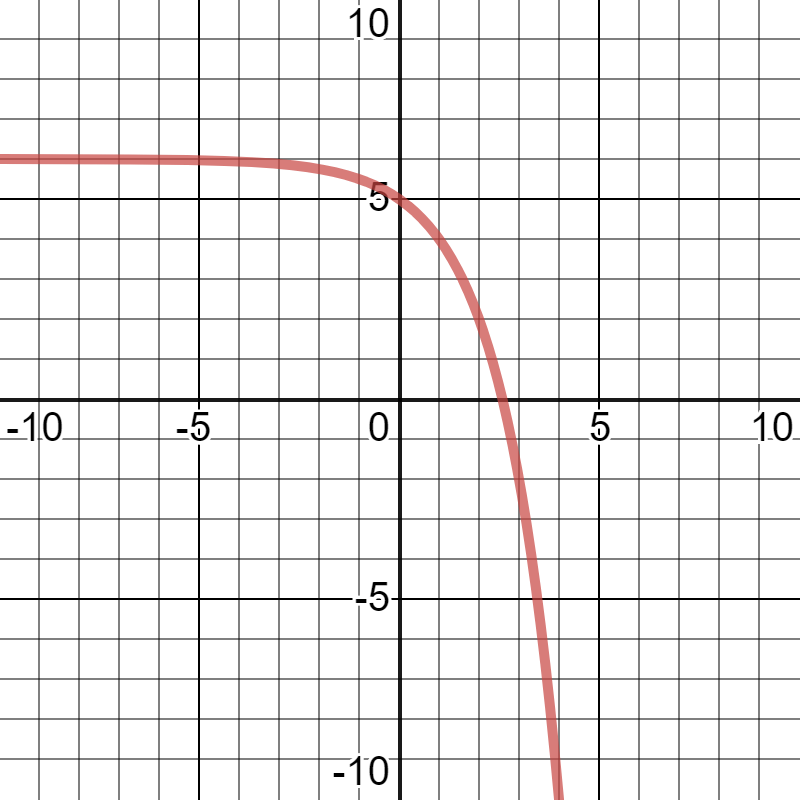
Sketch the graph of
-(1/2)^-x+6
500
Expand:
log_(8)((9x^3)/y^5)^2
2(log_(8)9+3log_(8)x-5log_(8)y)
or
2log_(8)9+6log_(8)x-10log_(8)y