Graphing Expo
Expo Growth & Decay
Converting between Expos and Logs
Graphing Logs
Curve of Best Fit
100
If the base is greater than one, the graph will be a ________.
Growth
100
What is the equation for exponential growth?
f(t) = a(1+r)^t
100
Convert to exponential form: logba = x
bx=a
100
What base is log(x)?
base 10
100
What value do I look at to determine which model fits the data the best?
r2
200
If the base is less than one, the graph will be a ___________.
Decay
200
What is the formula for exponential decay?
f(t) = a(1-r)^t
200
Convert to Logarithmic form: bx = a
logba = x
200
What log base is ln(x)?
loge(x)
200
What type of function is this?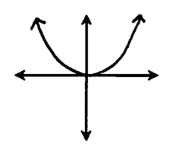
Quadratic
300
What is the parent function of the following function? What are the transformations?
f(x) = 1/2(3)^x+1
Parent: 3x
Transformations: Compression by 1/2, up by 1
300
Venessa invested $2,500 into an account that will increase in value by 3.5% each year. Write an exponential function to model this situation.
f(t) = 2500(1.035)t
300
Convert to Exponential form: log5x = 43
543 = x
300
What is the asymptote of f(x) = log5(x-2)+1 ?
asymptote: x = 2
300
What type of function is this?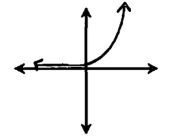
Exponential
400
What is the y-intercept of the following?
f(x) = 4(2/3)^x+1
(0, 5)
400
What is the formula for compound interest?
A = P(1+r/n)^(nt
400
Evaluate: log3243
= 5
400
What is the domain and range of f(x) = log1/2(x) + 3
Domain: x > 0
Range: All Real Numbers
400
What type of functions is this?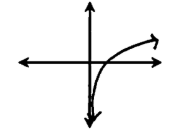
Logartithmic
500
What is the asymptote of the following? What is the range?
f(x) = -1/3(6)^x+5
y = 5
y < 5
500
Kaylee used her graduation money to set up a savings account that earns 3.4% interest compounded weekly. If the original amount deposited was $500, how much interest will she have earned after 10 years?
$202.40
500
Convert to logarithmic form: 2x=64
log264 = x
500
What transformations is happening to f(x) = log2(x + 8) - 4
Left 8, down 4
500
Which model suits the following data the best? Quadratic, Exponential, or Logarithmic?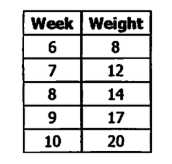
Logarithmic