Enzymes and Inhibitors
Photosynthesis
Cellular Respiration
Membrane Transport
Heredity
100
What type of Macromolecule is an enzyme
protein
100
Where do light reactions take place?
Thylakoid Membrane
100
Where does Glycolysis take place? How many Net ATP molecules are produced
Where: Cytosol of the cell
4 ATP total but it took 2 to do the process so NET gain of 2 ATP
100
If a solution has a high solute concentration and a low free water concentration, is the solution considered: Hypotonic, isotonic or Hypertonic?
Hypertonic
100
Identify 2 processes in meiosis that cause the daughter cells to be non-identical
Crossing over and independent assortment
200
What does Catabolic Reaction mean?
Reactions that break things down
200
Identify the path of electrons through the light reactions
Water --> Photosystem II --> ETC --> Photosystem I --> ETC #2 --> NADPH
200
What are the names of the electron carriers involved in Cellular Respiration
NADH and FADH2
200
1. what is an aquaporin
2. why are they needed?
1. Protein channel that let water into the cell
2. They are needed because water is a polar molecule and cannot easily move into the cell without the channel.
200
True or False: A dominant trait is always more common in the population than the recessive trait
False
Dominant refers to the ability to produce a protein that masks the recessive protein (or absence of a protein)
300
Where does the substrate bind to the enzyme
Active Site
300
When light energy boosts electrons from the chlorophyll known as P680 in photosystem II to the primary electron acceptor, P680 replaces its missing electrons from...
water
300
Why do cells go through fermentation when Oxygen in low?
Without Oxygen as the final electron acceptor, the electrons in the ETC get backed up and the electron carriers cannot drop off their electrons. This causes all processes in the mito to stop. Glycolysis continues to work but the broken glucose has to be broken down in they cytoplasm with fermentation which is not as efficient as the ETC
300
Name 1 type of protein that is involved in active transport
Pumps
Co-transport/Carrier proteins
300
Achondroplasia is a dominantly inherited trait. If the father is heterozygous for this condition and the mother does not have it, what is the probability of their first 2 children having the disease?
Father is heterozygous, mother is homozygous recessive. So the children will each have a 2/4 chance. So 1/2 *1/2 = 1/4 or 25% chance
400
Why can competitive inhibitors bind to the same spot as the ligand/substrate?
Have a similar shape or binding as the substrate which allows them to bind to the same spot
400
What part of the Chloroplast is the most acidic?
Thylakoid Lumen 
400
Name the 3 out of the 4 stages of cellular respiration (when oxygen is present)
Glycolysis --> Pyruvate oxidation --> Citric Acid Cycle aka Krebs Cycle --> Oxidative phosphorylation (ETC and chemiosmosis)
400
Explain the difference between simple and facilitated diffusion
Both involve materials flowing Down a concentration gradient (No energy used)
Simple diffusion flows through the membrane so it passed through the nonpolar region. Facilitated diffusion requires a transport protein to allow materials to move from 1 side to another. These materials are polar so they cannot move through though the nonpolar region
400
2 heterozygous parent plants are crossed. (yellow round seeds are dominant to green wrinkled) Researchers believe the traits are not linked, however they are unsure. They run an experiment and get 315 round yellow seeds, 108 round green seeds, 101 wrinkled yellow seeds, 32 wrinkled green seeds. Use chi-square analysis to test this hypothesis
1. Identify the null hypothesis
2. Calculate the chi-square value
3. Identify the degrees of freedom
4. Will you accept or reject the null?
1. If the genes are not linked, the expected values of 9:3:3:1 will match the observed values.
2. Chi-square = 0.5
3. degrees of freedom = 3
4. Accept because 0.5 is less than 7.81 so we accept the null
500
What 3 variables impact the rate in which an enzyme can function
pH, Temperature, and Substrate/ inhibitor concentration
500
1. When is CO2 used in photosynthesis?
2.Where does this process take place?
1. When? Calvin Cycle
2. Where? Stroma of the chloroplast
500
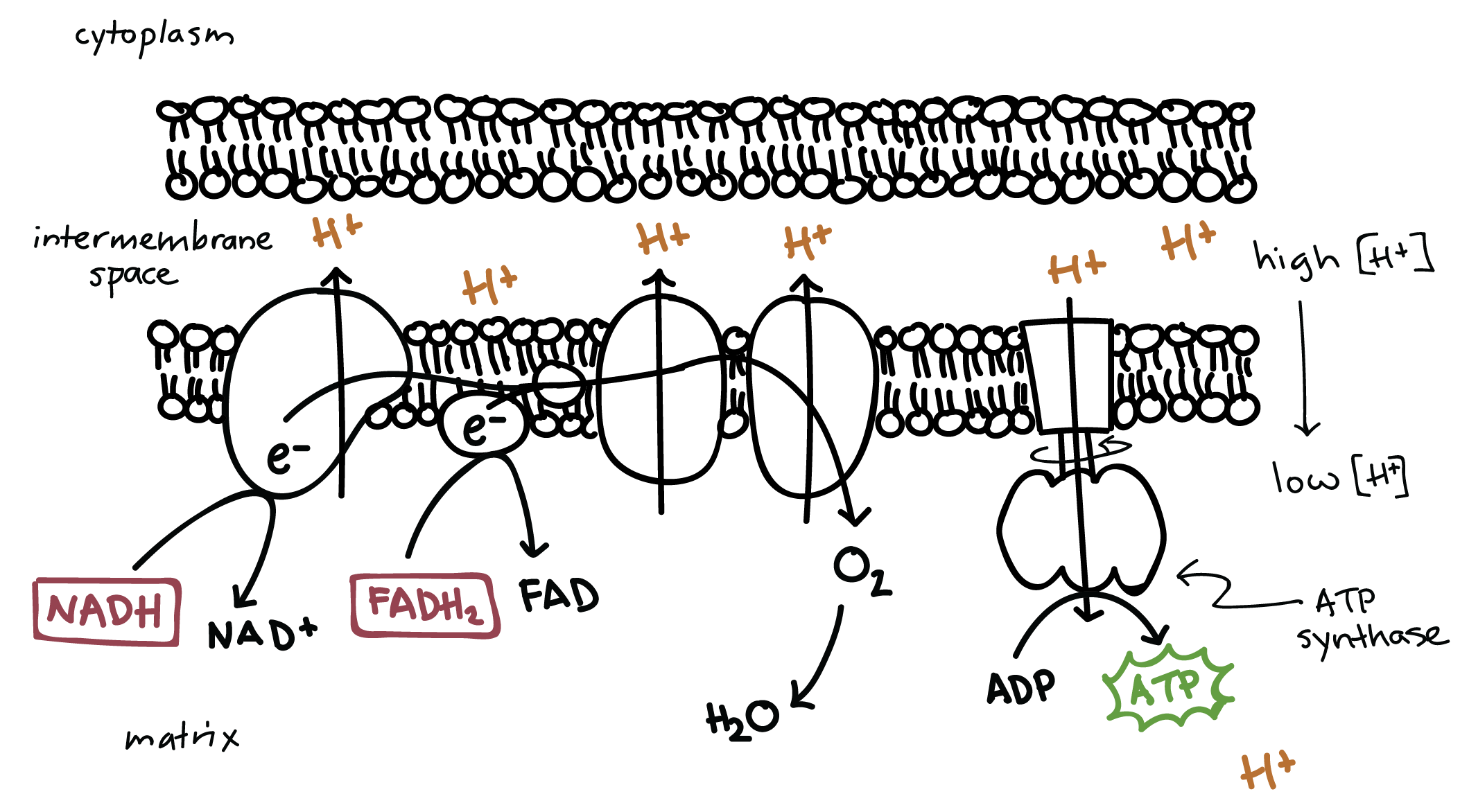
What is the role of the ETC and ATP synthase in creating ATP during cellular respiration
Electrons move through the ETC which provides energy for hydrogen ions to be pumped out of the Mito matrix. They then move through ATP synthase via simple diffusion. This movement then give off the energy needed for ATP synthase to turn ADP into ATP
500
If a cell with a concentration of 0.5M was put in a solution with 0.5M which way will the water move?
Water will move in and out of the cell equally.
* Note water will move from areas of high water concentration (aka low solute) to low water water concentration (aka high solute concentration to water it down)
500
View picture on slide show and identify the inheritance pattern. Be sure to have evidence to back up your claim
X-linked Recessive