Transformations
Exponentials
Domain&Range
Rationals
100
Using the parent function and transformed function, how did the graph change?
f(x)=7^x
g(x)=7^(x-4) +2
The graph shifted right 4 and up 2
100
Is this graph exponential growth, exponential decay, or neither? How do you know?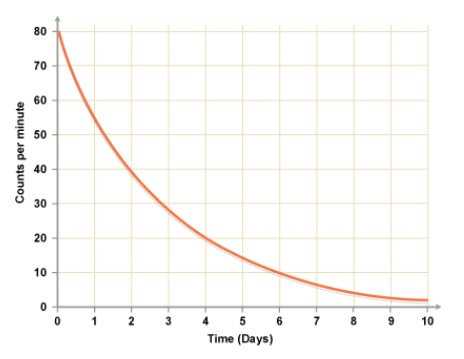
Exponential decay, its going down!
100
What is the domain of this graph?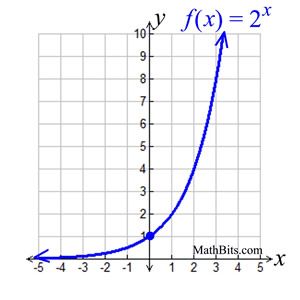
(-∞,∞ )
100
What value of x makes the following undefined?
(3x-5)(x+2)
x=-2
200
Using the graphs, what is the value of k? (The blue is the original graph, and the green is the trnasformed graph).
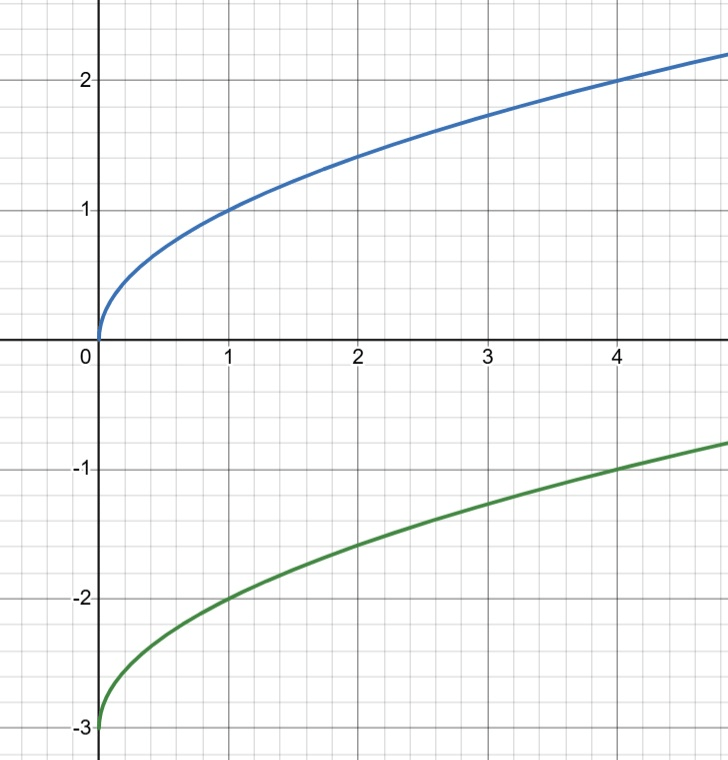
k= -3
200
Is this function an example of exponential growth, exponential decay or neither? How do you know?
f(x)=5(7)x
Exponential growth, the number in the parenthesis is bigger than 1!
200
What is the range of this graph?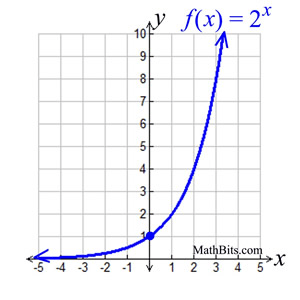
(0, ∞)
200
Perform the indicated operation and simplify:
7/(x-1) * ((x-1)(x+3))/(x+3)
7 or
7/1
300
Describe the transformations from the parent graph to the translated graph:
f(x)= sqrtx
g(x)=-1/4 sqrt x
Reflection (flip) over the x-axis
Vertical shrink by 1/4
300
What is the initial amount in a bank account represented by the equation:
y=1000(1.25)t
$1000
300
What is the domain of this graph?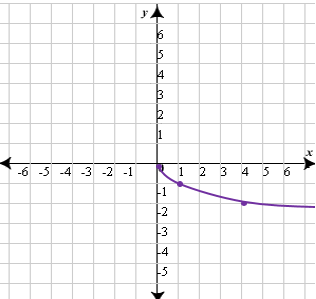
(0, ∞)
300
Perform the indicated operation and simplify:
(2(x+1)(x-4))/((x-9)(x+1)) div ((x-4)(x+6))/ (x+6)
2/(x-9)
400
Describe the transformations from the parent graph to the translated graph:
f(x)= sqrtx
g(x)=sqrt (x-5) -2
The graph shifted right 5 and down 2
400
The value of a car is $21,500. It loses 12% of its value every year. Write an equation that represents the value y ( in dollars) of the car after t years.
y= 215000(.88)t
400
What is the range of this graph? 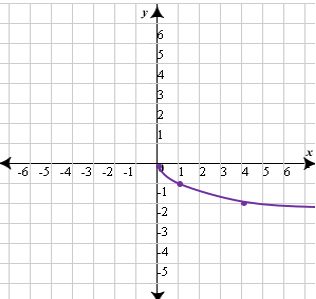
(-∞, 0)
400
Solve for x:
x/3 = (x+4)/9
x=2