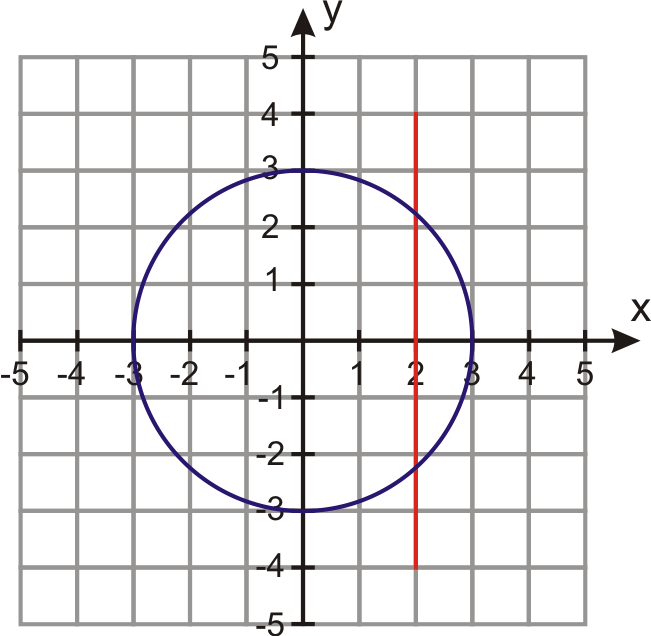
Is it a Function:
Graphs?
Graphs?
No, using the vertical line test, the line hits more that 2 points.
x y
-2 3
-1 4
0 5
1 6
Yes, each input has exactly one output
Does this represent a function? Explain
(1,2) (2, 3) (3,4) (4,5)
yes, because each input has exactly one output.
Does the relation represent a function?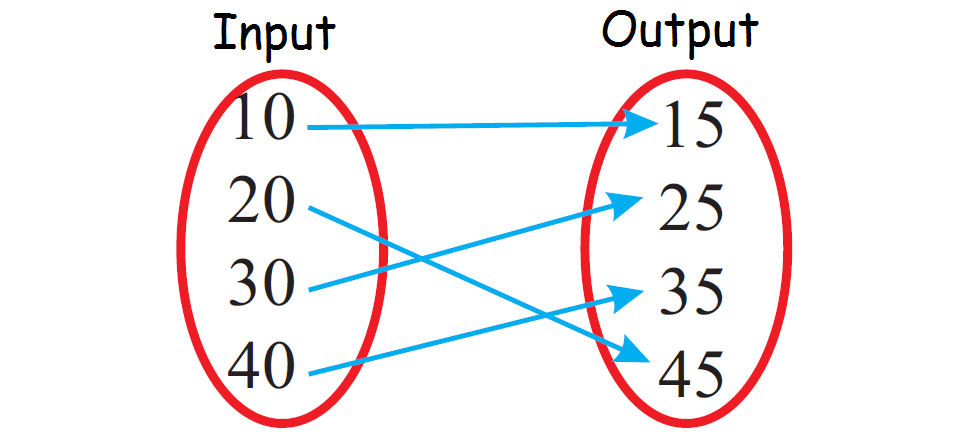
Yes, each input has its own output.
(10,15)
(20,45)
(30,25)
(40,35)
What is a function?
Each input has exactly one output
Which relation represents a function?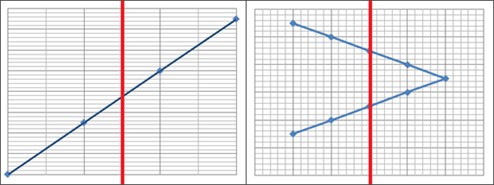
The first graph. Using the vertical line test, each input has exactly one output.
Bonus Information: The second graph is not a functions, because when using the vertical line test, the line hits more than one point.
Input, x Output, y
-1 4
0 -3
0 6
1 2
2 4
Does this represent a function? Explain
(-2, 3) (4, 5) (-2, 6)
No, because the x value (input) -2 has more than one output
Which relation DOES NOT represents a function?
B--It is the only map where each does not have its own output.
a--q
a--r
What is the vertical line test? What does it mean to pass the vertical line test?
A graph represents a function when no vertical line passes through more than one point on the graph.
Does the relation represent a function.
No, using the vertical line test, the line hits more that 2 points.
No, because the input (8) has multiple outputs
Does this represent a function? Explain
(0, 1) (1,1) (2,1) (3,1)
yes, because each input has exactly one output
Which table DOES NOT represents a function.
T--Each input does not have its own output.
the x values
x y
8 1
7 2
-8 3
3 4
2 5
This IS a function
Does this represent a function? Explain (-2,0) (-1,0) (-1,1) (0,1) (1,2) (2,2)
No, because the x value (-1) has more than one output.

4----Each input has its own output.
What is an output?
The y values.
Which graph represents a function.
A. Using the vertical line test, each input has exactly one output
x y
1 4
2 4
3 4
4 4
Yes, because each input has exactly one output
Does this represent a function? Explain (-2,2) (-1,2) (0,2) (1,0) (2,0)
yes, because each input has exactly one output.
Does this relations represent a function? Explain.
(-2,3), (2,3), (-1,4), (5,2), (0,6), (4,3)
The relation represents a function. Each input has its own output.