Function/D&R
Evaluating Functions
Average Rate of Change
Mixed
100
Is this a function? Explain why.
{(0, 1), (2, 5), (-7, 1), (3, 8), (-2, 4)}
Yes there are no repeating x-values.
100
Evaluate y = 2x +1 when x = -3
y = -5
100
Find the average rate of change from x = -1 to x = 2.
x -1 1 2 3
y 3 8 6 10
average rate of change = 1
100
A table of values for a linear function is given. What point can put in the table to make this NOT a function?
x -1 0 1
y 3 8 5
(-1, ___)
(0, ___ )
(1, ___)
200
Is this a function? Explain why.
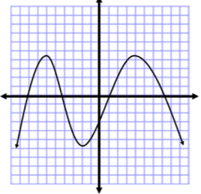
Yes, because it passes the vertical line test.
200
Evaluate y= x2 + x + 1 when x = -5
y = 21
200
Find the average rate of change from x= -1 and x = 3
x -5 -1 0 2 3
y 6 -2 5 8 1
average rate of change = 3/4
200
What does the domain stand for? What does the range stand for?
Domain is the x - values and range is the y - values.
300
What is the domain and range of the points shown below?
{(0, 1), (2, 5), (7, 1), (3, 8)}
Domain: {0, 2, 7, 3}
Range: {1, 5, 8}
300
f(x)= x2 - 2, find f(-2)
f(-2)= 2
300
Find the average rate of change from x=0 to x=2
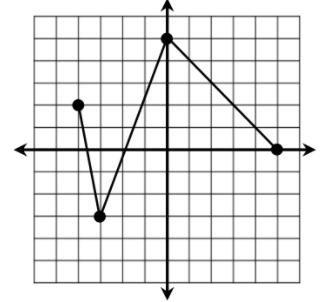
average rate of change = -1
300
Based on the graph of the function, what is y when x = 4?
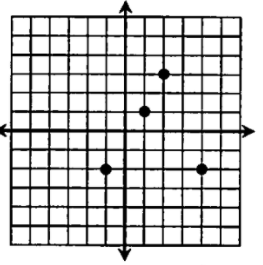
y = -2
400
Does the following table represent a function? Explain.
x y
1 2
2 5
6 2
2 9
5 1
No because there is a repeating x-value of 2.
400
If f(x) = 4x2 - 1, then f(-2)=2
f(-2) = 15
400
Find the average rate of change of the equation
f(x) = 2x + 1 from x=1 and x=5
average rate of change = 2
400
Find f(-3)

y = -3
500
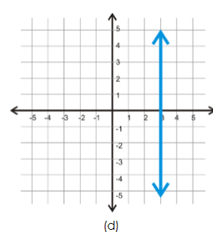
No because it does not pass the vertical line test. It crosses more than one point.
500
If f(x) = 2x + 4, find x when f(x)=8.
x = 2
500
Find the average rate of change from f(x) = -3x -1 from when x = -2 to x = 1
average rate of change = -3
500
find x when f(x) = 5
x=0