Boyle
Charles
Gay-Lussac
Behavior of Gases
Miscellaneous
100
Boyle's formula for gases
P1 xx V1 = P2 xx V2
100
Charles' formula for gases
(V1)/(T1) = (V2)/(T2)
100
Gay-Lussac's formula for gases
(P1)/(T1) = (P2)/(T2)
100
The theory that defines the random movement and energy of gases
Kinetic Molecular Theory
100
The rising water experiment is an example of this gas law.
Charles' law
200
What happens on the inside of a balloon if you squeeze it
Pressure increases
200
An example of a real world experiment that shows Charles' Law
Hot air balloons, shrinking balloons, tires deflating in winter, etc.
200
A phenomenon that showcases Gay-Lussac's law
Can crush, rocket canister, exploding aerosol cans, etc.
200
The best way to decrease kinetic energy in gas particles
Decrease temperature
200
The reason gas particles are easy to compress
Open space (like air) exists between each gas particles
300
Given the following values, what is the initial pressure of this gas in atm?
P1: ?, P2: 675.1 kPa, V1: 24.4 L, V2: 46.66 L
12.74 atm
300
Charles' first name
Jacques
300
This must remain constant in order for Gay-Lussac's law to be true
Volume
300
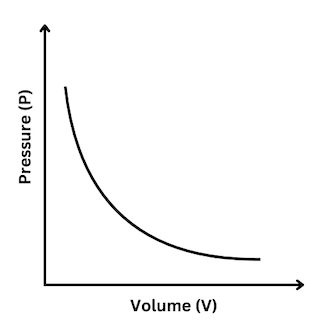
A graphical example of the relationship between pressure and volume (please label your axis)
300
The five correct units used in the Ideal Gas formula
atm, L, mol, K,
(L xx atm)/(mol xx K)
400
An example of a real-world phenomenon or experiment that shows Boyle's Law
Marshmallows in syringes, pistons compressing air, opening a soda can, blowing up a balloon, etc.
400
Given the following values, find the missing volume in mL.
V1: ?, V2: 4.733 L, T1: 4 C, T2: 529.56 C
2000 mL
400
Three ways the pressure of a gas in an enclosed container can increase
Decreasing volume, increasing temperature, increasing the amount of gas
400
This is something gas particles do to create/maintain pressure
Collide with each other or the walls of their container
400
This gas particle moves the slowest compared to the others: H, Xe, O2, Ne
Xe (has the largest atoms)
500
Given the following values, what is the missing Pressure in mmHg?
P1: ?, P2: 197.4 kPa, V1: 35.52 L, V2: 56,050 mL
2,337.02 mmHg
500
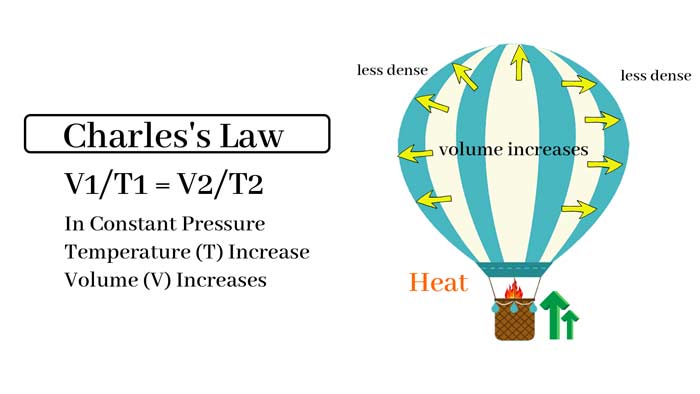
A diagram showing how hot air balloons work (using Charles' law)
500
Given the following values, find the missing temperature in Celsius.
P1: 8.53 atm, P2: 318 kPa, T1: 181.8 C, T2: ?
-106 C
500
Three assumptions we make about the movement of gases.
Particles have constant and random motion, there's no attractive or repulsive forces between particles, the particles move in straight lines until they collide with something
500
These are the two constants of Avogadro's gas law
Pressure and Temperature