Translations
Rotations
Reflections
Misc
Vocabulary
100
State the image of point A(1, 4) after a translation 4 units up and 5 units left? (Include the name of the translated point)
A'(-4, 8)
100
When the question asks you to rotate, but does not specify clockwise or counter-clockwise, which direction do we use by default?
Counter-clockwise
100
True or False: Reflections preserve congruency and orientation.
False - orientation is not preserved under a reflection.
100
What will the coordinates be after the following composition?
G: ( 5, 3 ), H: ( -2, 6 ), & K: ( -1, -4 )
Translate: ( x, y ) --> ( x - 7, y )
Reflection: in the x-axis
G":( -2, -3 ), H":( -9, -6 ), & K":( -8, 4 )
100
What do we call the shape we made with our transformation?
The Image.
200
Translate L: ( -3 , -2 ), A:( 0 , -1 ), & D: ( 3 , -2 ) one unit right and three units up.
L':( -2 , 1 ), A': ( 1 , 2 ), & D':( 4 , 1 )
200
True or False: Rotating a figure 90 degrees CCW is NOT the same as rotating a figure 270 degrees CW.
False - rotating a figure 90 degrees CCW IS the same as rotating a figure 270 degrees CW.
200
What is the new coordinate point of H:(-7, 9) if you reflect it over the x-axis?
H':(-7, -9)
200
Find point C on the x-axis so AC + BC is a minimum.
A: ( 1 , 2 ) & B: ( 12 , 5 )
C: ( 4 , 0 )
200
If your triangle is in the second quadrant, how many degrees CCW do you need to rotate to put the image in the fourth quadrant?
180 degrees CCW
300
Write the following translation using its algebraic representation:
A:( -3, -4 ), B: ( -1, -5 )
A':( 3, -4 ), B': ( 5, -5 )
( x , y ) --> (x + 6, y )
300
What is the new image of Z: ( -4 , 0 ) if you rotate it 90 degrees clockwise?
Z': ( 0 , 4 )
300
What are the points of the new image D:(-1, -4), E:(2, -4), & F:(4, -5) after a reflection over the x-axis?
D':(-1, 4), E':(2, 4), & F':(4, 5)
300
Name the coordinates of the vertices of the image after a 90 degree clockwise rotation.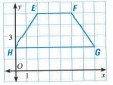
H': ( 2 , 0 ), E': ( 5 , -2 ),
F': ( 5, -5 ), & G': ( 2 , -7 )
300
What is the name for the type of transformation which every point P is mapped onto a point P" by translating P onto P' and a reflection in line k parallel to the direction of the translation maps P' onto P".
A glide reflection
400
What is the coordinate point of the pre-image A given that A' is ( 8, -7 ) and underwent this translation:
( x , y ) -->( x - 2, y + 3 )
A:( 10, -10 )
400
How many degrees was the figure rotated if the pre image was X: (-4, 2), Y:(-4, 0), & Z:(0, 3) and the image is X':(4, -2), Y':(4, 0), & Z':(0, -3)?
Rotation of 180 degrees
400
What is the line of reflection if L:(1, 4), M:(1, 0), & N:(3, 0) became L':(-1, 4), M':(-1, 0), & N':(-3, 0)?
Reflection over the y-axis.
400
Where would the final image be after the following glide reflection?
A: ( -6 , -2 )
Translation: ( x , y ) --> ( x + 1 , y + 3 )
Reflection: in the x-axis
A": ( -5 , -1 )
400
What does orientation mean?
The direction a shape is facing.
500
What is the new image of A:( 2 , 4 ), B:( 3 , -6 ), & C:( -6 , -6 ) given (x, y) --> (x + 4, y - 2)?
A': ( 6 , 2 ), B': ( 7 , -8 ), C': ( -2 , -8 )
500
What is the pre-image of M':(-2, 2), N':(-1, -2), & O':(-3, -3) after a rotating 180 degrees?
M:(2, -2), N:(1, 2), & O:(3, 3)
500
What is the pre-image of A':(4, 0), B':(5, 1), & C':(4, -4) if it underwent reflection over the x-axis?
A:(4, 0), B:(5, -1), & C:(4, 4)
500
Describe the Frieze Pattern: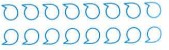
THG
500
What is the name for the type of transformation that preserves lengths?
Isometry