Perpendicular Bisector Theorem
Angle Bisectors
Symmetry
Transformations
100
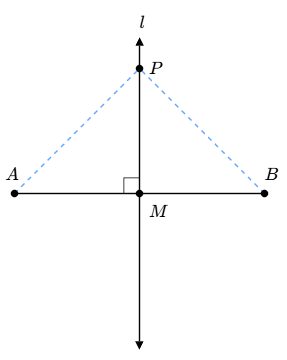
Prove line AP is congruent to line BP
CHECK WITH YOUR NEIGHBOR FOR FULL CREDIT!!!
100
Find x and angle ABC.
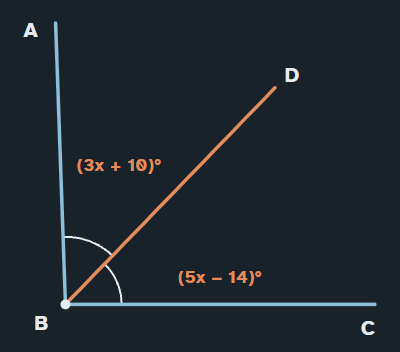
x = 12
angle ABC = 92o
100
Decide how many lines of symmetry each figure has. Sketch them on the figures.
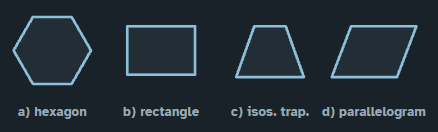
- Figure (a) is a regular hexagon. How many lines of symmetry?
- How many lines for (b), (c), and (d)?
- Why does the diagonal of the rectangle not count as a line of symmetry?
1.) 3 through opposite vertices, 3 through midpoints of opposite sides
2.) 2 Vertical and horizontal midlines
3.) No reflection maps it onto itself
100
Translate △ABC using the rule (x, y) → (x + 5, y − 3).
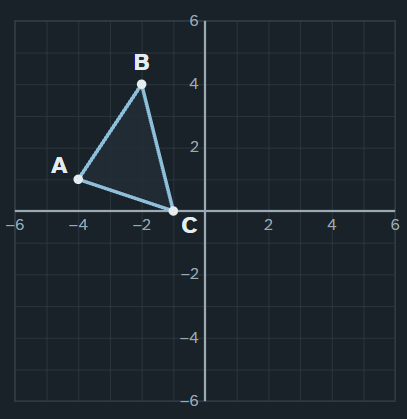
- Write the coordinates of A, B, and C.
- Find A′, B′, and C′ and graph △A′B′C′.
A(−4, 1), B(−2, 4), C(−1, 0)
Add 5 to each x and subtract 3 from each y.
A′(1, −2) · B′(3, 1) · C′(4, −3)
200
Find x and y
y = 4
x = 5
200
Ray BD bisects ∠ABC. The whole angle measures m∠ABC = (10x − 6)°.
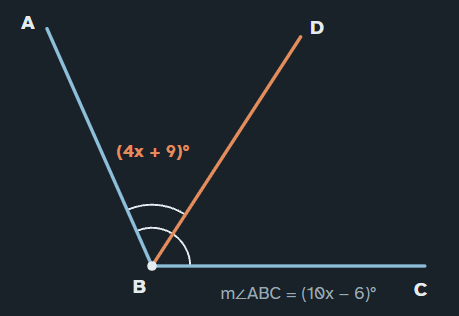
- Write an equation relating m∠ABD and m∠ABC.
- Solve for x.
- Find m∠ABD, m∠DBC, and m∠ABC.
Bisector ⇒ 2 · m∠ABD = m∠ABC
2(4x + 9) = 10x − 6 → 8x + 18 = 10x − 6 → x = 12
m∠ABD = 4(12) + 9 = 57° = m∠DBC
200
The polygon is symmetric across the line x = 1. Only its left half is drawn. S and T lie on the line of symmetry.
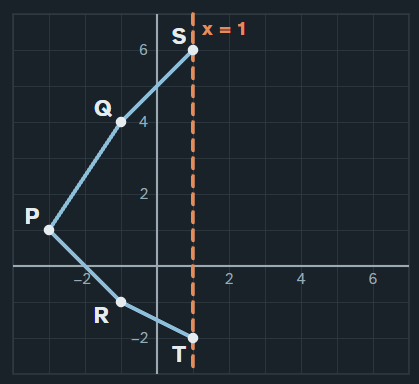
- Write the coordinates of S, Q, P, R, and T.
- Find Q′, P′, and R′, the images of Q, P, and R across x = 1.
- How far is P from the line of symmetry? How far is P′?
S(1, 6), Q(−1, 4), P(−3, 1), R(−1, −1), T(1, −2)
Across x = 1, the y-value stays the same and the new x-value is 2(1) − x.
Q(−1, 4) → Q′(3, 4) · P(−3, 1) → P′(5, 1) · R(−1, −1) → R′(3, −1)
P is 4 units left of x = 1, and P′ is 4 units right of it.
200
Reflect quadrilateral KLMN across the x-axis.
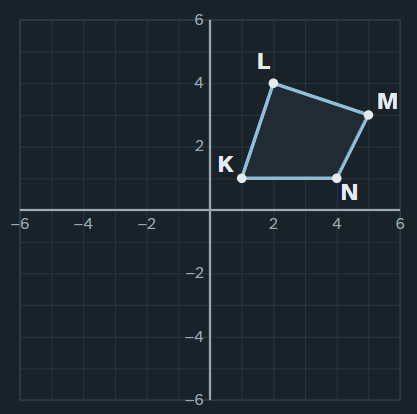
- Write the rule for a reflection across the x-axis.
- Find K′, L′, M′, and N′ and graph K′L′M′N′.
- Which point is closest to the x-axis?
Rule: (x, y) → (x, −y). The x-value stays the same and the y-value changes sign.
K(1, 1) → K′(1, −1) · L(2, 4) → L′(2, −4) · M(5, 3) → M′(5, −3) · N(4, 1) → N′(4, −1)
K and N are tied, each 1 unit above the x-axis.
300
Find x. Once you find x, how do we know that line EF is congruent to line ED? Even if we were not provided their lengths of 13.
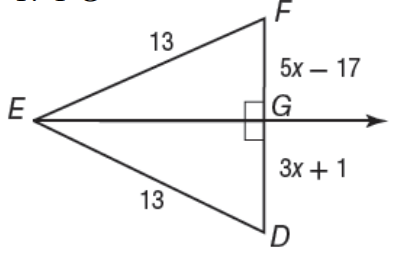
x = 9
CHECK WITH YOUR NEIGHBOR FOR FULL CREDIT!!
300
Point P lies on the bisector of ∠ABC. Segments PE and PF are perpendicular to the sides of the angle.
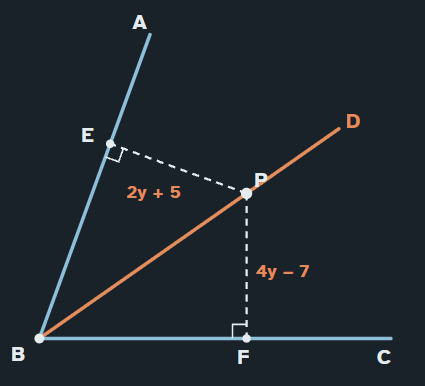
- Explain why PE = PF.
- Solve for y.
- How far is P from each side of the angle?
A point on an angle bisector is equidistant from the sides, and distance is measured along the perpendicular, so PE = PF.
2y + 5 = 4y − 7 → 12 = 2y → y = 6
PE = 2(6) + 5 = 17, PF = 4(6) − 7 = 17
300
Kite ABCD has diagonal AC as its line of symmetry.
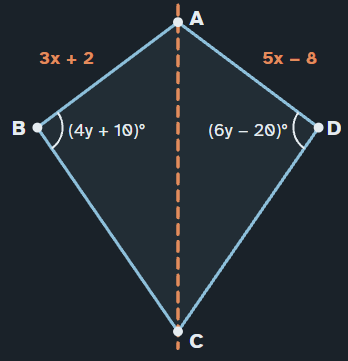
- Reflecting across AC maps B onto which point? Which side is AB's image?
- Solve for x and find AB.
- Solve for y and find m∠ABC.
The reflection across AC fixes A and C and sends B to D, so AB ≅ AD and ∠ABC ≅ ∠ADC.
3x + 2 = 5x − 8 → 10 = 2x → x = 5, so AB = AD = 17
4y + 10 = 6y − 20 → 30 = 2y → y = 15, so m∠ABC = m∠ADC = 70°
300
Rotate △DEF about the origin.
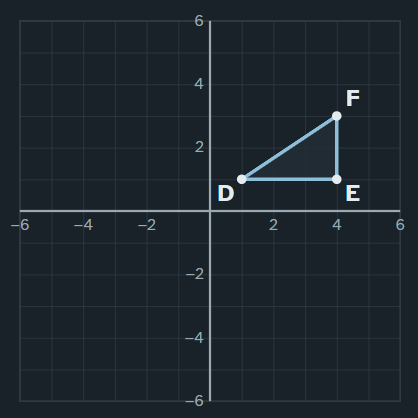
- Rotate △DEF 90° counterclockwise. Find D′, E′, and F′.
- Rotate the original △DEF 180°. Find D″, E″, and F″.
Point90° CCW (−y, x)180° (−x, −y)D(1, 1)D′(−1, 1)D″(−1, −1)E(4, 1)E′(−1, 4)E″(−4, −1)F(4, 3)F′(−3, 4)F″(−4, −3)
400
Use the diagram below. Line EH is the perpendicular bisector of Line DF. Find the indicated measure of line DG and line FH
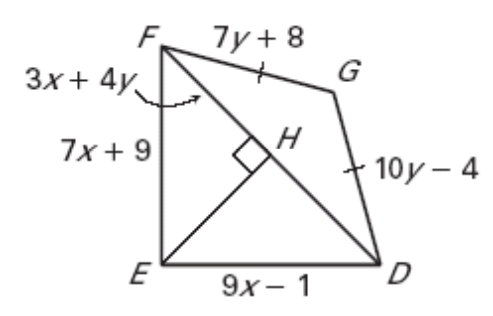
Line DG = 36
Line FH = 31
400
In △ABC, AD bisects ∠BAC and meets BC at D. AB = 12 and AC = 18. 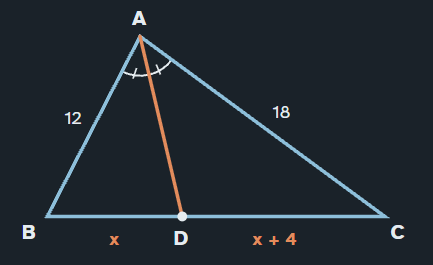
- Set up a proportion using the Triangle Angle Bisector Theorem.
- Solve for x.
- Find BD, DC, and BC.
BD / DC = AB / AC → x / (x + 4) = 12 / 18
18x = 12(x + 4) → 18x = 12x + 48 → 6x = 48 → x = 8
BD = 8, DC = 12. Check: 8/12 = 12/18 = 2/3 ✓
400
This polygon is symmetric across the line y = x. Only the half above the line is drawn. S and T lie on the line of symmetry.
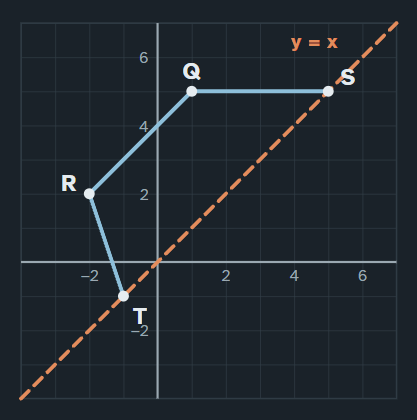
- Write the coordinates of T, R, Q, and S.
- What happens to (x, y) when it is reflected across y = x? Use this to find Q′ and R′.
T(−1, −1), R(−2, 2), Q(1, 5), S(5, 5)
Reflecting across y = x swaps the coordinates: (x, y) → (y, x).
Q(1, 5) → Q′(5, 1) · R(−2, 2) → R′(2, −2). S and T map to themselves.
400
Figure G is the pre-image. Figures P, Q, and R (dashed) are each the image of G after one rigid motion.
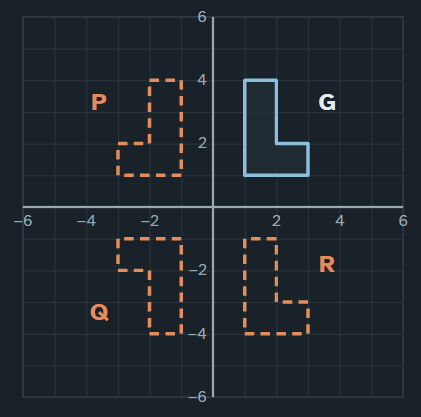
- Describe the single transformation that maps G to P, G to Q, and G to R. Be specific: give the vector, line, or angle and center.
- Kai says R is a reflection of G across the x-axis. Explain Kai's mistake.
G → P: reflection across the y-axis. (1, 4) → (−1, 4) and so on; the foot of the L now points left.
G → Q: rotation of 180° about the origin. (1, 4) → (−1, −4); the L is upside down and points left.
G → R: translation ⟨0, −5⟩, or 5 units down. (1, 4) → (1, −1); the orientation is unchanged.
A reflection across the x-axis would flip the L upside down, putting the foot at the top (y = −1 to −2). In R the foot is still at the bottom, so R has the same orientation as G.