Algebra Proofs
Segment Proofs
Angle Proofs
Definitions
Statements
100
The first reason on any algebra proof is this ____.
Given
100
Point a is in between point C and point B. Point C and point B are collinear. Therefore CA + AB = AC. This is an example of which postulate?
Segment Addition
100
The following is an example of the ______ property.
m<1 = 150 degrees.
m<1 + m<2 = 180 degrees
150 + m<2 = 180 degrees
Substitution
100
Supplementary Angles add to _______°
180°
100
What is the converse of this statement?
If two lines form a right angle, then they are perpendicular.
If two lines are perpendicular, then they form a right angle.
200
Give an example of the subtraction property.
x + 8 = 58
x = 50
200
Give an example of the segment addition postulate, with a drawing. (Use the points A, B, and C).
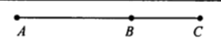
AB + BC = AC
200
Explain how the angle bisector theorem is different then the angle addition postulate.
With the angle bisector theorem the angle is split into two equal pieces.
200
The point that divides a segment into two congruent segments.
Midpoint
200
Is this a biconditional statement?
A shape is a rectangle if and only if it has four sides.
No - the converse is not true.
300
This would be an example of the which property?
If /_A+/_B=180° and /_B+/_C=180°
then
/_A=/_C
Transitive
300
True/False. Definition of congruence is only used with segment proofs.
False.
300
Give an example of a property that is used just with angles.
Angle Addition Postulate
Angle Bisector
Supplementary Angles
Complementary Angles
300
A pair of opposite angles made by two intersecting lines that are congruent.
Vertical angles
300
Write in if-then form:
Two segments are congruent if they have the same length.
If two segments are congruent, then they have the same length.
400
What is the last reason for the following algebra proof?
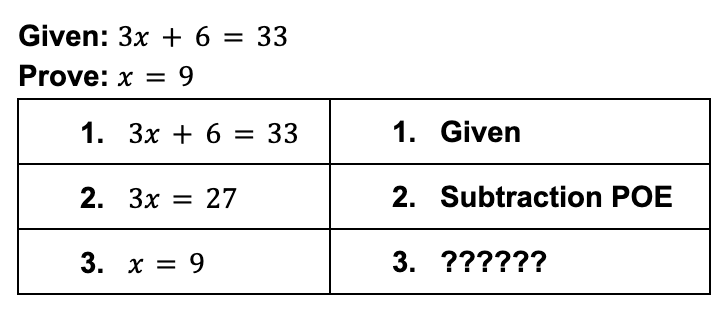
Division Property
400
This reason justifies statement 2 in the following proof.
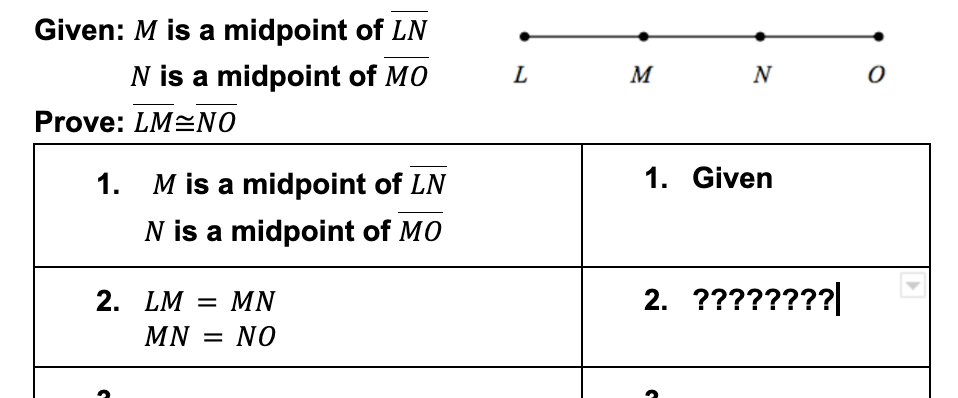
Definition of midpoint
400
What tells us that
If
/_1 and /_2 are supplements
and /_2 and /_3
are supplements.
Then
/_1 cong/_3
Transitive Property
400
Two angles that are next to one another, have a common side, a common vertex, and don't overlap.
Adjacent Angles
400
Decide if the statement is true or false. If it's false, come up with a counterexample.
If |x|=2, then x = 2
-2
500
What is a logical 2nd statement (assuming the first is a given):
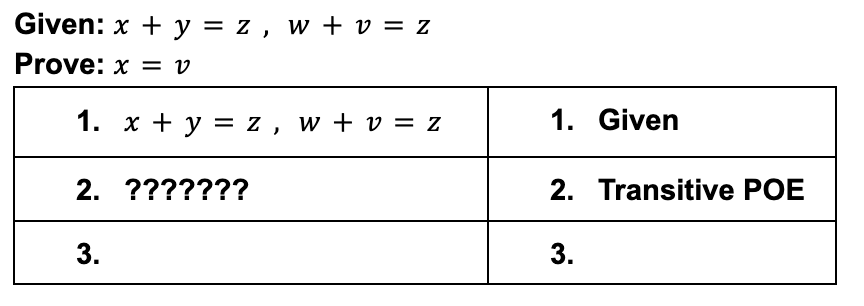
x + y = w + v
500
What would be the last reason in the following proof?
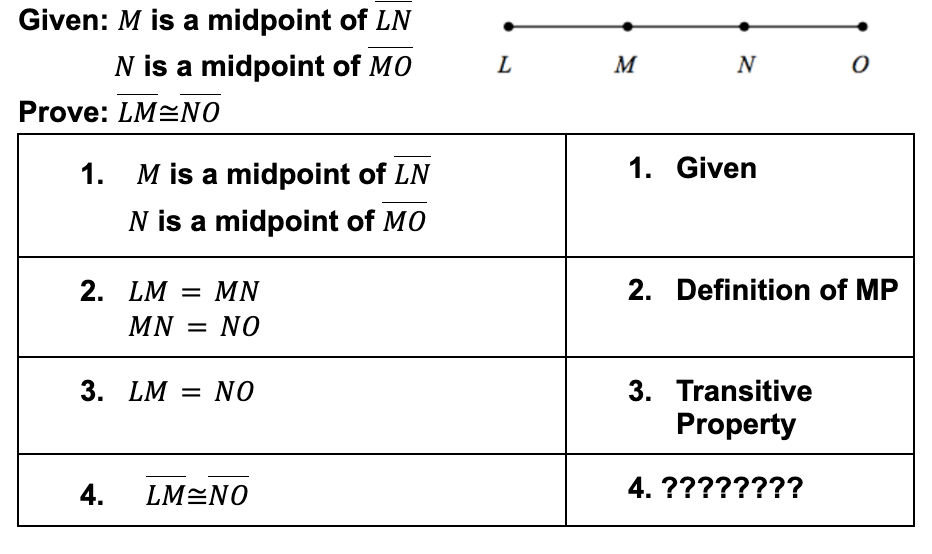
Definition of congruence
500
Give statement #6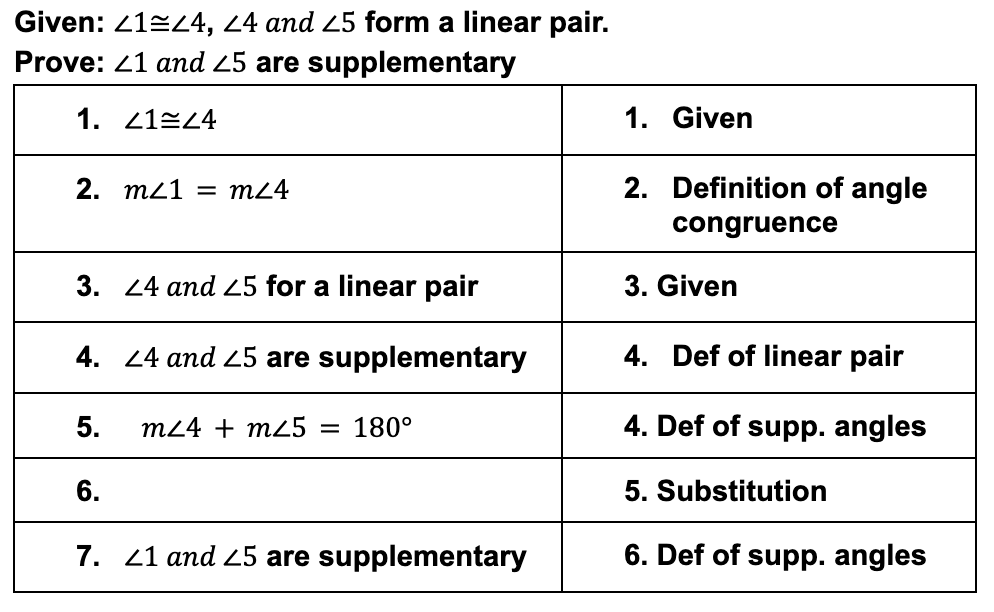
m<1 + m<5 = 180
500
Two angles are supplementary. Does this mean they form a linear pair?
No, the 2 angles in a linear pair have to be both supplementary AND adjacent.
500
What phrase appears in a biconditional statement?
If and only if / iff / <=>