B2.1 Membranes & Membrane Transport
B2.3 Cell Specialization
C1.2 Cellular Respiration
C1.3 Photosynthesis
B3.2 Transport
100
What name is given to the chemicals that can open gated channels?
Ligands
100
State the name given for early stage embryos & zygotes that can turn into any type of cell.
Totipotent
100
State the name of the process that turned ADP into ATP.
Phosphorylation
100
State one similarity and one difference between an action spectrum and an absorption spectrum.
SIMILARITY:
X-axis shows the wavelength of light
DIFFERENCE:
Y-axis
Absorption Spectrum - absorption of different wavelengths of light
Action Spectrum - rate of photosynthesis occurring at different wavelengths of light
100
Identify the structures shown in the micrograph.
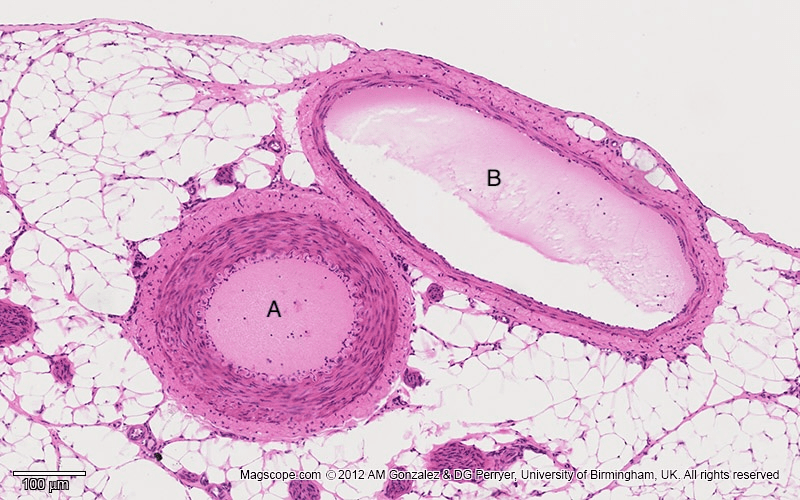
A - Artery
B - Vein
200
State three types of passive transport.
1) Diffusion
2) Osmosis
3) Facilitated Diffusion
200
Outline the adaptations of type I pneumocytes.
Thin, Flat, Large surface area for gas exchange
200
What happens to NAD during glycolysis?
It is reduced.
200
he image shows part of a chloroplast and was produced by electron tomography.
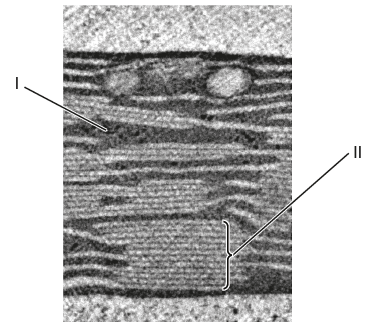
What is the name of I and which reactions of photosynthesis occur in II?
I) Stroma
II) Light dependent reactions
200
What is the name for the fat and cholesterol build up that occurs in arteries?
Plaque
300
State an example of indirect active transport.
Sodium-dependent glucose cotransporters.
300
Outline two examples of cell adapted to increase surface area to volume ratio.
1) Red blood cells - thin, small, biconcave
2) Proximal convoluted tubule cells - micovilli
300
What distinguishes aerobic respiration from anaerobic respiration in humans?
A. Mitochondria are only used in anaerobic respiration.
B. Aerobic respiration yields lower quantities of ATP.
C. Only aerobic respiration can use glucose as a starting substrate.
D. Only aerobic respiration produces carbon dioxide.
D
300
The image shows the separation of photosynthetic pigments in a spinach leaf by thin layer chromatography and the colours that appear on a chromatogram.
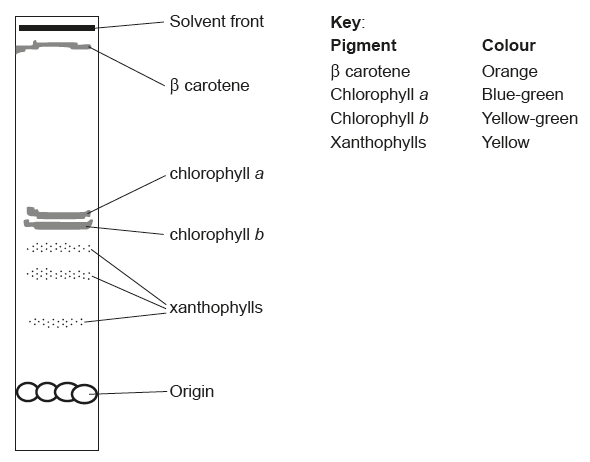
What colour is the pigment with Rf value 0.2?
A. Yellow
B. Yellow-green
C. Blue-green
D. Orange
A
300
Outline 3 adaptions of phloem cells.
Sieve tube elements
No Nucleus
Sieve plates
No other organelles (need comanion cell to support)
Companion cell
Many mitochondria to supply ATP to sieve tube element
400
Draw and label a diagram of the fluid mosaic model of the membrane.

400
Distinguish between two types of muscle cells.
Cardiac muscles - Shorter cells, single nucelus. Connect to other cells.
Skeletal muscles - attach to bones. Long, unbranched cylinders with many nuclei.
400
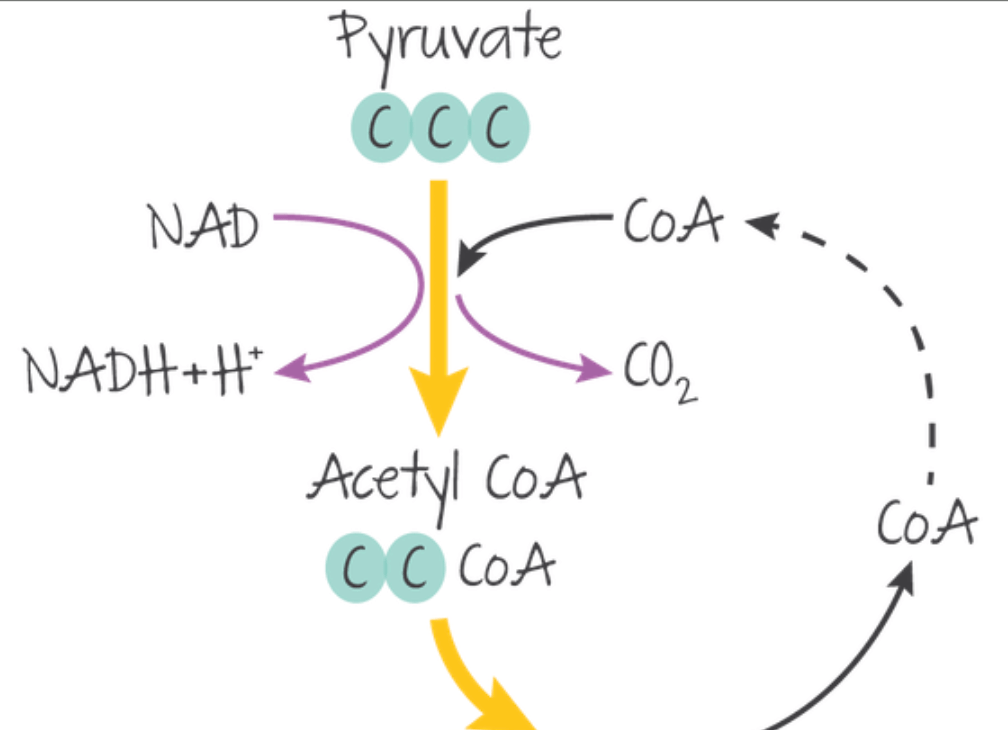
Outline three events that take place in the link reaction.
1) NAD is reduced
2) pyruvate is decarboxylated
3) CoA joins the carbon molecule to make Acetyl CoA
400
Below is the first step of the Calvin Cycle. Identify the missing molecule names and process name (a, b, c).
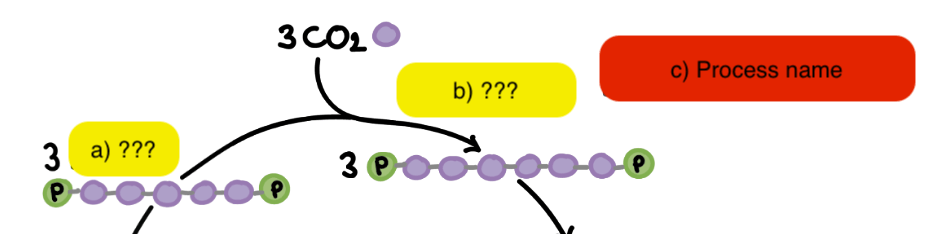
a) RuBP
b) Rubisco
c) Carbon Fixation
Context: Enzyme Rubisco fixes (attaches) CO2 to RuBP (a 5 carbon molecule), forming a 6-carbon molecule.
400
Draw a flow chart outlining the flow of oxygenated blood through the heart.
Pulmonary artery --> left atrium --> AV valve --> left ventricle --> semi-lunar valve --> aorta
500
A membrane is heated above normal levels, causing excessive fluidity. Name two adaptations the membrane may make to reduce fluidity at a high temperature.
1) Increase cholesterol
2) Increase saturation (more saturated fatty acids on phospholipids)
500
Draw and label a diagram of a human egg cell.

500
Outline 3 effects of removing NAD from cells on the process of chemiosmosis.
Without NADH
- no proton concentration gradient
- no protons to move through ATP synthase
- ADP is not phosphorylated into ATP by ATP synthase, so no energy made
Context: NADH is oxidized, releasing electrons that supply energy to the Electron Transport Chain, and proton pumps use this energy to build a concentration gradient.
500
Outline three main events occurring in photosystem II.
1) Photoactivation of chlorophyll - Photons are absorbed by chlorophyll, providing energy.
2) Photolysis of water passes 2e- to an electron acceptor.
3) Reduction of NADP+ to NADPH + H+
500
The diagram shows the pressure changes in the left atrium, left ventricle and aorta during part of the cardiac cycle.
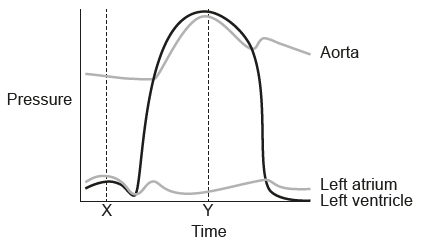
Are the valves between the atria and the ventricles open or closed at time X and time Y?
Time X Time Y
A. open open
B. open closed
C. closed open
D . closed closed
B