Domain & Range
Increasing & Decreasing
Zeros
BAM
Square Roots
Mystery Question
Inverses
100
Find the domain and range of the function.
f(x)=3x-5
A. D: All real numbers R: All real numbers
B. D: [0,∞) R: All real numbers
C. D: All real numbers R: [-5,∞)
D. D: All real numbers R. (-∞,-5]
A. D: All real numbers R: All real numbers
100
Find the interval where the function is increasing.
f(x)=x^2
A. (-∞,0)
B. (0,∞)
C. All real numbers
D. It's never increasing
B. (0,∞)
100
Find the zero(s) of the function
f(x)=x^2-9
x = 3 and x = -3
100
Solve the equation
4^x=64
x = 3
100
Solve the equation
sqrt(x)+3=9
x = 36
100
Is this function one-to-one?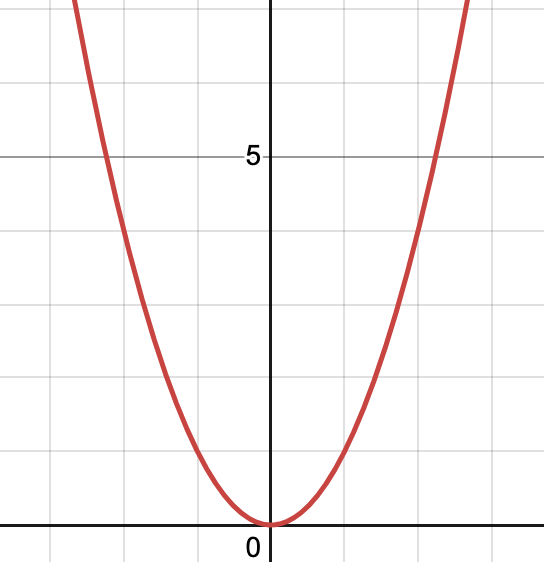
NO! It does not pass the horizontal line test
100
Find f-1(x) if:
f(x)=x+7

f^-1(x)=x-7
200
Find the domain and range of the function.
f(x)=x^2+2
A. D: All real numbers R: All real numbers
B. D: All real numbers R: [2,∞)
C. D: [2,∞) R: All real numbers
D. D: All real numbers R. (-∞,2]
B. D: All real numbers R: [2,∞)
200
Find the interval where the function is decreasing.
f(x)=(x-3)^2
A. (-∞,3)
B. (3,∞)
C. It's never decreasing
D. (-∞,0)
A. (-∞,3)
200
Find the zero(s) of the function
f(x)=x^2+4x+1
x = -3.73 and x = -0.27
200
Solve the equation
log_5(x+5)=2
x = 20
200
Solve the equation
2sqrt(x+5)=14
x = 44
200
What are the solution(s) to this system of equations?
f(x)=x+2
f(x)=x^2
(-1, 1) & (2, 4)
200
Find f-1(x) if:
f(x)=4x-3
f^-1(x)=(x+3)/4
300
Find the domain and range of the function.
f(x)=-x^2+5
A. D: All real numbers R: All real numbers
B. D: All real numbers R: [5,∞)
C. D: [5,∞) R: All real numbers
D. D: All real numbers R. (-∞,5]
D. D: All real numbers R. (-∞,5]
300
Find the interval where the function is increasing.
f(x)=-x^2+4
A. (0,∞)
B. All real numbers
C. (-∞,0)
D. It's never increasing
C. (-∞,0)
300
Find the zero(s) of the function
f(x)=x^3-x^2-6x
x = 0 and x = 3 and x = -2
300
Solve the equation
2^x+4=12
x = 3
300
solve the equation
5root(3)(x-1)=10
x = 9
300
TRUE OR FALSE:
The graph shown has a y-intercept on the interval from x = -3 to x = -1.
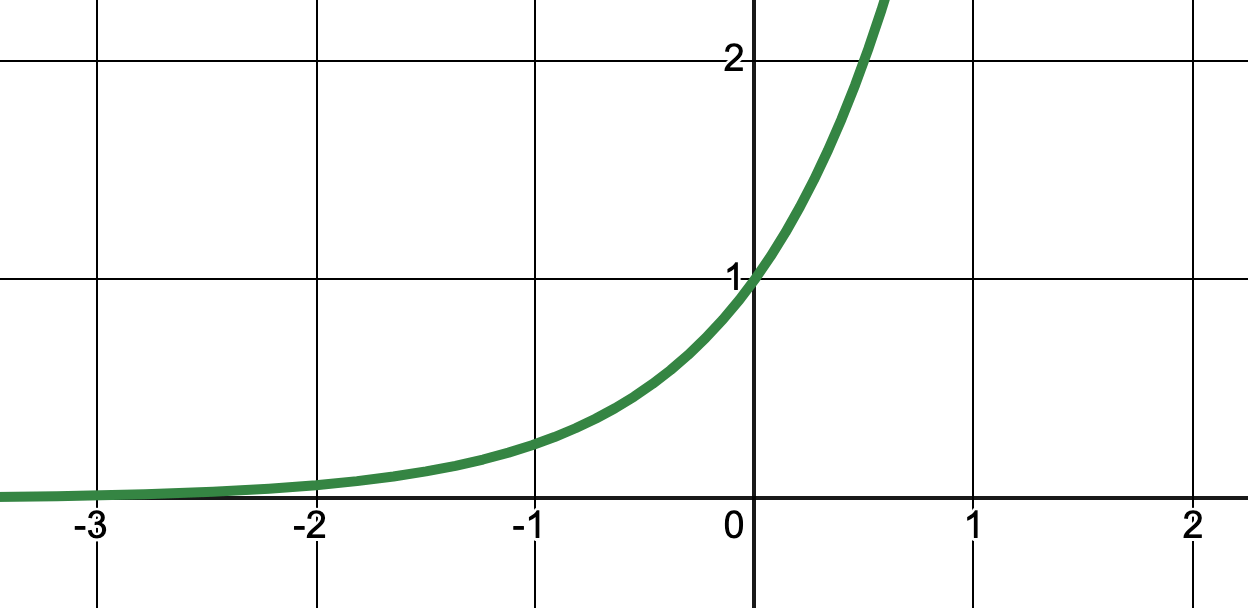
FALSE
300
Find f-1(x) if:
f(x)=sqrt(x+3)
f^-1(x)=x^2-3
400
Find the domain and range of the function.
f(x)=sqrt(x-3)
A. D: [3,∞) R: [0,∞)
B. D: [0,∞) R: [3,∞)
C. D: All real numbers R: [0,∞)
D. D: [3,∞) R. All real numbers
A. D: [3,∞) R: [0,∞)
400
Find the interval(s) where the function is decreasing.
f(x)=x^3-5x
A. (-∞, -1.3) and (1.3, ∞)
B. All real numbers
C. (-∞, -2.2) and (2.2, ∞)
D. (-1.3, 1.3)
D. (-1.3, 1.3)
400
Find the zero(s) of the function
f(x)=sqrt(x-4)-2
x = 8
400
Solve the equation
ln(2x+1)=3
x = 9.5
400
Solve the equation
root(3)(2x-8)=0
x = 4
400
Which transformations have been applied to the parent quadratic function to obtain the graph shown? SELECT 2 ANSWERS!
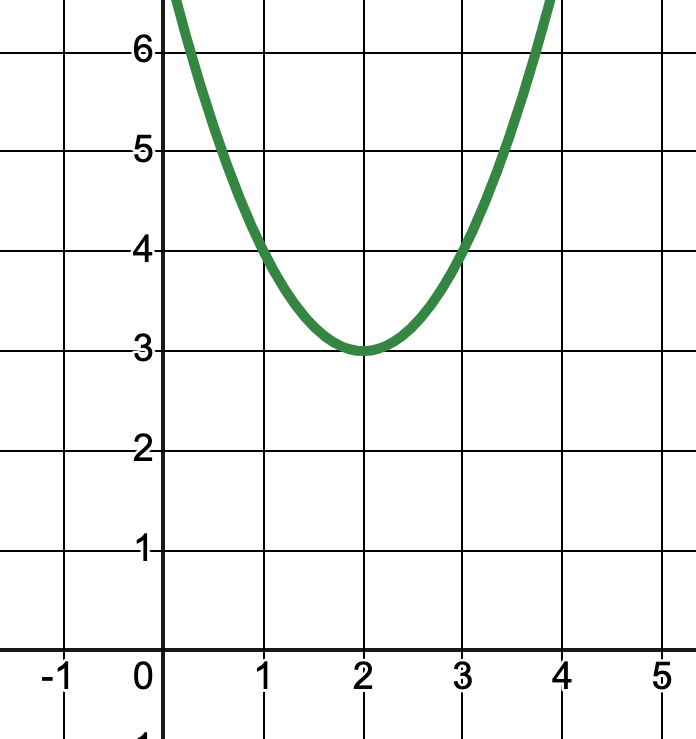
A. Down 3 B. Left 2 C. Up 3 D. Up 4
E. Right 2 F. Right 4
C, E
400
Find f-1(x) if:
f(x)=(x-5)^2
f^-1(x)=sqrt(x)+5
500
Find the domain and range of the function.
f(x)=3^x-2
A. D: All real numbers R: (-∞,2)
B. D: All real numbers R: (2,∞)
C. D: (0,∞) R: (2,∞)
D. D: All real numbers R. (-2,∞)
D. D: All real numbers R. (-2,∞)
500
Find the interval(s) where the function in increasing.
f(x)=x^3-3x
A. (-∞,0)
B. (-1, 1)
C. (-∞, -1) and (1, ∞)
D. (-∞, -1.7) and (1.7, ∞)
C. (-∞, -1) and (1, ∞)
500
Find the zero(s) of the function
f(x)=log(x-1)-2
x=101
500
Solve the equation
3*2^(x-5)=21
x = 7.8
500
Solve the equation
sqrt(9-x)=sqrt(1-9x)
x = -1
500
A student solves an equation and her work is shown. Which equivalent equation could complete the table correctly?
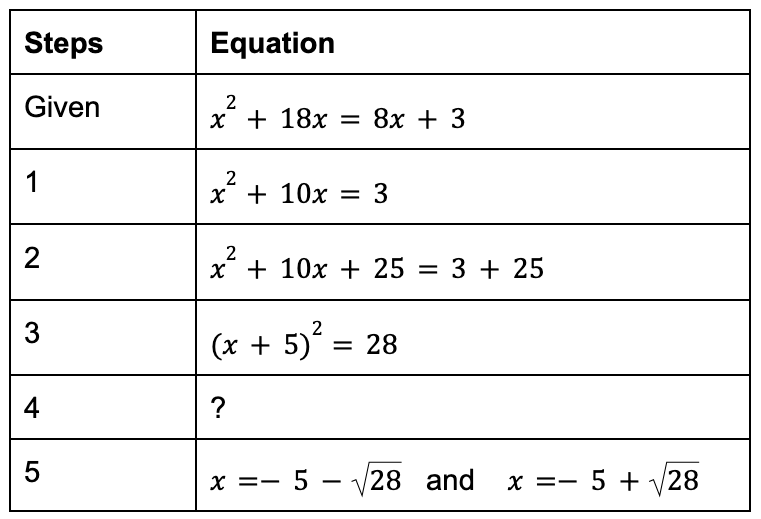

D
500
For a given function f(x), the domain is all real numbers, and the range is all real numbers greater than 5.
What is the domain of the inverse of f(x)?
All real numbers greater than 5