4.1 Early Ideas About Matter
4.2 Defining the Atom
4.3 How Atoms Differ
4.4 Unstable Nuclei & Radioactive Decay
100
Democritus proposed that matter is made of tiny, indivisible particles called atomos, moving through this.
What is empty space?
100
This subatomic particle carries a 1- charge, resides in the space surrounding the nucleus, and has a relative mass of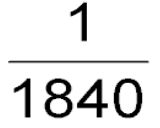
What is an electron?
100
The unique number of these positively charged subatomic particles in an atom's nucleus defines its atomic number and element identity.
What are protons?
100
Unstable radioactive atoms emit radiation and undergo radioactive decay primarily to gain this.
What is stability (or a lower energy state)?
200
This influential philosopher rejected Democritus's ideas because he did not believe empty space could exist.
Who is Aristotle?
200
J. J. Thomson used cathode-ray tubes to discover this first subatomic particle and measured its charge-to-mass ratio.
What is the electron?
200
Atoms of the same element that have the same number of protons but different numbers of neutrons are known by this term.
What are isotopes?
200
Name the three main types of radiation and state the electric charge associated with each.
What are Alpha (2+ charge), Beta (1- charge), and Gamma (0/neutral charge)?
300
John Dalton revised Democritus's ideas in 1803 based on scientific research and mass ratios measured during these.
What are chemical reactions?
300
Robert Millikan determined the exact magnitude of an electron's charge using this famous experiment.
What is the Oil Drop Experiment?
300
Calculate the number of protons, neutrons, and electrons in a neutral atom of Sodium-23

What are:
P: 11
E: 11
N: 12
300
This type of radiation consists of high-energy electromagnetic rays that possess no mass and no electric charge.
What is gamma radiation (or gamma rays)?
400
Dalton’s atomic theory explains this fundamental law by stating that chemical reactions involve only the separation, combination, or rearrangement of atoms.
What is the Law of Conservation of Mass
400
Ernest Rutherford expected alpha particles to pass straight through gold foil with minimal deflection, based on this atomic model proposed by J. J. Thomson.
What is the plum pudding model?
400
One atomic mass unit (amu) is formally defined as exactly one-twelfth the mass of an atom of this specific isotope.
What is Carbon-12?
400
This numerical ratio inside an atom's nucleus is the primary factor determining whether a nucleus is stable or unstable.
What is the neutron-to-proton ratio?
500
Identify two specific statements in Dalton's original atomic theory that were later proven to be incorrect.
What are:
1.) that atoms are indivisible/indestructible (they can be divided into subatomic particles) and
2.) that all atoms of a given element are identical in mass/properties (isotopes have different masses)
500
This scientist proved the existence of the neutron in 1932, a neutral subatomic particle in the nucleus with a mass nearly equal to a proton.
Who is James Chadwick?
500
Element X has two naturally occurring isotopes: A (6.015 amu, 7.59% abundance) and B (7.016 amu, 92.41% abundance). Calculate its weighted average atomic mass and identify the element.
What is 6.939 amu and the element is Lithium (Li)?

500
Complete the nuclear decay equation and name the type of radiation emitted:
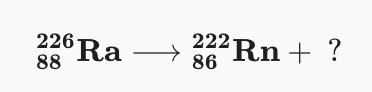
What is Alpha decay and
