Types of Bonds/IMFs
Types of Rxns/Balancing Rxns
Stoichiometry (Teach the class!)
Enthalpy/Heat Transfer
Reaction Rate/Equilibrium
100
(1 min) This type of bond is between a metal and non-metal
Ionic Bond
100
(1 min) Balance this equation: __Fe + __Cl2 -> __FeCl3
2Fe + 3Cl2 --> 2FeCl3
100
(1 min) How many molecules are there in 1.00 mole of glucose, C6H12O6?
6.022 x 10²³ molecules of glucose. (Avogadro's Number)
100
(1 min) This type of reaction has more potential energy in the products than it does in the reactants.
Endothermic reaction
100
(1 min) What is "chemical equilibrium" ?
The point when a reversible reaction is making products and reactants at the same rate
200
(1 min) Carbon and Oxygen create this kind of bond
Covalent bond
200
(90 sec) Balance the following equation:
__CO2 +__H2O -->__C6H12O2 +__O2
6CO2 + 6H2O --> C6H12O2 + 6O2
200
(90 sec) What is the mass of 5 moles of Fe2O3 ?
798.5 grams
200
(1 min) What is the difference between an open system and a closed system?
An open system has both energy and matter exchange with the surroundings, a closed system only has energy (heat) exchange with the surroundings.
200
(1 min) What are the three variables that can change the rate of a reaction?
Temperature
Concentration
Catalysts
300
(1 min) Hydrogen bonding, the strongest type of IMF, is an intermolecular force between Hydrogen and what other elements? (Write out the names of the elements and their symbol)
Nitrogen (N), Oxygen (O), Fluorine (F)
300
(1 min) What are the three common reactants (elements) in a combustion reaction?
Carbon, Hydrogen, and Oxygen
300
(2 min) Cl2 + 2NaBr --> 2NaCl + Br2
You have 0.34 moles of Cl2 gas. How many moles of NaCl will be produced?
0.68 moles NaCl
300
(2 min)(Draw a model) Use arrows to show the heat transfer in a cup of coffee at 140ºF in a room with a temperature at 65ºF at 1 minute and after 10 minutes.
(answers will vary - arrows should should heat from coffee transferring to the surroundings until it reaches equilibrium with the surroundings - room temperature)
300
(2 min) How does a catalyst affect the rate of a reaction? (Be specific...)
A catalyst lowers the activation energy required for a reaction by weakening the chemical bonds (which store chemical potential energy).
400
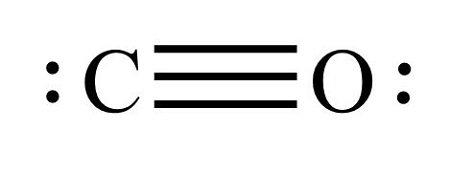
(3 min) Draw the correct Lewis structure for Carbon monoxide.
400
(2 min) Predict the products and balance the following synthesis reaction.
__Na + __Cl2 --> ?
2Na + Cl2 --> 2NaCl
400
(3 min) 2Al + 6HCl --> 3H2 + 2AlCl3
If 2.5 g Al reacts, how many moles of H2 are produced?
0.1389 mol H2
400
(2 min)Describe the image below using these terms:
(specific heat capacity, heat transfer)
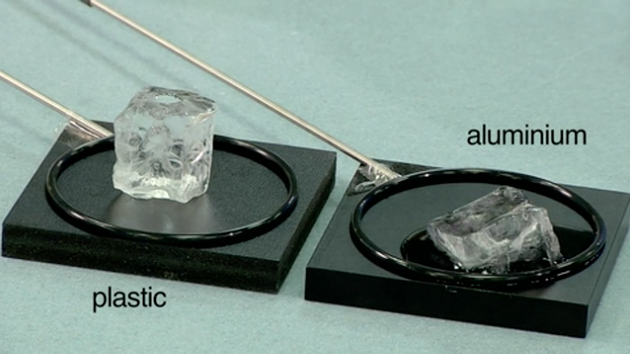
The aluminum has a lower heat capacity than the plastic, meaning it more readily transfers its heat to the ice cube which causes it to melt faster.
400
(2 min)Name three ways a reversible reaction can be stressed. (Hint: Le Chatelier's Principle)
Answers may include:
Adding reactant, removing reactant, adding product, removing product, changing temperature, changing pressure (for gases only)
500
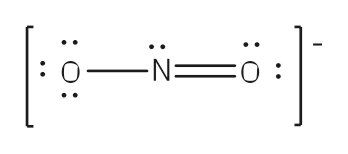
(3 min) This Lewis Structure shown below for NO2- is incorrect. Draw the correct Lewis structure.

500
(2 min) Name the type of reaction, predict the products, and balance the following equation:
__Cl2 + __NaBr --> ?
Single displacement
Cl2 + 2NaBr --> 2NaCl + Br2
500
(2 min) 2Al + 6HCl --> 3H2 + 2AlCl3
If 5.34 g H2 are formed, how many grams of Al reacted?
48.06 g of Al
500
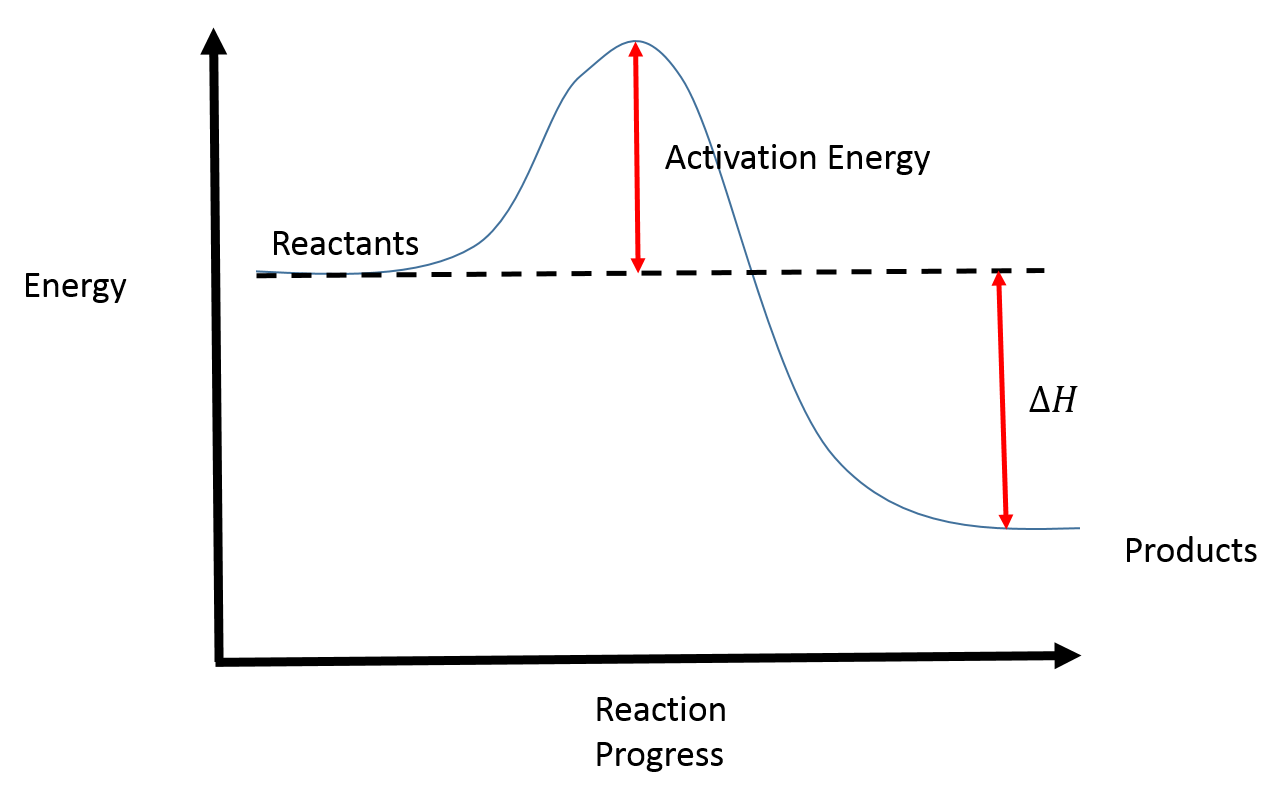
(2 min) (Draw a model) Draw the reaction coordinate diagram of an EXOTHERMIC reaction. Label your graph and include:
Axis labels, ∆H (change in enthalpy), Ea (activation energy), reactants, products
(answers will vary - example included below)
500
∆ + Fe3+(aq) + SCN–(aq) ⇆ FeSCN2+(aq)
Yellow Colorless Red
If a chemical were added that removed some of the FeSCN2+ ions from the system, what direction would equilibrium shift and what color would it be? (1 min)
It would shift to the right because more products would be formed. Therefore, the solution would be Red.