Module 10
Module 10
Module 11
Module 11
100
What is consolidation in memory?
--> Makes recent memories (that you currently remember) SOLID and into older memories that you can remember in the future
-->An extended encoding period
-->If interrupted during this process, then the memory trace is not consolidated, and that memory is lost
100
As we learned in the lecture, we forget less during sleep. What are the two theories that support this idea? Which theory does the results from Rasch, et al. (2017)'s study support?
TWO THEORIES:
1. Passive Theory: As concluded in Jenkins & Dallenback's (1924) study, there are fewer interfering events during sleep so our memory is better.
2. Active Theory: Less interference is not all that is occurring. There is also something happening during sleep, specifically during slow-wave sleep, that promotes consolidation and lessens forgetting.
---> Rasch, et al. (2017)'s study tested odor cues in rats. Four experiments were performed in total, ranging in differences of where the odor cue was presented (whether in the learning phase and in which stage of sleep). Results supported the active theory of memory in sleep as the slow-wave sleep period was discovered to be a rehearsal period for the material associated with that odor cue.
100
What were the methods and main findings from Fried's (2008) study on patients with severe epilepsy?
The patients watched short film clips of familiar people, TV shows, animals, etc. After a one-minute distractor task, they were asked to recall what they were shown. Electrodes were placed in and around the hippocampus to record neural activity.
-->The neurons responded strongly when shown "the Simpsons" in the encoding phase, as well as the retrieval process. This supports the notion that memory retrieval involves the reactivation of specific neural firing patterns that occurred during encoding.
-->This can also be described as reliving the experience.
100
What is the Part-Set Cuing Effect?
The Part-Set Cuing Effect: When target recall is impaired by having retrieval cues that are other items drawn from the same set.
--> As in, the category with most of the list items given is actually the hardest to complete.
-->Category names help recall.
-->Cues from the same set causes retrieval competition between cues and targets.
200
What is Jost's Law?
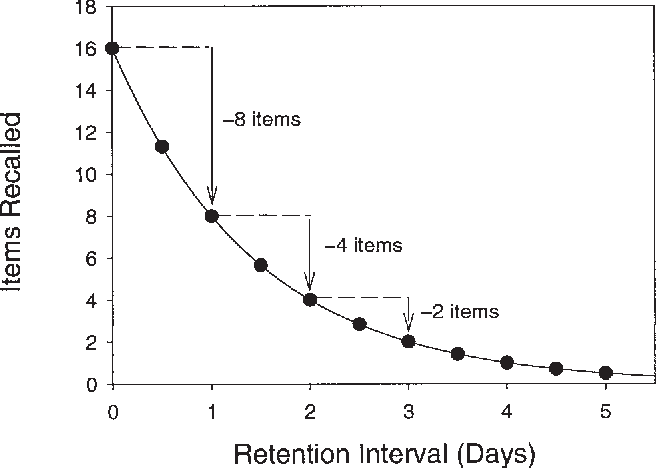
--> Assumption: Memories vary in strength
--> If two memories have equal encoding, an older memory is stronger than a more recent memory (less fragile)
-->Illustrates older memories that persist went through a period of consolidation
200
What is the difference between dissociative amnesia, dissociative fugue, and dissociative identity disorder?
Dissociative Amnesia: Refers to when a person is unable to remember segments of information about their life; associated with traumatic events
Dissociative Fugue: When memory is disrupted to a point that a person forgets fundamental aspects of their identity; for example, who they are, where they live, and what they do for a living
Dissociative Identity Disorder: When a person acts as if they have many different personalities/identities, each with its own autobiographical history
200
What is the "Tip of the Tongue State"?
--> An irritating memory lapse, accompanied by a feeling that you are extremely close to being able to retrieve something
-->We can often recall the memory trace if we are given a cue that helps us recognize it
200
What are some of the factors determining retrieval success, as mentioned in chapter 8 of the textbook? (Hint: there are 8 total listed!)
1. Attention to cues
2. Relevance of cues
3. Cue target associative strength
4. Number of cues
5. Strength of target memory
6. Retrieval strategy
7. Retrieval mode
8. Context clues
300
What is amnesia? What are the two distinctions between how they are caused? What are the two heavily discussed forms of amnesia?
AMNESIA: Partial or total loss of memory
CAUSED:
-->Organic Amnesia: Caused by shock, brain injury, illness
-->Psychogenic Amnesia: Caused by psychological trauma
TWO TYPES:
--> Anterograde Amnesia: Inability to learn anything new since the time of trauma
-->Retrograde Amnesia: Loss of memory for events prior to the time of trauma
300
What was the main finding of the Squire et. al. study on patients EP and GP? What methods did they use to study them?
The study used pair-congruent discriminant tasks to study to test patients EP and GP, who have large medial-temporal lobe lesions.
Results showed that they gradually learned the task, but could not do it in a new format. This study provides useful evidence for the distinction between declarative and non-declarative learning systems.
300
What are retrieval cues? What are the two types of retrieval cues? What makes retrieval cues effective?
A retrieval cue is a hint that helps you retrieve the desired target memory.
---> Episodic Cue: Cues encoded alongside the event when it was first experienced; EX: sights, smells, sounds, thoughts, etc. (CONTEXT)
---> Semantic Cues: Cues based on general world knowledge.
---> Retrieval cues are effective when they are STRONG & SPECIFIC, strongly related to the target memory, and not strongly related to other memories.
300
What are some factors that encourage incidental forgetting, as mentioned in chapter 9 of the textbook?
1. Interference
2. Trace decay (infantile amnesia & contextual fluctuations)
400
What is used as evidence for consolidation?
Ribot's Law: Describes the temporal gradient of retrograde amnesia
--> Memories recently before the time of trauma is lost due to the traces not being fully consolidated.
400
We discussed patient H.M. in the lecture heavily. What was his condition? How did it affect his memory?
Patient H.M. underwent surgery for his severe epilepsy in 1953. Parts of his medial-temporal lobe, including his hippocampus, were removed. As a result, he had medial-temporal lobe amnesia, where his declarative LTM was greatly impaired.
His short term memory was intact.
400
What is the Cue Overload Effect? How does Retroactive and Proactive Interference play a part in memory impairment?
Cue Overload Effect is the inverse relationship between the number of items recalled and the number of items in each category.
--> When too many target memories are attached to the cue, which inadvertently makes the cue ineffective (password video from lecture).
Retroactive Interference: Memory for an event is impaired by later events
Proactive Interference: Information overload as memory is impaired because of the presence of earlier events
400
What is collaborative inhibition?
A phenomenon in which a group of individuals remembers significantly less material collectively than does the combined performance of each group individually when recalling alone.
---> Interference
---> Group members disrupt each other's retrieval process when working together
500
What are the two initial theories of forgetting? Which theory does the results of Jenkins & Dallenback's study (1924) on sleep and memory support?
Two Theories:
1. Decay Theory of Forgetting: Forgetting is due to the passage of time
2. Interference Theory: Forgetting is due to having to remember more events
---> Jenkins & Dallenback's study supports the interference theory of forgetting. Fewer things happen while you are sleeping, so interference decreases, and you remember more.
500
What is the role of the hippocampus in memory?
It is a key part of a process that allows memories to be consolidated as explicit long term memories.
--> It is also important for remote spatial memory; for example, rats remembering how to get around a water maze.
500
Why do we avert our gaze when we are trying to retrieve explicit information? What does Glenburg,et al.'s study reveal about this phenomenon?
--> Glenburg, et al.'s study revealed that the harder the question the participants were faced with, the more likely that they looked away during retrieval
-->Why? Averting our gaze aids explicit retrieval by cutting off external stimuli. The idea is that our current environment interfers with our ability to unlock the right retrieval cues to revisit the past.
500
What are the mechanisms underlying interference effects as discussed in the lecture?
1. Displacement of effective retrieval cues
--> The more events that intervene between study and test, the less similar the context is at the time of retrieval
--> The contextual fluctuation leads to the context being a weaker cue
2. Response Competition
--> Multiple associations with the same cue leads to competition at the time of retrieval
--> Follows "Cue Overload Principle"