Cell Respiration
and
Photosynthesis
and
Photosynthesis
Write out the chemical equation for aerobic cell respiration.
C6H12O6 + 6 O2 --> 6 CO2 + 6 H2O + 38 ATP
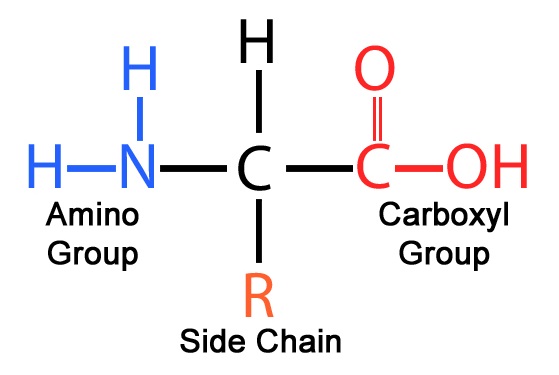
Draw an amino acid.
Compare and contrast condensation and hydrolysis reactions.
Condensation (dehydration) - build polymer, loss of water Hydrolysis - break a polymer into monomers, gain of water
Name a difference in structure between glucose and ribose.
glucose is a hexagon shape and ribose is a pentagon shape
Explain the effect of temperature on enzyme activity.
Enzymes work at optimal temperature. Generally, as temperature increases, enzyme activity increases. However, when the temperature becomes to extreme for the enzyme, the enzyme will denature and the activity will halt.
List four enzymes involved in DNA replication and their role.
Helicase - unwinds the DNA
DNA polymerase 3 - adds complementary bases to template strand
RNA primase - adds RNA primer to template strand so DNA polymerase knows where to begin
DNA polymerase 1 - replaces RNA primer with DNA
DNA ligase- bonds the nicks in the sugar phosphate molecule between fragments on the leading and lagging strand
DNA gyrase- uncoils the double DNA helix from the supercoiling
State four functions of proteins, giving a named example of each.
1. Transporter - haemoglobin 2. Muscle movement (contraction) in animals - actin and myosin 3. Act as hormones - insulin 4. Antibodies - immunoglobulins 5. Enzymes - amylase
List a difference between DNA polymerase III and DNA polymerase I.
DNA polymerase III - synthesizes new strand by adding nucleotides onto the template strand DNA polymerase I - removes the primer and replaces it with DNA
Translation involves several phases: initiation, elongation, translocation, and termination. Explain each of these.
Initiation: a start codon on mRNA for the tRNA to read and bind to with the anticodon to start the process of translation. Elongation: involves tRNA bringing amino acids to mRNA. Translocation: Movement if tRNA from A site, to P site, to E site. The amino acid is added to the growing polypeptide chain by peptide bond. Termination: One of the three stop codons appears signaling the tRNA to stop the process and leave.