Particulate Nature of Matter
🜂H in Reactions
Calculating 🜂H
Counting Particles by Mass
Potpourri
100
The state of matter wherein particles take up the shape of the container but particles cannot move freely in all directions?
What is liquid?
100
A thermodynamic property that measures the total heat content of a system at constant pressure.
What is enthalpy?
100
Given the following reaction:
2Mg(s) + O2(g) --> 2MgO(s) 🜂H = -1204 KJ.
What is the standard enthalpy of formation, 🜂H_f, of magnesium oxide in kJ mol-1?
-602 kJ mol-1
100
The unit representative of 6.022 x 10²³ particles of any substance.
What is the mole?
100
Calculate the molar mass for
Ca3(PO4)2
310.18 g/mol
200
The state of matter represented in the diagram by #5.
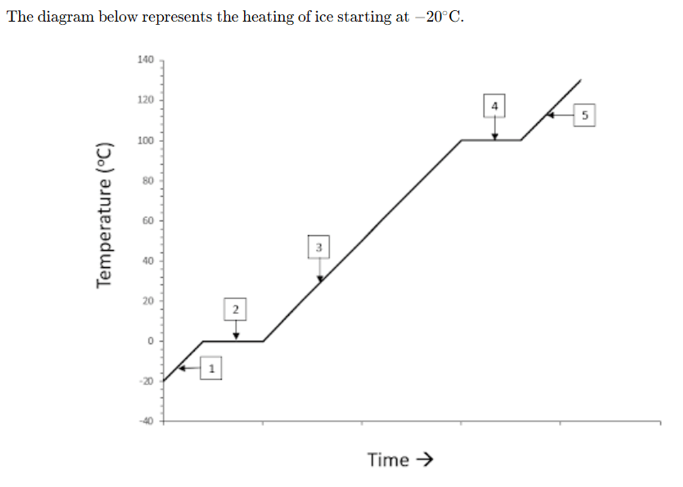
What is gas?
200
The units for 🜂H.
What is KJ/mol?
200
A neutralization reaction is performed in a calorimeter and temperature change, 🜂T, is recorded. If the experiment were repeated using double the volume of each solution but at the same concentrations, what would be the effect on the record 🜂T and the calculated molar enthalpy of neutralization, 🜂H?
A. 🜂T would double and 🜂H would double.
B. 🜂T would stay the same and 🜂H would double.
C. 🜂T would halve and 🜂H would stay the same.
D. 🜂T would stay the same and 🜂H would stay the same.
D. 🜂T would stay the same and 🜂H would stay the same.
200
The mass of 2 moles H2O.
What is 32 g H2O?
200
The dissolution of ammonium chloride in water is an endothermic process. Which statement correctly describes the enthalpy changes involved?
A. The enthalpy of the hydrated ions is greater than the enthalpy of the solid ionic lattice and solvent
B. The process releases more energy in hydration than it consumes to break the lattice structure.
C. The temperature of the system increases as it absorbs heat from the surroundings.
A. The enthalpy of the hydrated ions is greater than the enthalpy of the solid ionic lattice and solvent
300
Identify the state of particles at 40*C on the diagram.
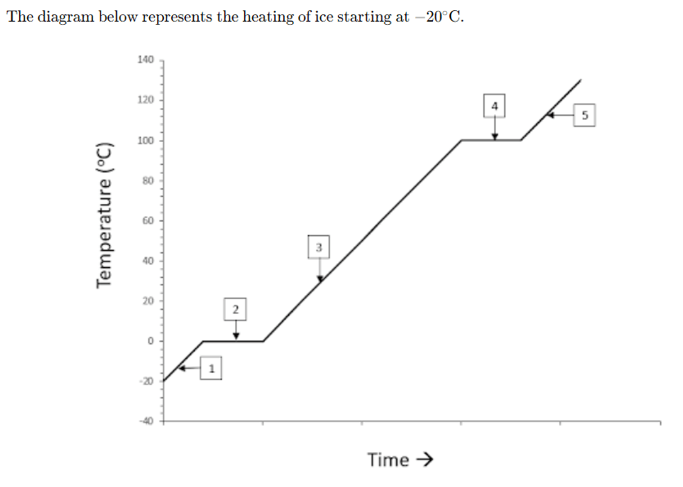
What is liquid?
300
The type of reaction producing a decrease in temperature in the surroundings an a 🜂H > 0
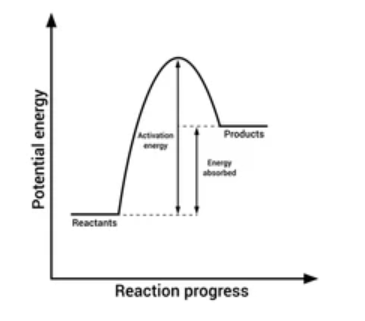
What is endothermic?
300
Using standard enthalpies of formation, calculate the enthalpy change for the combustion of glucose:
C6H12O6(s) + 6O2(g) --> 6CO2(g) + 6H2O(l)
Given:
🜂Hf [C6H12O6] = -1273 kJ mol-1
🜂Hf [CO2] = -394 kJ mol-1
🜂Hf [H2O] = -286 kJ mol-1
-2807 kJ mol-1
300
The number of moles in 168.33 g of potassium hydroxide (KOH).
What are 3 moles?
300
Calculate the mass of 3.00 mol of selenium oxybromide, SeOBr2
764 g
400
The state change represented by the following chemical equation:
H2O (g) -> H2O (l)
What is condensation?
400
The type of reaction producing an increase in temperature in the surroundings around the system and a 🜂H < 0.
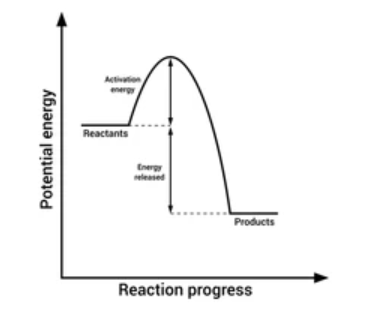
What is exothermic?
400
The standard enthalpy of formation of H2O(l) is -286 KJ mol-1 and the standard enthalpy of formation of H2O(g) is -242 KJ mol-1. What is the standard enthalpy of vaporization of water, in KJ mol-1?
+44 KJ mol-1
400
How many molecules are there in 4.00 moles of glucose?
What are 2.41 x 1024 molecules?
400
Which assumption is NOT typically made when conducting a calorimetry experiment involving aqueous solutions in a simple polystyrene cup?
A. The specific heat capacity of the final solution is equal to that of pure water.
B. The reaction proceeds to completion.
C. The enthalpy change of reaction is independent of temperature.
D. The density of the final solution is equal to that of pure water.
C. The enthalpy change of reaction is independent of temperature.
500
The state change of matter represented by the following equation
CO2 (s) -> CO2 (g)
What is sublimation?
500
The mean amount of energy required to break one mole of a specific type of covalent bond across a wide range of gaseous molecules?
What is average bond enthalpy?
500
Combustion of 1.00 mol of methane releases 890 kJ of energy. A gas stove burns 16.0 g of methane (M=16.0 g mol-1) to heat 2.00 kg of water from 20.0 *C to 90.0 *C. What is the efficiency of the heat transfer process? (c(H2O) = 4.18 KJ kg-1 K-1)
66%
500
The substance with the lowest mass
A. 2 moles H2O
B. 2 moles CH4
C. 2 moles SO2
D. 2 moles CO2
What is B. 2 moles CH4?
500
The bond enthalpy for the bond in carbon monoxide can be calculated from the information below.
CH₄(g) + H₂O(g) → CO(g) + 3H₂(g) 🜂H = +210 KJ mol⁻¹
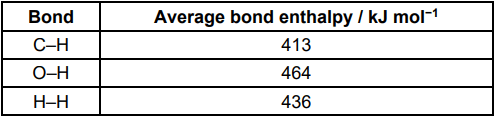
+1062 KJ mol-1