Development Indicators
Food Supply
Industry & Location
Tourism
Energy, Water & Environment
100
Which indicator of development is a 'composite' index, meaning it combines statistics for life expectancy, education (literacy), and GNI per capita?
Human Development Index (HDI)
100
Which of the following describes 'Intensive Farming'?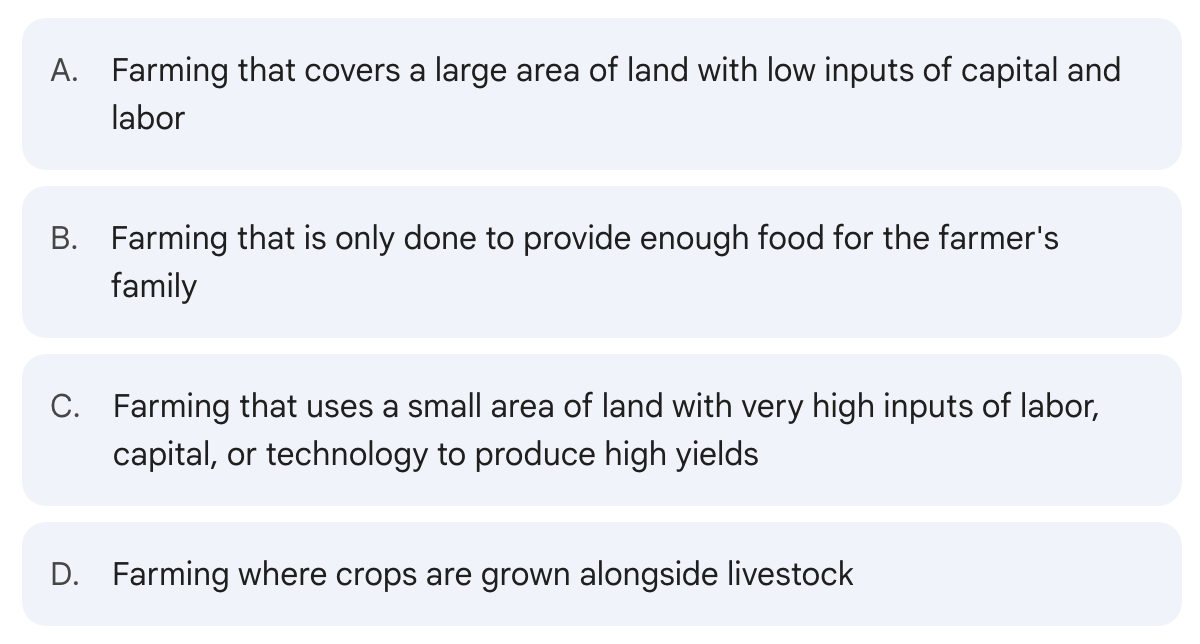
C. Farming that uses a small area of land with very high inputs of labor, capital, or technology to produce high yields
100
This sector involves manufacturing, processing, and assembling raw materials into finished products.
Secondary sector
100
Sandy beaches and coral reefs are examples of physical attractions, but what is an example of a human attraction?
Historical sites, theme parks, festivals, or museums.
100
Coal, oil, and natural gas are collectively known as these.
Fossil Fuels.
200
In which economic sector would a research scientist working in a high-technology laboratory be classified?
Quaternary Sector
200
Seeds, fertilizer, and labor are examples of these in an agricultural system.
Inputs
200
An industry that chooses to locate near its customers to save on transport costs (like a bakery) is called this.
Market-oriented
200
When money spent by tourists "leaks" out of the country to pay for foreign-owned hotel chains, it is called this.
Economic Leakage.
200
In HICs (High-Income Countries), the largest percentage of water is typically used for this purpose.
Industrial Use (or Power Generation).
300
A country like the UK or the USA typically has a high percentage of its workforce employed in the Tertiary sector. What does this indicate about its development level?
It is a High-Income Country (HIC)
300
In this type of farming, crops are grown only to feed the farmer and their family, with little or no surplus for sale.
Subsistence Farming
300
High-tech industries that are not tied to raw materials or markets and can "sit" anywhere are called this.
Footloose Industries.
300
Identify two major environmental disadvantages of rapid tourism growth.
Pollution (water/air/noise), destruction of habitats (e.g., mangroves/reefs), or depletion of local water resources.
300
This environmental problem is caused by an "enhanced" version of a natural process, primarily due to rising carbon dioxide and methane levels.
The Enhanced Greenhouse Effect (or Global Warming).
400
This process describes the increasing interconnectivity of the world’s economies, cultures, and populations, driven by trade and technology.
Globalisation
400
List one natural cause and one political/economic cause of food shortages.
Natural (e.g., Drought, Pests); Political/Economic (e.g., War, Low Investment, Poor Transport).
400
In an industrial system, "Smelting," "Welding," and "Packaging" are all examples of this stage.
Processes
400
This model describes the stages of a tourist resort’s life, from "Exploration" to "Stagnation" and eventually "Rejuvenation" or "Decline."
The Butler Model.
400
Give one benefit and one drawback of Nuclear Power.
Benefit (e.g., No CO2 emissions, high energy density); Drawback (e.g., Radioactive waste, risk of accidents).
500
Large companies that operate in multiple countries (like Nike or Apple) are known by this three-letter acronym.
TNCs (Transnational Corporations)
500
When too many animals are kept on a piece of land, they eat the vegetation faster than it can grow back. This is called...
Overgrazing (a major cause of soil erosion).
500
How can Government Policy influence where a factory is built?
Through grants, tax-free zones (SEZs), or by providing infrastructure like new roads to attract businesses to a specific area.
500
This specific type of tourism aims to be small-scale, involve local people, and protect the natural environment.
Ecotourism
500
The process where fertile land becomes dry and desert-like, often due to overgrazing or deforestation, is called this.
Desertification