Complex Numbers
Imaginary Numbers
Graphing Polynomials
Dividing Polynomials
x-intercepts and roots
100
What two parts make up a complex number?
Real Part and Imaginary Part
100
What is the following equal to?
i^2
-1
100
Will this graph cross or bounce off the x-axis?
y=x^2
bounce
100
divide the following:
(9x)/3
3x
100
What is y-value for any x-intercept?
y=0
200
Write a complex number
Example:
3+4i
200
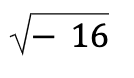
Rewrite the following with an imaginary number
4i
200
State the degree of the polynomial
y=(x-3)^2(x-4)^3(x-5)
6
200
Divide the following expression:
(18x^2)/(2x)
9x
200
State the x-intercepts of the following polynomial.
y=(x+2)(x-4)
x=-2
x=4
300
Add the following:
(4+2i)+(-2+3i)
2+5i
300
Multiply the following
(3i)(2i)
-6
300
State the degree and whether your graph is positive or negative orientation.
y=-3x^4-5x^2+2x-4
Degree 4
Negative orientation
300
What goes in the missing square?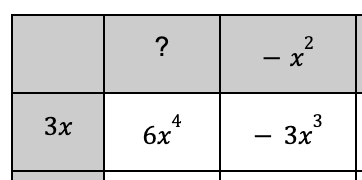
2x^3
300
State the roots of the following polynomial
y=x(x^2-25)
x=0
x=5
x=-5
400
Subtract the following:
(5+3i)-(3+3i)
2
400
Evaluate the following
(5i^2) (3i^2)
15
400
State the degree and whether the ends with face the same or opposite directions:
y=3x^4-5x^6+2x-4
degree: 6
Same direction
400
Solve the following expression by dividing:
(x^2+2x-15)/(x+5
(x-3)
400
How many times with this graph touch the x-axis?
y=(x^2+36)(x-2)(x+4)
two times at
x=2
x=-4
500
Multiply the following:
(4-3i)(4+3i)
25
500
What does this equal to?
i^8
1
500
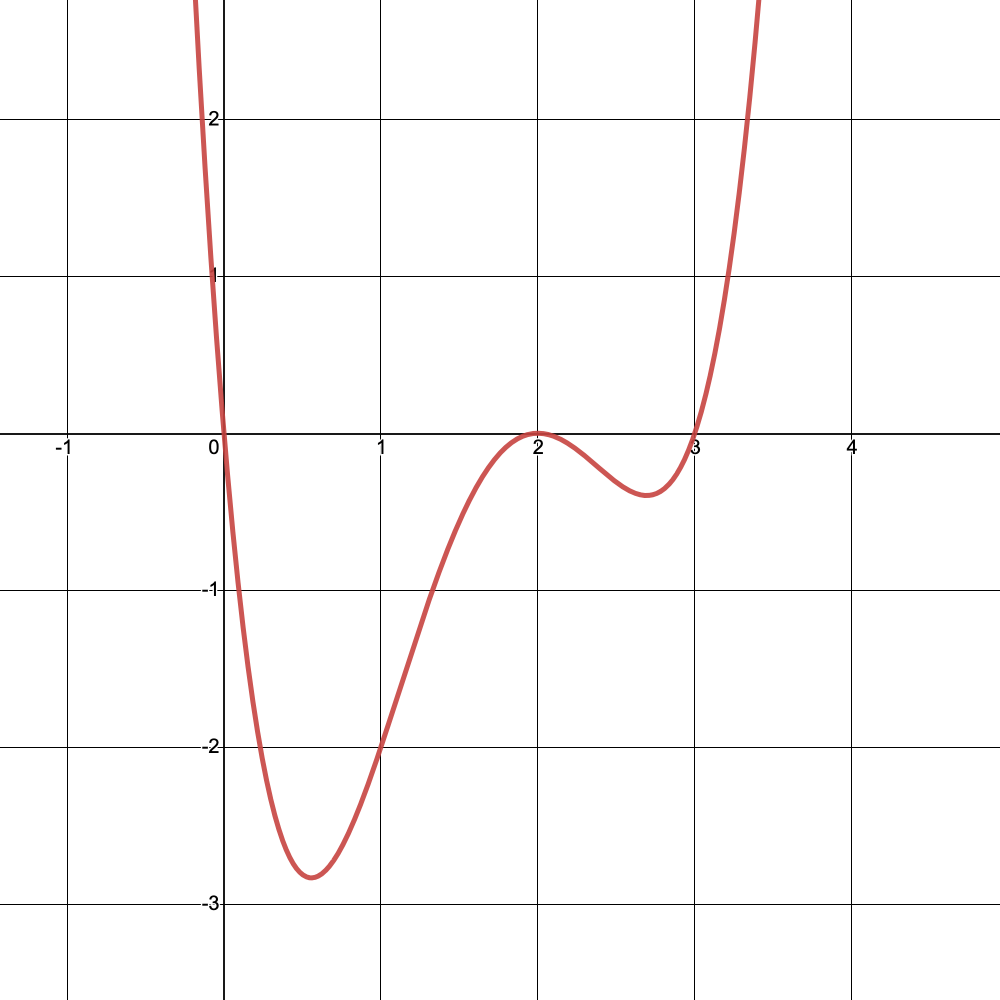
y=x(x-2)^2(x-4)^3
Sketch a quick graph of the following polynomial:
500
Divide the following by dividing:
(x^3-4x^2+6x-4)/(x-2)
x^2-2x+2
500
State the roots:
y=(x^2+9)(x^2-16)
x=4
x=-4
x=-3i
x=3i