Artists and Communities
Media
Interpretive Lenses
Histories
100
A community in the Southwest known for their textiles.
Navajo
100
These art objects can be made using coil, plait, or twined methods.
Baskets
100
The past, present, and future in which an artist works as context for the work they make.
Temporality
100
Binding agreements between nations and become part of international law.
Treaties
200
This artist was a designer, illustrator, and painter who taught Indian Arts at Carlisle Indian School.
Angel De Cora
200
 Edmonia Lewis is known for her sculptures made of this material.
Marble
200
The "system of relationships" between an artist and their communities that "extend beyond the human realm to include animate/inanimate, spiritual, and metaphysical relationships that inform our identities."
Kincentricity
200
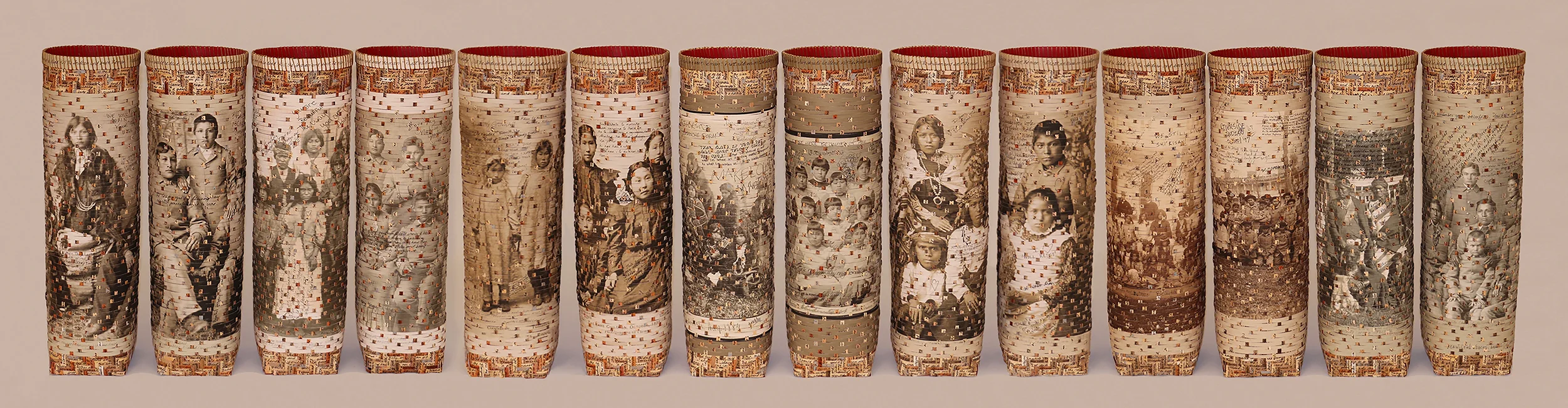
This work by Shan Goshorn uses before-and-after portraits taken at these colonial institutions.
Boarding/Residential Schools
300
Dat So La Lee's tribal community in present-day Nevada
Yerington Paiute Tribe
300
An art form made from porcupines
Quillwork
300
"A single motif of a bird with lightning coming from its mouth can be a visual reference to Thunderbird" is an example of one of ahtone's interpretive lenses
Metaphor and Symbolism
300
Contemporary Pueblo artists Jason Garcia and Virgil Ortiz make artwork about this historic event that happened in the 1600s.
The Pueblo Revolt
400
This contemporary artists sometimes draws inspiration from ancient Mississippian mound-builder cultures.
Jeffrey Gibson
400

A style from the Pacific Northwest
Formline
400
One of ahtone's interpretive lenses, this encompasses the entirety of the physical and intellectual influences on an artist's final work.
Materiality
400
George Washington commissioned one of these to commemorate the signing of the Treaty of Canandaigua (1792)
Wampum belt