Commutative
Associative
Distributive
Category Flex
100
Will 3 + 4 give you the same answer as 4 + 3?
YES
100
Solve 19 + 36 + 4 using the associative law.
19 + 36 + 4 = 19 + (36 + 4)
= 19 + 40 = 59
19 + 36 + 4 = (19 + 36) + 4
= 55 + 4 = 59
100
Does the distributive law apply to division?
No
100
Solve this question
3 (4 +3+ 17)=
72
200
Using the commutative law which option is the same as c + b.
a. 2(B + C)
b. c - b
c. b+ b
d. None
none
200
It doesn't matter how we group the numbers. This is true for which operations?
Addition and Multiplication
200
State one use of the distributive law
- To break up a difficult multiplication
- When combining numbers
- For long addition
200
What law is shown below?
a(b + c) = ab + ac
Distributive Law
300
True or False?
2 × 3 = 1 × 6 is using the commutative law of multiplication.
False
300
Give an example for the associative law.
...
300
Use the distributive law to solve 3(5 - 1)
3 × 5 - 3 × 1
=15 - 3
= 12
300
Which law means to group?
Associative
400
True or False
The commutative law of division refers to dividing and arriving at the same answer
False
400
State in your own words the meaning of Associative law.
The "Associative Laws" say that it doesn't matter how we group the numbers when we are adding or multiplying.
400
State one use of the distributive law.
- To break up a difficult multiplication
- When combining numbers
- For long addition
400

What law is being displayed
Associative
500
Define Commutative law in your own words.
The Law that says you can swap numbers around and still get the same answer when you add.
Or when you multiply.
500
Re-write the expression with different parenthesis to change the order of.
8 + (5 + 6) + 7
(8 + 5)+ 6 + 7
or
8 + 5 + (6 + 7)
500
Is there a distributive law of division?
Yes
500
What law is represented below?
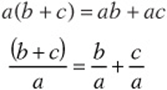
Distributive law