Cancer overview
Gene mutations contributing to cancer phenotypes
Chemotherapy
chromosomal defects in cancer
Cancer predisposition
100
List at least 3 hallmarks of Cancer.
75 pt. bonus: Which hallmark is distinct for stage 4 cancer and why?
increased proliferation, increased cell growth, decreased apoptosis, loss of contact inhibition, ability to migrate, ability to colonize new locations, escape immune response, up-regulated telomerase activity, up-regulated metabolism, enabling replicative immortality, inducing angiogenesis, evading growth supressors.
Activating invasion and metastisis is distinct for stage 4 cancer, due to unknown origin.
100
Which mutation is rare and which is common? Which is required for both mutations.
Gain-of-function mutations are rare but only need to hyper-activate one allele. Loss-of-function mutations are common, but need to inactivate both alleles in the same cell.
100
What is the difference between standard and targeted chemotherapy?
Standard chemotherapy typically targets proliferating cells while targeted chemotherapy are tailored to an individual tumor to a specific patient.
100
Define chromosomal abnormalities?
Chromosomal abnormalities: duplications and deletions of chromosomes.
Advanced cancers are associated with extensive chromosomal abnormalities.
100
1.How do most cancers arise?
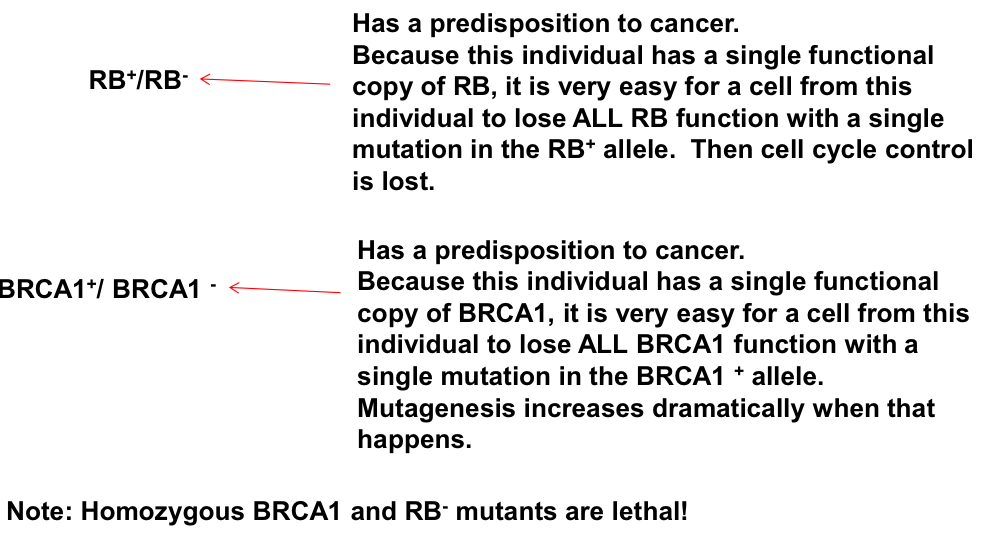
2. What are the two varieties predisposition to cancer come in?
1. Most cancers arise de novo(with no genetic predisposition).
2. The two varieties predisposition to cancer come in are: mutations in tumor suppressors and mutations in DNA repair.
200
What is apoptosis and why is it important?
Apoptosis is programmed cell death. Apoptosis is important for preventing cancer development, killing cells that might have abnormal proliferation and metabolism(pre-cancerous cells).
Many factors within a cell can promote or inhibit apoptosis.
200
What kinds of genetic or epigenetic changes can lead to loss-of-function or gain-of-function mutations?(List at least 3 for each).
LOF: missense, nonsense, frameshift, chromosomal deletion, deletion of enhancer/promoter, and hypermethylation.
GOF: missense, chromosomal duplication, deletion of a silencer, hypomethylation, hybrid gene created by chromosomal translocation.
200
What is EGFR?
EGFR is the receptor-kinase that activates the Ras/MAPK pathway in lung cells.
200
Define IGH. What does it do?
IGH stands for Immunoglobulin Heavy chain and is a component of antibodies. IGH is expressed at very high levels in immune cells.
200
What is Morgan's major?
Public Health!
300
What does the immune system do?
The immune system clears out pre-cancerous cells, screens for cells with abnormalities, and triggers apoptosis within abnormal cells or kill it another way.
300
Which Gene activities are tumor suppressors and which are proto-oncogenes:
Inhibitors of G1/S transition, Inhibitors of G2/M transition, activators of apoptosis, inhibitors of migration, activators of immune function, inhibitors of immune function, telomerase, activators of migration, growth factor signaling, and inhibitors of cell death?
Tumor suppressors: Inhibitors of G1/S transition, Inhibitors of G2/M transition, activators of apoptosis, inhibitors of migration, activators of immune function.
Proto-oncogenes: inhibitors of immune function, telomerase, activators of migration, growth factor signaling, and inhibitors of cell death?
300
Which inhibitor would block the MAPKKK-GOF proliferation?
a) Receptor
B) Ras
c) MAPKK
Both MAPKK and MAPKKK would work the most.
300
What is Morgan's favorite color(s)?
Navy blue and purple.
300
When is Morgan's birthday month?
June
400
What is cancer?
Cancer is the result of uncontrolled proliferation and other cellular changes in individual cells. Cancer phenotypes occur as a result of genetic changes within individual cells.
400
What does RB stand for, what type of gene is it, and what type of mutation could occur in RB promoting cancer?
What does RB do?
RB stands for Retinoblastoma and is a tumor suppressor. Loss-of-function mutation in RB promotes cancer.
RB is a causal factor in many individual cancers. RB normally locks the transcription factors E2F and DP in an inactive state, preventing them from activating S-phase transcription.
400
What information is needed for targeted chemotherapy?
Must know why a particular tumor has cancer phenotypes, the genetic changes that occurred in this specific tumor, and what can be done with protein stains, cDNA analysis, and/or genomic sequencing. Must also know what type of mutation is happening, and must have drugs to target specific protein.
400
Why does cancer occur?
Cancer is the progressive loss of cellular controls- there are too many blocks on out-of-control cells.
It is characterized by the accumulation of mutations in the same cell lineage.
400
Which of the following is true of cancer?
a). LOF of proto-oncogenes lead to cancer
b). A random mutation in a gene is more likely to cause GOF, rather than LOF
c). Cancer is the result of an accumulation of genetic changes in individual cells
d). Only one allele needs to be mutated for cancer to arise in a tumor suppressor
e). Cancer cells spend the majority of time in the G0 phase of the cell cycle
C). Cancer is the result of an accumulation of genetic changes in individual cells
500
1. What is the name for genes that protect from cancer called? What is the type of mutation in this genes that promote cancer?
2. What are genes that regulate cell growth and development in a normal way called? What is the type of mutation in these genes that promote cancer- and what are these genes then called when mutated?
1. Tumor suppressor genes protect from cancer. Loss-of-function mutation in these genes promote cancer.
2. Proto-oncogenes regulate cell growth and development in a normal way. Gain-of-function mutation in these genes promote cancer turning them into oncogenes.
500
Describe the Ras-GOF mutation. What is the RAS-GOF effect on MAPK signaling?
Ras gets stuck to GTP keeping the "on" state, blocking GTP hydrolysis and leads to constituitive signaling and cancer phenotypes. The RAS-GOF effect on MAPK signaling is it keeps going when needs to stop, leading to increased cell division.
500
What are some of the cellular processes affected by standard chemotherapy? Why does Standard chemo have such serious side effects?
Cellular processes affected by standard chemotherapy includeL DNA & RNA synthesis, DNA damage/mutation, chromosome segregation, and blood vessel formation. Standard chemo has such serious side effects because the drugs cannot distinguish cancerous cells from normal cells- making the patient very sick.
500
What do chromosome abnormalities have to do with cancer?
* Chromosome duplications can increase the gene activity of an oncogene.
* Deletions can remove tumor suppressor genes.
*Translocations can provide unique gene activation.
500
Why does it take 2 mutations of tumor-suppressor genes in the same cell to contribute to cancer, while it only takes one mutation of a proto-oncogene to contribute to cancer?
One copy of an allele is sufficient to produce enough protein to allow whatever the function of the gene is to be carried out.