Spiral Review
Exponential Functions
Log to Exponent
Evaluating Logs
Half-Life
100
What is the end behavior for the following function:
x4+5x+7
ANSWER SETUP
As x gets more negative, y gets more...
As x gets more positive, y gets more...
As x gets more negative, y gets more positive
As x gets more positive, y gets more positive
100
The equation C(t) = 25,000(0.78)t represents the value of the car C(t), in dollars, as a function of t, the number of years since 2010.
What do the numbers 25,000 and 0.78 tell us about the situation?
25,000 --> initial value of the car
0.78 --> rate (car is decreasing in value)
100
Convert from logarithmic form to exponential form
log13169 = 2
Logarithmic Form
log13169 = 2
Exponential Form
132 = 169
100
Evaluate log 7
Then write the equation in exponent form
Remember: The default base is 10
log 7 = 0.845
100.847 = 7
100
The half-life of a radioactive substance is 15 years. Write an equation that can be used to determine the amount, s(t), of 200 grams of this substance that remains after t years.
f(t) = 200(1/2)^t/15
200
What is the end behavior for the following function:
-x5+7
ANSWER SETUP
As x gets more negative, y gets more...
As x gets more positive, y gets more...
As x gets more negative, y gets more positive
As x gets more positive, y gets more negative
200
The equation C(t) = 25,000(0.78)t represents the value of the car C(t), in dollars, as a function of t, the number of years since 2010.
What is the percent decrease of the value of the car each year?
1.00 - 0.78 = 0.22
or
100% - 78% = 22%
200
Convert from logarithmic form to exponential form
log6216 = 3
Logarithmic Form
log6216 = 3
Exponential Form
63 = 216
200
Evaluate log 35
Then write the equation in exponent form
Remember: The default base is 10
log 35 = 1.544
101.544 = 35
200
The half-life of a radioactive substance is 15 years. Initially we have 200 grams of this substance present. How many grams of the substance remains after 25 years?
f(25) = 200(1/2)^25/15
f(25) = 62.996 g
300
Solve the equation using the quadratic formula
m2 - 6m - 72 = 0
Half points (+150): Identify a, b, and c
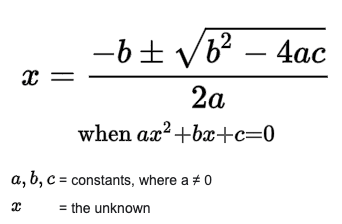
m = 12
m = -6
300
$2000 is deposited in a bank account and no further deposits or withdrawals are made. The account receives 6% annual interest compounded monthly.
Write an equation representing the value of the bank account f(m), in dollars, m months later.
(initial value) (rate)(time)
(initial value) (rate)(time)
f(m) = (2000) (1.06)(m)
m, months
300
Convert from exponential from to logarithmic form
82 = 64
Exponential Form
82 = 64
Logarithmic Form
log864 = 2
300
Evaluate log325
Then write the equation in exponent form
log325 = 2.93
32.93 = 25
300
Imagine a medicine has a half-life of 3 hours. If a patient takes 200 mg of the medicine, then the amount of medicine in their body, in mg, can be modeled by the function, f(t), where t represents a unit of time.
Write the model for the function, f(t).
f(t) = 200 (1/2) ^ t
400
Solve the equation using the quadratic formula
3p2 + 9p - 54 = 0
Half points (+200): Identify a, b, and c
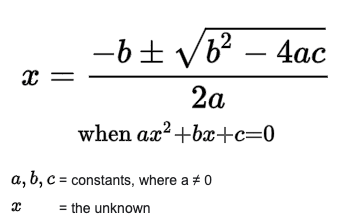
p = 3
p = -6
400
The value of a stock grows by 7% each year after 1940.
Write an equation representing the value of the stock V(t), in dollars, t years after 1940.
(initial value) (rate)(time)
(initial value) (rate)(time)
V(t) = (1.25) (1.07)(t)
t, years
400
Convert from exponent form to log form
25 = 32
25 = 32
log232 = 5
400
Evaluate log234
Then write the equation in exponent form
log234 = 5.087
25.087 = 34
400
Imagine a medicine has a half-life of 3 hours. If a patient takes 200 mg of the medicine, then the amount of medicine in their body, in mg, can be modeled by the function, f(t), where t represents a unit of time.
Determine the amount remaining after 8 hours.
f(t) = 200 (1/2) ^ 8/3
f(t) = 158.74 mg
500
Solve the equation using the quadratic formula
5x2 - 2x - 3 = 0
Half points (+250): Identify a, b, and c
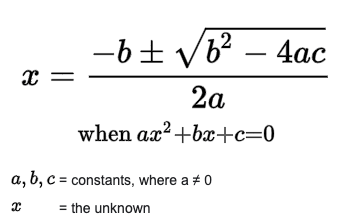
x = 1
x = -3/5
500
The value of a stock grows by 7% each year after 1940.
What does the value of V(50) represent in this situation?
V(50) represents the value of the stock after 50 years
500
Convert from log form to exponent form
Hint: The default log is base 10
log 10 = 1
Logarithmic Form
log 10 = 1
Exponential Form
101 = 10
500
Evaluate log41.6
Then write the equation in exponent form
log41.6 = 0.399
40.399 = 1.6
500
The half-life of a radioactive kind of tin is 10 days. If you start with 160 grams of it, how much will be left after 14 days?
f(t) = 160 (1/2) ^14/10
f(t) = 60.63g