Push it to the LIMIT!
Yaaaay, GRAPHS.
DERIVATIVES...
Dun Dun Duuunnn!
Dun Dun Duuunnn!
Let's get down to BUSINESS!
100
Use the Product Rule to find the derivative of
j(x) = (5x^4)(2x^2-9x+1)
j'(x)=60x^5-225x^4+20x^3
100
A business has the following equations for Cost and Revenue (in thousands of dollars) below
C(x)=x^2+4x \qquad \qquad \qquad R(x)=11x-10
x is the quantity of items (also in thousands).
Find the 2 break-even quantities of x.
x = 2 and 5 thousand
200
Use the Quotient Rule to find the derivative of
k(x) = \frac{5x^4}{2x^2-9x+1}
k'(x) = \frac{20x^5-135x^4+20x^3}{(2x^2-9x+1)^2}
200
A business has the following equations for Cost and Revenue (in thousands of dollars) below
C(x)=x^2+4x \qquad \qquad \qquad R(x)=11x-10
x is the quantity of items (also in thousands).
Find the Profit function, P(x).
P(x)=-x^2+7x-10
300
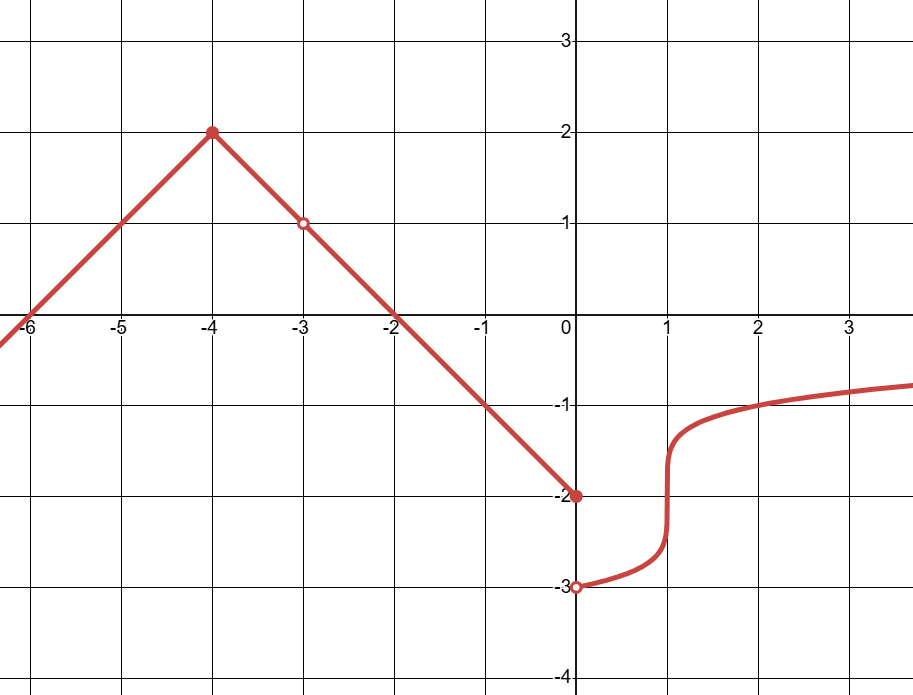
For what values of x is this function NOT continuous? For what values of x is this function NOT differentiable?
Not continuous at x = -3, 0
Not differentiable on x = -4, -3, 0, 1
300
Use the Chain Rule to find the derivative of
m(x) = 5(2x^2-9x+1)^4
m'(x)=(80x-180)(2x^2-9x+1)^3
300
A business has the following equations for Cost and Revenue (in thousands of dollars) below
C(x)=x^2+4x \qquad \qquad \qquad R(x)=11x-10
x is the quantity of items (also in thousands).
Find the average rate of change in Profit when x = 2.5 and x = 4 thousand items.
$500 per thousand items