TESTing, TESTing...
The situation is CRITICAL!
EXTREMA Danger!
More $$$ More Problems
100
Take the first derivative of the following function, then decide which derivative test you should *probably* use?
h(x) = 6x^2-10x+31
h'(x) = 12x-10
and you should *probably* use the Second Drivative Test.
100
Find the critical points and inflection point of f(x) = -x^3+3x-3 .
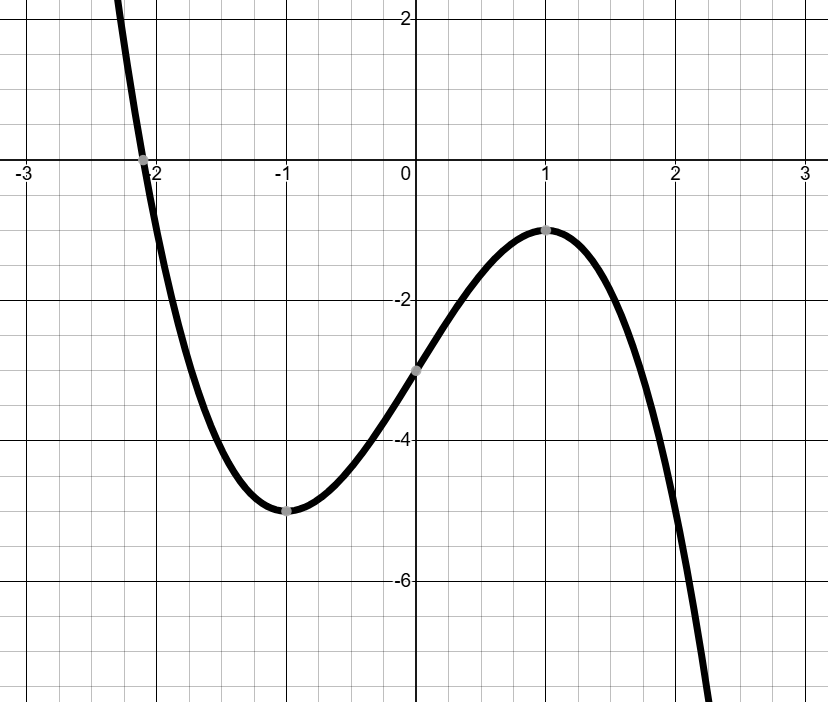
Critical points: (-1, -5) and (1, -1)
Inflection point: (0, -3)
100
Find the absolute minimum and absolute maximum of the following graph.
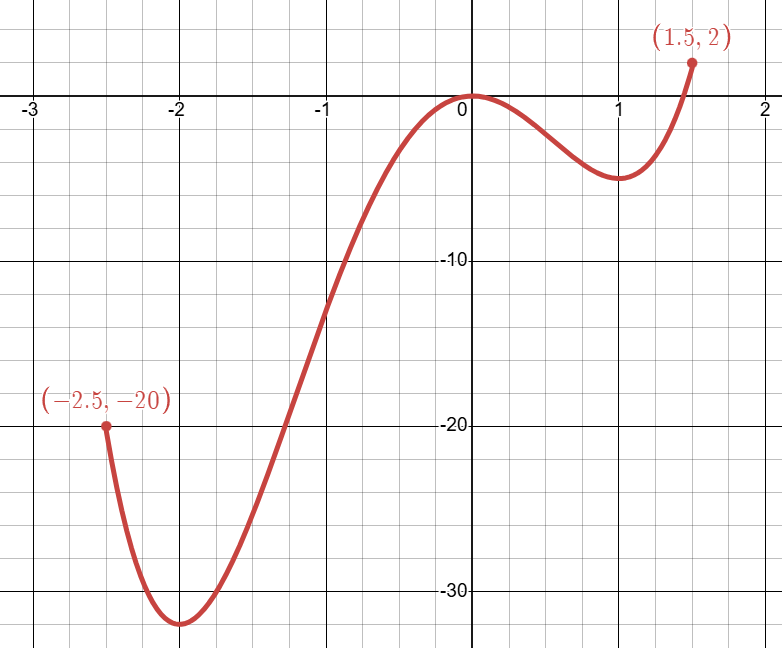
Absolute minimum: (-2, -32)
Absolute maximum: (1.5, 2)
100
The demand of a certain item (q) is given as p = 500 - 2q. The cost of production for that item to the manufacturer is $4 per item, plus $1,000 in fixed costs. How would you write the Revenue and Cost functions based on this information?
R(q) = 500q - 2q^2
C(q) = 4q + 1,000
200
Take the first derivative of the following function, then decide which derivative test you should *probably* use?
g(x) = 2e^{x^2+2x+1}
g'(x) = (4x+4)e^{x^2+2x+1}
and you should *probably* use the First Derivative Test.
200
Find the critical point for
g(x) = 2e^{x^2+2x+1}
Critical Point: (-1, 2)
200
Find the local maximum(s) and local minimum(s) of the following graph.

Local minimum: (-2,-32)
Local minimum: (1, -5)
Local maximum: (0, 0)
200
If R(q) = 500q-2q^2 and C(q) = 4q + 1,000, find the quantity q that would maximize Profit.
q = 124 items
300
Use the First or Second Derivative Test to determine the minimum(s) and/or maximum(s) of the function.
j(x) = 2x^3-9x^2-60x+98
Minimum at (5, -177)
Maximum at (-2, 166)
300
Identify the intervals of increasing and decreasing, and the intervals of concavity for f(x) = -x^3+3x-3 .
Increasing: (-1, 1)
Decreasing: (- \infty, -1) \cup (1, \infty)
Concave Up:
(- \infty, 0)
Concave Down:
(0, \infty)
300
** DAILY DOUBLE **
Sketch the curve of f(x) = -x^3+3x-3 .
300
If the demand for q items is p = 500 - 2q, and price is set to $22 per item, find the elasticity of demand. Will an increase in price lead to an increase in revenue?
Round to 3 decimal places.
E = 0.046
It is inelastic, so an increase in price will lead to an increase in revenue.